
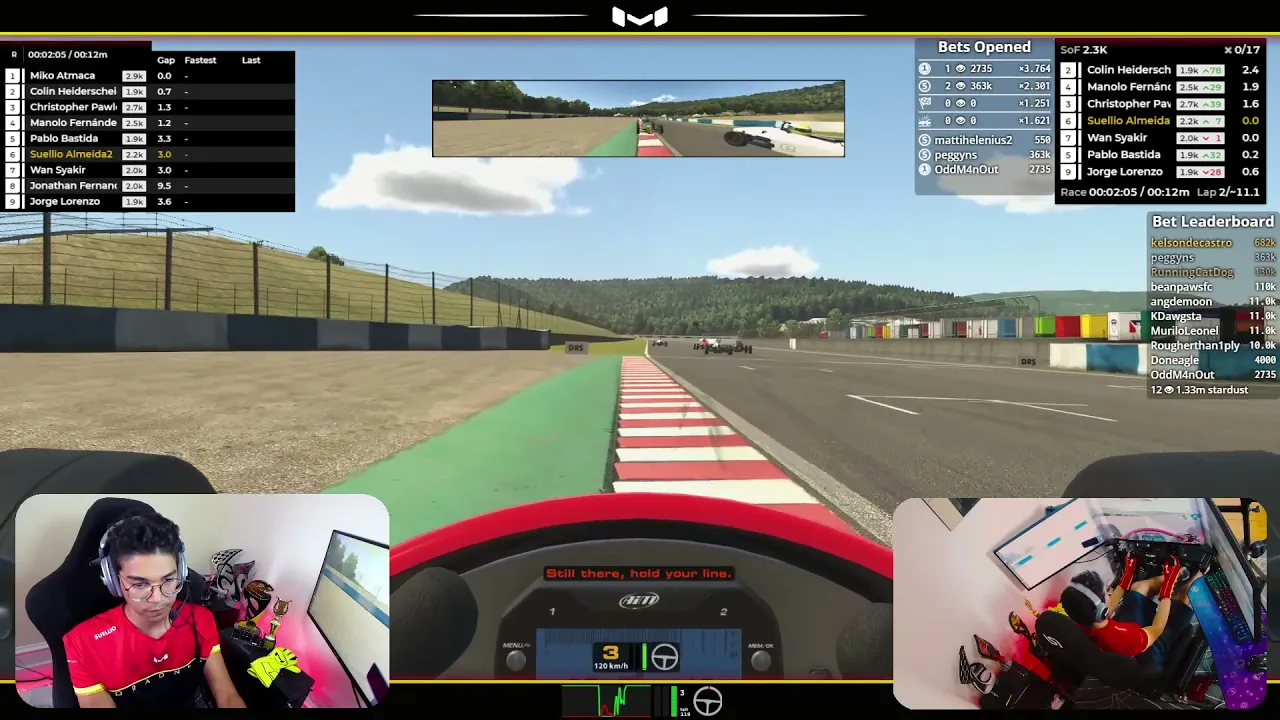
Formula Vee Downshifting: Why You're Slow (And How Sequential Thinking is Killing Your Lap Times)
Suellio Almeida
•
Friday, July 9, 2021
You're Not Driving a Sequential — Stop Pretending You Are
Formula Vee isn't a Formula 3 car. It's not an LMP2. Hell, it's not even a Mazda MX-5 Cup car.
Yet here you are, jamming through every gear on corner entry like you're piloting something with synchronized downshifts and modern transmission tech.
You're not. And that approach? It's bleeding time everywhere.
The Sequential Brain vs. The H-Pattern Reality
Your brain is wired from modern sims. iRacing GT3s. ACC hypercars. Everything with paddle shifters and seamless downshifts.
Formula Vee has an H-pattern gearbox. Old-school. Mechanical. Unforgiving.
Every downshift you make costs you:
Braking stability — You're upsetting the car mid-corner entry
Attention bandwidth — You're thinking about gears instead of racing line
Mechanical wear — You're destroying the gearbox unnecessarily
And for what? To be in third gear for 0.4 seconds before you shift to second anyway?
The Shocking Truth: You Don't Need Most of Those Downshifts
Let's talk about what actually matters in Formula Vee.
This car makes 52 horsepower. You're not managing a turbo powerband. You're not preventing engine damage from over-revving. You're just... shifting because that's what race drivers do.
Right?
Wrong.
Here's the technique that faster drivers figured out years ago: Skip gears aggressively.
Fourth to second. Third to first. Whatever gets you to your corner exit gear with the fewest mechanical operations.
What Changes When You Stop Sequential Downshifting
I've watched thousands of Formula Vee onboards. The pattern is consistent.
Drivers who treat it like a modern car: 4-3-2-1 through every braking zone. Choppy. Busy. Slow.
Drivers who win: Smooth. Minimal shifts. Maximum focus on brake application and rotation.
Because here's what you're actually doing when you downshift unnecessarily:
You're taking your left hand off the wheel. In an H-pattern car. During the most critical phase of corner entry.
Your steering inputs suffer. Your brake modulation suffers. Your lap time suffers.
The Physics You're Ignoring
Let's get specific about what's happening to the car.
Every downshift requires:
1. Clutch engagement — Momentary loss of engine braking
2. Rev matching — If you're good. If you're not, you're locking the rear tires
3. Hand movement — Your left hand comes off the wheel
4. Mental processing — Cognitive load during peak demand
Now multiply that by 3-4 shifts per corner. Times 10-15 corners per lap.
You're spending 40% of your corner entry managing the gearbox instead of managing the car.
The fast guys? They're spending that attention on trail braking depth, rotation timing, and throttle application precision.
How to Actually Downshift in Formula Vee
Rule #1: Know your corner exit gear BEFORE you start braking.
Is this a second-gear corner? Then go straight from fourth to second. Don't visit third just because it exists.
Rule #2: Make ONE downshift, maybe two.
High-speed corners might need one intermediate gear. Most corners don't. Figure out the absolute minimum and do that.
Rule #3: Time your downshift for AFTER initial brake application.
Get the car settled under braking first. THEN shift. Not during. Not before.
Rule #4: If you're unsure, stay in the higher gear longer.
You lose almost nothing holding fourth gear deep into braking. You lose EVERYTHING shifting too early and upsetting the platform.
The Mental Game: Breaking Sequential Habits
Your muscle memory is fighting you.
You've done 10,000 laps in cars where downshifting is free. Where it's expected. Where the transmission literally does half the work for you.
Formula Vee doesn't care about your habits.
Here's how to retrain:
Practice session #1: Force yourself to use ONLY fourth and second gear. Entire session. No third gear allowed. You'll be slow at first. Then you'll realize how little you actually need it.
Practice session #2: One downshift per corner maximum. Doesn't matter which gear you end up in (within reason). The constraint is: ONE shift.
Practice session #3: Normal driving, but count your shifts per lap. If you're doing more than 15-20 total shifts, you're overworking it.
What the Data Actually Shows
I've analyzed telemetry from Formula Vee races at every level.
The correlation is stark:
More downshifts = Slower lap times.
Not because the shifts themselves are slow (though they are). Because the drivers making more shifts are fundamentally misunderstanding the car.
They're treating corner entry like a sequential car: manage gears, manage brakes, manage steering, manage throttle.
The fast drivers treat it like an H-pattern momentum car: Brake. Rotate. One shift. Accelerate.
Simpler process. More attention on the physics that actually matter.
The Common Excuses (And Why They're Wrong)
"But I need engine braking through all the gears."
No, you don't. The aero drag and mechanical grip changes are doing 80% of your deceleration work. Engine braking is a minor player in a low-power car.
"I'm keeping the engine in the powerband."
This isn't a turbocharged car. The Formula Vee powerband is wide and forgiving. You're not losing meaningful acceleration by shifting later.
"That's just how I was taught to downshift."
You were taught wrong. Or you were taught for a different type of car. Question everything.
The Real Skill: Knowing When to Break the Rule
Look, there ARE corners where you need intermediate gears.
Long, sweeping decreasing-radius turns. Corners with significant elevation change. Situations where you genuinely can't manage the speed differential in one shift.
The skill isn't "never downshift."
The skill is knowing which corners actually require it versus which corners you're downshifting out of habit.
Fast drivers can explain every single downshift they make. They know why it's there. They've tested without it.
Slow drivers just shift through the gears because... that's what you do?
Your Action Plan for the Next Session
Here's what you're going to do:
Lap 1-3: Drive normally. Count your total shifts per lap. Write it down.
Lap 4-10: Aggressively minimize shifts. Skip gears everywhere. Target 50% reduction.
Lap 11-15: Find your optimal balance. Some corners might genuinely need that intermediate gear. Most don't.
Lap 16-20: Compare your best lap from each stint. I'll bet money your fastest lap comes from the minimal-shift approach.
Then compare the feel of the car. More stable on entry? More predictable rotation? More confidence to push?
That's what proper Formula Vee technique feels like.
Why This Matters Beyond Formula Vee
Here's the bigger lesson.
You just spent your entire driving career learning techniques optimized for modern race cars. Sequential gearboxes. Paddle shifters. Computer-controlled rev matching.
Now you're in a car that doesn't have any of that. And your instincts are wrong.
This is what car-specific technique actually means. It's not just "brake later" or "carry more speed." It's fundamentally rethinking your entire process based on the machinery you're piloting.
Formula Vee is teaching you to question your assumptions. To test what actually matters versus what you think matters.
That's the skill that separates good drivers from great ones.
And it starts with something as simple as realizing you don't need to downshift through every gear.
What Would Change If You Drove Every Car This Way?
Think about how much mental bandwidth you waste on unnecessary mechanical operations.
Not just in Formula Vee. Everywhere.
Shifts that don't matter. Inputs that don't optimize anything. Habits you've never questioned.
The drivers who win aren't the ones who do the most. They're the ones who do exactly what's required and nothing more.
Every unnecessary input is attention stolen from the inputs that actually matter.
Every extra downshift is focus lost from brake pressure, steering angle, throttle timing.
How much faster would you be if you eliminated everything that doesn't contribute to lap time?
What if you approached every car with that same ruthless efficiency?
Are You Ready to Stop Wasting Time on Technique That Doesn't Transfer?
You can keep downshifting through every gear because that's what feels "race car" to you.
Or you can start driving with the precision and intentionality that actually produces lap time.
This isn't just about Formula Vee. This is about learning to analyze what actually matters versus what you've been conditioned to do.
Almeida Racing Academy exists because most sim racers are stuck repeating habits they've never questioned. YouTube tutorials and forum wisdom that worked for someone else's car, someone else's style.
Our Gold Membership gives you 8 complete courses, 80 lessons teaching you how to actually analyze technique across every car type. Not generic advice. Car-specific methods backed by data and 5,000+ hours of coaching.
You'll learn how to diagnose what's actually costing you time—versus what just feels wrong. How to adapt technique to machinery instead of forcing square pegs into round holes.
Right now, use code WINTER for $25/month. That's access to the same systematic approach that's helped 36,000+ students break through their plateaus.
Join Gold Membership and Learn Technique That Actually Transfers
Sim Racing Academy Membership
Everything you need to stop guessing and start getting faster.
Starting at
$25
/mo
Car Handling Online Course
4 levels, full curriculum. Aimed to get you to top 1% in driving pace.
Racecraft Online Course
Overtaking, Defending, Race Strategy
Live coaching + on-track practice
Bi-weekly pro-coach workshops (recorded — never miss one) plus on-track Pit Parties to practice racecraft with a coach.
Plus These Bonuses
13,000+ Member Community
League Racing
Advanced MX-5 Mini Course
Racing Technique Development Guide
The Motor Racing Book (260 pages)
Think & Behave Like a Pro Driver — Mini eBook
Formula Vee Downshifting: Why You're Slow (And How Sequential Thinking is Killing Your Lap Times)
Suellio Almeida
•
Friday, July 9, 2021
You're Not Driving a Sequential — Stop Pretending You Are
Formula Vee isn't a Formula 3 car. It's not an LMP2. Hell, it's not even a Mazda MX-5 Cup car.
Yet here you are, jamming through every gear on corner entry like you're piloting something with synchronized downshifts and modern transmission tech.
You're not. And that approach? It's bleeding time everywhere.
The Sequential Brain vs. The H-Pattern Reality
Your brain is wired from modern sims. iRacing GT3s. ACC hypercars. Everything with paddle shifters and seamless downshifts.
Formula Vee has an H-pattern gearbox. Old-school. Mechanical. Unforgiving.
Every downshift you make costs you:
Braking stability — You're upsetting the car mid-corner entry
Attention bandwidth — You're thinking about gears instead of racing line
Mechanical wear — You're destroying the gearbox unnecessarily
And for what? To be in third gear for 0.4 seconds before you shift to second anyway?
The Shocking Truth: You Don't Need Most of Those Downshifts
Let's talk about what actually matters in Formula Vee.
This car makes 52 horsepower. You're not managing a turbo powerband. You're not preventing engine damage from over-revving. You're just... shifting because that's what race drivers do.
Right?
Wrong.
Here's the technique that faster drivers figured out years ago: Skip gears aggressively.
Fourth to second. Third to first. Whatever gets you to your corner exit gear with the fewest mechanical operations.
What Changes When You Stop Sequential Downshifting
I've watched thousands of Formula Vee onboards. The pattern is consistent.
Drivers who treat it like a modern car: 4-3-2-1 through every braking zone. Choppy. Busy. Slow.
Drivers who win: Smooth. Minimal shifts. Maximum focus on brake application and rotation.
Because here's what you're actually doing when you downshift unnecessarily:
You're taking your left hand off the wheel. In an H-pattern car. During the most critical phase of corner entry.
Your steering inputs suffer. Your brake modulation suffers. Your lap time suffers.
The Physics You're Ignoring
Let's get specific about what's happening to the car.
Every downshift requires:
1. Clutch engagement — Momentary loss of engine braking
2. Rev matching — If you're good. If you're not, you're locking the rear tires
3. Hand movement — Your left hand comes off the wheel
4. Mental processing — Cognitive load during peak demand
Now multiply that by 3-4 shifts per corner. Times 10-15 corners per lap.
You're spending 40% of your corner entry managing the gearbox instead of managing the car.
The fast guys? They're spending that attention on trail braking depth, rotation timing, and throttle application precision.
How to Actually Downshift in Formula Vee
Rule #1: Know your corner exit gear BEFORE you start braking.
Is this a second-gear corner? Then go straight from fourth to second. Don't visit third just because it exists.
Rule #2: Make ONE downshift, maybe two.
High-speed corners might need one intermediate gear. Most corners don't. Figure out the absolute minimum and do that.
Rule #3: Time your downshift for AFTER initial brake application.
Get the car settled under braking first. THEN shift. Not during. Not before.
Rule #4: If you're unsure, stay in the higher gear longer.
You lose almost nothing holding fourth gear deep into braking. You lose EVERYTHING shifting too early and upsetting the platform.
The Mental Game: Breaking Sequential Habits
Your muscle memory is fighting you.
You've done 10,000 laps in cars where downshifting is free. Where it's expected. Where the transmission literally does half the work for you.
Formula Vee doesn't care about your habits.
Here's how to retrain:
Practice session #1: Force yourself to use ONLY fourth and second gear. Entire session. No third gear allowed. You'll be slow at first. Then you'll realize how little you actually need it.
Practice session #2: One downshift per corner maximum. Doesn't matter which gear you end up in (within reason). The constraint is: ONE shift.
Practice session #3: Normal driving, but count your shifts per lap. If you're doing more than 15-20 total shifts, you're overworking it.
What the Data Actually Shows
I've analyzed telemetry from Formula Vee races at every level.
The correlation is stark:
More downshifts = Slower lap times.
Not because the shifts themselves are slow (though they are). Because the drivers making more shifts are fundamentally misunderstanding the car.
They're treating corner entry like a sequential car: manage gears, manage brakes, manage steering, manage throttle.
The fast drivers treat it like an H-pattern momentum car: Brake. Rotate. One shift. Accelerate.
Simpler process. More attention on the physics that actually matter.
The Common Excuses (And Why They're Wrong)
"But I need engine braking through all the gears."
No, you don't. The aero drag and mechanical grip changes are doing 80% of your deceleration work. Engine braking is a minor player in a low-power car.
"I'm keeping the engine in the powerband."
This isn't a turbocharged car. The Formula Vee powerband is wide and forgiving. You're not losing meaningful acceleration by shifting later.
"That's just how I was taught to downshift."
You were taught wrong. Or you were taught for a different type of car. Question everything.
The Real Skill: Knowing When to Break the Rule
Look, there ARE corners where you need intermediate gears.
Long, sweeping decreasing-radius turns. Corners with significant elevation change. Situations where you genuinely can't manage the speed differential in one shift.
The skill isn't "never downshift."
The skill is knowing which corners actually require it versus which corners you're downshifting out of habit.
Fast drivers can explain every single downshift they make. They know why it's there. They've tested without it.
Slow drivers just shift through the gears because... that's what you do?
Your Action Plan for the Next Session
Here's what you're going to do:
Lap 1-3: Drive normally. Count your total shifts per lap. Write it down.
Lap 4-10: Aggressively minimize shifts. Skip gears everywhere. Target 50% reduction.
Lap 11-15: Find your optimal balance. Some corners might genuinely need that intermediate gear. Most don't.
Lap 16-20: Compare your best lap from each stint. I'll bet money your fastest lap comes from the minimal-shift approach.
Then compare the feel of the car. More stable on entry? More predictable rotation? More confidence to push?
That's what proper Formula Vee technique feels like.
Why This Matters Beyond Formula Vee
Here's the bigger lesson.
You just spent your entire driving career learning techniques optimized for modern race cars. Sequential gearboxes. Paddle shifters. Computer-controlled rev matching.
Now you're in a car that doesn't have any of that. And your instincts are wrong.
This is what car-specific technique actually means. It's not just "brake later" or "carry more speed." It's fundamentally rethinking your entire process based on the machinery you're piloting.
Formula Vee is teaching you to question your assumptions. To test what actually matters versus what you think matters.
That's the skill that separates good drivers from great ones.
And it starts with something as simple as realizing you don't need to downshift through every gear.
What Would Change If You Drove Every Car This Way?
Think about how much mental bandwidth you waste on unnecessary mechanical operations.
Not just in Formula Vee. Everywhere.
Shifts that don't matter. Inputs that don't optimize anything. Habits you've never questioned.
The drivers who win aren't the ones who do the most. They're the ones who do exactly what's required and nothing more.
Every unnecessary input is attention stolen from the inputs that actually matter.
Every extra downshift is focus lost from brake pressure, steering angle, throttle timing.
How much faster would you be if you eliminated everything that doesn't contribute to lap time?
What if you approached every car with that same ruthless efficiency?
Are You Ready to Stop Wasting Time on Technique That Doesn't Transfer?
You can keep downshifting through every gear because that's what feels "race car" to you.
Or you can start driving with the precision and intentionality that actually produces lap time.
This isn't just about Formula Vee. This is about learning to analyze what actually matters versus what you've been conditioned to do.
Almeida Racing Academy exists because most sim racers are stuck repeating habits they've never questioned. YouTube tutorials and forum wisdom that worked for someone else's car, someone else's style.
Our Gold Membership gives you 8 complete courses, 80 lessons teaching you how to actually analyze technique across every car type. Not generic advice. Car-specific methods backed by data and 5,000+ hours of coaching.
You'll learn how to diagnose what's actually costing you time—versus what just feels wrong. How to adapt technique to machinery instead of forcing square pegs into round holes.
Right now, use code WINTER for $25/month. That's access to the same systematic approach that's helped 36,000+ students break through their plateaus.
Join Gold Membership and Learn Technique That Actually Transfers
Sim Racing Academy Membership
Everything you need to stop guessing and start getting faster.
Starting at
$25
/mo
Car Handling Online Course
4 levels, full curriculum. Aimed to get you to top 1% in driving pace.
Racecraft Online Course
Overtaking, Defending, Race Strategy
Live coaching + on-track practice
Bi-weekly pro-coach workshops (recorded — never miss one) plus on-track Pit Parties to practice racecraft with a coach.
Plus These Bonuses
13,000+ Member Community
League Racing
Advanced MX-5 Mini Course
Racing Technique Development Guide
The Motor Racing Book (260 pages)
Think & Behave Like a Pro Driver — Mini eBook
Formula Vee Downshifting: Why You're Slow (And How Sequential Thinking is Killing Your Lap Times)
Suellio Almeida
•
Friday, July 9, 2021
You're Not Driving a Sequential — Stop Pretending You Are
Formula Vee isn't a Formula 3 car. It's not an LMP2. Hell, it's not even a Mazda MX-5 Cup car.
Yet here you are, jamming through every gear on corner entry like you're piloting something with synchronized downshifts and modern transmission tech.
You're not. And that approach? It's bleeding time everywhere.
The Sequential Brain vs. The H-Pattern Reality
Your brain is wired from modern sims. iRacing GT3s. ACC hypercars. Everything with paddle shifters and seamless downshifts.
Formula Vee has an H-pattern gearbox. Old-school. Mechanical. Unforgiving.
Every downshift you make costs you:
Braking stability — You're upsetting the car mid-corner entry
Attention bandwidth — You're thinking about gears instead of racing line
Mechanical wear — You're destroying the gearbox unnecessarily
And for what? To be in third gear for 0.4 seconds before you shift to second anyway?
The Shocking Truth: You Don't Need Most of Those Downshifts
Let's talk about what actually matters in Formula Vee.
This car makes 52 horsepower. You're not managing a turbo powerband. You're not preventing engine damage from over-revving. You're just... shifting because that's what race drivers do.
Right?
Wrong.
Here's the technique that faster drivers figured out years ago: Skip gears aggressively.
Fourth to second. Third to first. Whatever gets you to your corner exit gear with the fewest mechanical operations.
What Changes When You Stop Sequential Downshifting
I've watched thousands of Formula Vee onboards. The pattern is consistent.
Drivers who treat it like a modern car: 4-3-2-1 through every braking zone. Choppy. Busy. Slow.
Drivers who win: Smooth. Minimal shifts. Maximum focus on brake application and rotation.
Because here's what you're actually doing when you downshift unnecessarily:
You're taking your left hand off the wheel. In an H-pattern car. During the most critical phase of corner entry.
Your steering inputs suffer. Your brake modulation suffers. Your lap time suffers.
The Physics You're Ignoring
Let's get specific about what's happening to the car.
Every downshift requires:
1. Clutch engagement — Momentary loss of engine braking
2. Rev matching — If you're good. If you're not, you're locking the rear tires
3. Hand movement — Your left hand comes off the wheel
4. Mental processing — Cognitive load during peak demand
Now multiply that by 3-4 shifts per corner. Times 10-15 corners per lap.
You're spending 40% of your corner entry managing the gearbox instead of managing the car.
The fast guys? They're spending that attention on trail braking depth, rotation timing, and throttle application precision.
How to Actually Downshift in Formula Vee
Rule #1: Know your corner exit gear BEFORE you start braking.
Is this a second-gear corner? Then go straight from fourth to second. Don't visit third just because it exists.
Rule #2: Make ONE downshift, maybe two.
High-speed corners might need one intermediate gear. Most corners don't. Figure out the absolute minimum and do that.
Rule #3: Time your downshift for AFTER initial brake application.
Get the car settled under braking first. THEN shift. Not during. Not before.
Rule #4: If you're unsure, stay in the higher gear longer.
You lose almost nothing holding fourth gear deep into braking. You lose EVERYTHING shifting too early and upsetting the platform.
The Mental Game: Breaking Sequential Habits
Your muscle memory is fighting you.
You've done 10,000 laps in cars where downshifting is free. Where it's expected. Where the transmission literally does half the work for you.
Formula Vee doesn't care about your habits.
Here's how to retrain:
Practice session #1: Force yourself to use ONLY fourth and second gear. Entire session. No third gear allowed. You'll be slow at first. Then you'll realize how little you actually need it.
Practice session #2: One downshift per corner maximum. Doesn't matter which gear you end up in (within reason). The constraint is: ONE shift.
Practice session #3: Normal driving, but count your shifts per lap. If you're doing more than 15-20 total shifts, you're overworking it.
What the Data Actually Shows
I've analyzed telemetry from Formula Vee races at every level.
The correlation is stark:
More downshifts = Slower lap times.
Not because the shifts themselves are slow (though they are). Because the drivers making more shifts are fundamentally misunderstanding the car.
They're treating corner entry like a sequential car: manage gears, manage brakes, manage steering, manage throttle.
The fast drivers treat it like an H-pattern momentum car: Brake. Rotate. One shift. Accelerate.
Simpler process. More attention on the physics that actually matter.
The Common Excuses (And Why They're Wrong)
"But I need engine braking through all the gears."
No, you don't. The aero drag and mechanical grip changes are doing 80% of your deceleration work. Engine braking is a minor player in a low-power car.
"I'm keeping the engine in the powerband."
This isn't a turbocharged car. The Formula Vee powerband is wide and forgiving. You're not losing meaningful acceleration by shifting later.
"That's just how I was taught to downshift."
You were taught wrong. Or you were taught for a different type of car. Question everything.
The Real Skill: Knowing When to Break the Rule
Look, there ARE corners where you need intermediate gears.
Long, sweeping decreasing-radius turns. Corners with significant elevation change. Situations where you genuinely can't manage the speed differential in one shift.
The skill isn't "never downshift."
The skill is knowing which corners actually require it versus which corners you're downshifting out of habit.
Fast drivers can explain every single downshift they make. They know why it's there. They've tested without it.
Slow drivers just shift through the gears because... that's what you do?
Your Action Plan for the Next Session
Here's what you're going to do:
Lap 1-3: Drive normally. Count your total shifts per lap. Write it down.
Lap 4-10: Aggressively minimize shifts. Skip gears everywhere. Target 50% reduction.
Lap 11-15: Find your optimal balance. Some corners might genuinely need that intermediate gear. Most don't.
Lap 16-20: Compare your best lap from each stint. I'll bet money your fastest lap comes from the minimal-shift approach.
Then compare the feel of the car. More stable on entry? More predictable rotation? More confidence to push?
That's what proper Formula Vee technique feels like.
Why This Matters Beyond Formula Vee
Here's the bigger lesson.
You just spent your entire driving career learning techniques optimized for modern race cars. Sequential gearboxes. Paddle shifters. Computer-controlled rev matching.
Now you're in a car that doesn't have any of that. And your instincts are wrong.
This is what car-specific technique actually means. It's not just "brake later" or "carry more speed." It's fundamentally rethinking your entire process based on the machinery you're piloting.
Formula Vee is teaching you to question your assumptions. To test what actually matters versus what you think matters.
That's the skill that separates good drivers from great ones.
And it starts with something as simple as realizing you don't need to downshift through every gear.
What Would Change If You Drove Every Car This Way?
Think about how much mental bandwidth you waste on unnecessary mechanical operations.
Not just in Formula Vee. Everywhere.
Shifts that don't matter. Inputs that don't optimize anything. Habits you've never questioned.
The drivers who win aren't the ones who do the most. They're the ones who do exactly what's required and nothing more.
Every unnecessary input is attention stolen from the inputs that actually matter.
Every extra downshift is focus lost from brake pressure, steering angle, throttle timing.
How much faster would you be if you eliminated everything that doesn't contribute to lap time?
What if you approached every car with that same ruthless efficiency?
Are You Ready to Stop Wasting Time on Technique That Doesn't Transfer?
You can keep downshifting through every gear because that's what feels "race car" to you.
Or you can start driving with the precision and intentionality that actually produces lap time.
This isn't just about Formula Vee. This is about learning to analyze what actually matters versus what you've been conditioned to do.
Almeida Racing Academy exists because most sim racers are stuck repeating habits they've never questioned. YouTube tutorials and forum wisdom that worked for someone else's car, someone else's style.
Our Gold Membership gives you 8 complete courses, 80 lessons teaching you how to actually analyze technique across every car type. Not generic advice. Car-specific methods backed by data and 5,000+ hours of coaching.
You'll learn how to diagnose what's actually costing you time—versus what just feels wrong. How to adapt technique to machinery instead of forcing square pegs into round holes.
Right now, use code WINTER for $25/month. That's access to the same systematic approach that's helped 36,000+ students break through their plateaus.
Join Gold Membership and Learn Technique That Actually Transfers
Sim Racing Academy Membership
Everything you need to stop guessing and start getting faster.
Starting at
$25
/mo
Car Handling Online Course
4 levels, full curriculum. Aimed to get you to top 1% in driving pace.
Racecraft Online Course
Overtaking, Defending, Race Strategy
Live coaching + on-track practice
Bi-weekly pro-coach workshops (recorded — never miss one) plus on-track Pit Parties to practice racecraft with a coach.
Plus These Bonuses
13,000+ Member Community
League Racing
Advanced MX-5 Mini Course
Racing Technique Development Guide
The Motor Racing Book (260 pages)
Think & Behave Like a Pro Driver — Mini eBook