
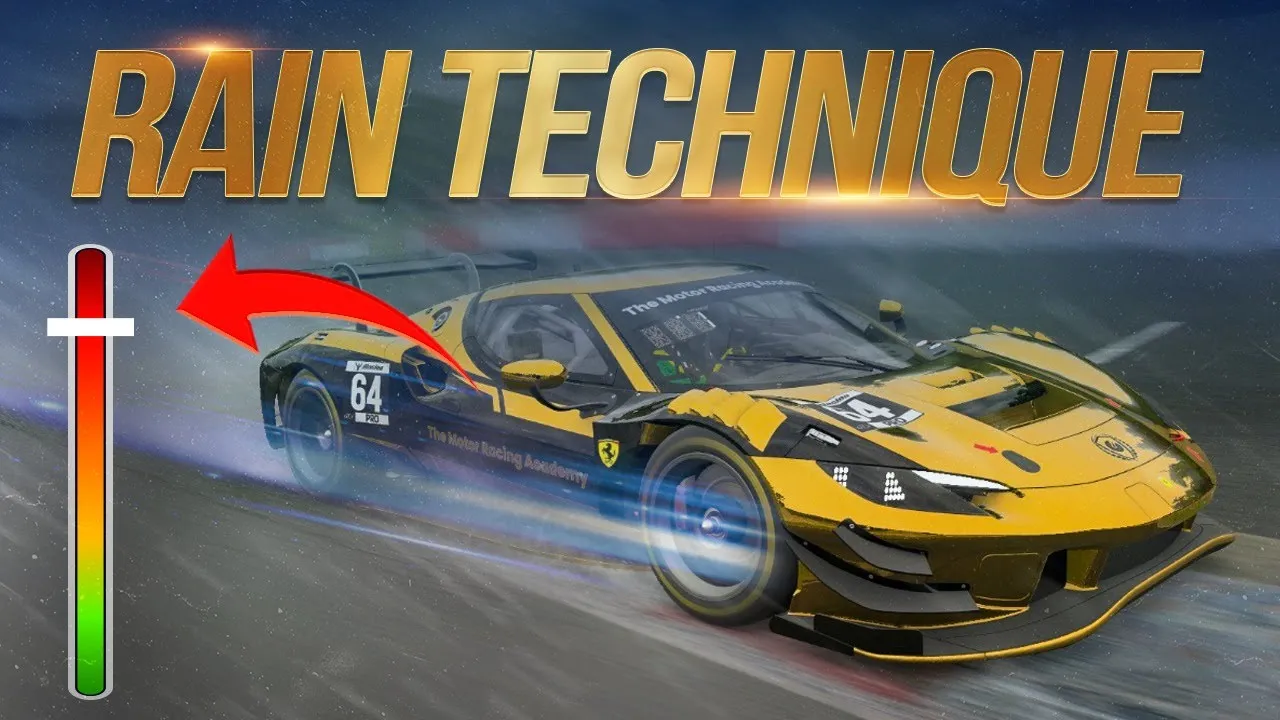
How to Find the Limit in the Rain: Wet Weather Racing Technique
Suellio Almeida
•
Sunday, December 1, 2024
Why Rain Driving Feels Impossible (And Why That's a Lie)
You hit the track in the rain and everything falls apart.
The car slides earlier. The braking zones shrink. You can't feel the limit anymore.
So you drive scared. You brake early, turn in gently, tip-toe through corners hoping the car stays planted.
And you're slow.
Here's the reality: rain doesn't change the physics of driving. It just removes your margin for error. The techniques that make you fast in the dry? They still apply. You just need to understand how grip degrades and adapt your inputs accordingly.
The best rain drivers aren't guessing. They're finding the limit systematically.
The One Thing Rain Actually Changes
Let's kill the myth right now: rain doesn't eliminate grip. It reduces it.
Your tires still generate friction. Weight transfer still shifts load. Trail braking still works.
What changes is the peak friction coefficient. In the dry, your tires might peak at 1.2-1.4g of lateral grip. In the wet, that drops to 0.7-0.9g depending on conditions.
But here's what doesn't change: where the grip is.
The racing line in the rain follows the same physics as the dry. You still want to maximize radius. You still need to load the front tires to turn. You still need rotation at the apex.
The difference? Your input precision matters ten times more.
In the dry, you can get away with being aggressive. You can muscle the car. In the rain, that same aggression breaks traction instantly.
So the real skill isn't "driving in the rain." It's finding where the new limit is without exceeding it.
How to Build Your Rain Reference Without Crashing
Most drivers approach rain sessions like a lottery. They push until they spin, back off, repeat.
That's not practice. That's guessing.
Here's the systematic approach:
Start at 70% of your dry pace. Not 90%. Not 80%. 70%.
Your first three laps are reconnaissance. You're not trying to go fast. You're calibrating where the grip is. Feel how early the car starts to slide under braking. Notice how much steering input triggers understeer. Learn the new limit through gradual exploration, not sudden disasters.
Increase speed in 5% increments. Brake 5 meters later. Add 5 degrees more steering angle. Increase throttle application by 5%.
Every two laps, make one small change. If the car stays stable, add another 5%. If you feel the edge, hold there for three more laps before pushing again.
This is how you build a limit reference in the rain without spinning every lap.
And here's the part nobody talks about: the drivers who dominate wet races aren't naturally gifted in the rain. They're just better at systematic exploration. They find the new limit faster because they approach it methodically.
The Vision Technique That Changes Everything
Here's where most drivers lose time in the rain: they look at the wrong thing.
In the dry, you can get away with late vision. You can glance at the apex, scan the exit, adjust mid-corner.
In the rain? You need to look where you want to go sooner and hold that focus longer.
Why? Because your reaction time to slides increases. By the time you feel the rear step out, you're already too late to catch it smoothly. But if your eyes are already focused on the exit, your hands instinctively make the correction before your brain processes the slide.
This is the same reason advanced drivers look smooth in the rain while beginners look jerky. It's not car control. It's vision timing.
Look to the exit before you turn in. Not at the apex. Not at the puddle in the braking zone. Where you want the car to go.
Your hands follow your eyes. If you're staring at the wet patch you're trying to avoid, you'll drive straight into it.
The Braking Mistake That Kills Your Lap Time
You know you need to brake earlier in the rain. Everyone knows that.
But here's what's actually happening: you're not just braking earlier. You're braking softer for longer.
And that's slow.
The grip is lower in the rain, yes. But the car still needs maximum load transfer to turn. If you brake too gently, the front tires never fully compress. The car understeers. You scrub speed mid-corner trying to force rotation that physics won't give you.
Here's the technique adjustment:
Brake earlier, but hit peak pressure sooner. You want maximum load on the front tires as quickly as possible without locking up. Then release pressure progressively as you approach turn-in.
This is trail braking, same as the dry. The only difference is your peak pressure threshold is lower.
Most drivers make the opposite mistake: they ease into the brakes gently, stay on them too long, and never get proper front-end bite. The car floats into the corner with no weight on the nose.
Result? Understeer. Slow corner speed. Frustrated driver.
Get aggressive with your initial brake application. Just do it earlier and release it sooner.
Why the Racing Line Changes (But Probably Not How You Think)
Everyone tells you to avoid the racing line in the rain because "that's where the rubber is, and rubber is slippery when wet."
Sometimes true. Often irrelevant.
Here's what actually matters: standing water.
The racing line typically follows the shortest geometric path or the path that maximizes radius. In the rain, that path might cut through a puddle that wasn't there in the dry.
That puddle? That's where you lose the car.
So yes, the line changes. But not because of rubber. Because of water depth.
Your job is to find the path with the least standing water while maintaining the largest possible radius. Sometimes that's off the racing line. Sometimes it's exactly on the racing line because that's where the camber drains water fastest.
Watch where the fast guys are driving in the rain. They're not all taking the same line. They're adapting to track-specific drainage.
And here's the key: the line that works in light rain might be terrible in heavy rain as puddles form in different spots.
You have to adapt lap by lap.
The Throttle Application Principle Nobody Explains
Throttle in the rain follows the same physics as the dry: weight transfer and traction are inverse.
When you apply throttle, weight shifts rearward. The front tires unload. If you're mid-corner, that unloading triggers understeer.
In the dry, you can get away with early, aggressive throttle because the grip ceiling is high. In the rain, that same aggression breaks traction immediately.
So here's the adjustment:
Wait longer to apply throttle, but apply it more progressively.
You want the car fully rotated and pointing at the exit before you commit to throttle. Not 80% rotated. Not "close enough." Fully rotated.
Then apply throttle like you're squeezing a sponge. Gradual, linear, smooth.
The drivers who spin in the rain aren't going in too fast. They're applying throttle before the car is ready.
And here's the part that will change your wet driving forever: you can feel when the car is ready for throttle.
The steering wheel goes light. The car stops resisting your input. That's your cue. Before that moment, any throttle application is just understeer or wheelspin.
What Actually Makes You Fast in the Rain
Let's strip this down to the core principle:
The fastest wet-weather drivers are the smoothest.
Not the bravest. Not the most aggressive. The smoothest.
Every input you make — brake, steering, throttle — must be gradual. Not because you're being gentle. Because abrupt inputs exceed the grip threshold instantly.
In the dry, you can mask poor technique with aggression. In the rain, that same aggression exposes every mistake.
So if you want to dominate in the rain, focus on input rate, not input magnitude.
How quickly are you adding steering angle? How fast are you releasing brake pressure? How aggressively are you applying throttle?
Slow all of that down. Not the car. The inputs.
The car will be faster because it stays planted.
Are You Actually Learning From Your Rain Sessions?
Here's the question most drivers never ask:
What are you taking away from your wet sessions?
Most drivers finish a rain race and think: "Well, that sucked. Can't wait for the track to dry."
But the drivers who improve fastest? They treat rain as a technique amplifier.
Because here's what rain does: it exposes every inefficiency in your driving.
That late turn-in you get away with in the dry? Understeer in the rain.
That aggressive throttle application? Wheelspin.
That inconsistent braking pressure? Lockups every lap.
Rain doesn't create bad habits. It reveals them.
So if you want to get faster overall — not just in the rain — use wet sessions as a diagnostic tool.
Where are you losing control? That's where your technique needs work.
Where does the car feel unstable? That's where your inputs are too abrupt.
The best drivers don't fear the rain. They use it to find gaps in their skill set.
What If You Could Master Wet-Weather Racing With Real Guidance?
You've just read the principles that separate fast rain drivers from slow ones.
But here's the reality: reading about technique and applying it consistently under pressure are two different skills.
How many rain sessions have you done where you know you should be smoother, but in the heat of the moment, you revert to old habits? How many times have you spun and thought, "I knew that would happen"?
What if you had a system — not just tips, but a structured approach — that built wet-weather speed lap by lap?
That's what Gold Membership gives you. Eight full courses covering every aspect of car control, including dedicated modules on low-grip conditions, trail braking, and vision techniques. 80 lessons built by drivers who actually race in the rain — not just talk about it.
You get access to coach-led workshops where we break down wet-weather replays. You get challenges that force you to practice the exact techniques that make you fast in the rain. And you get the Academy Discord, where you can ask questions and get real answers from drivers who've been exactly where you are.
Right now, Gold is $25/month with code WINTER. That's less than a single coaching session. Less than one tank of gas for a track day.
But if you're serious about becoming the driver who thrives in the rain — the one everyone else is watching, wondering how you're so fast — this is where you start.
Sim Racing Academy Membership
Everything you need to stop guessing and start getting faster.
Starting at
$25
/mo
Car Handling Online Course
4 levels, full curriculum. Aimed to get you to top 1% in driving pace.
Racecraft Online Course
Overtaking, Defending, Race Strategy
Live coaching + on-track practice
Bi-weekly pro-coach workshops (recorded — never miss one) plus on-track Pit Parties to practice racecraft with a coach.
Plus These Bonuses
13,000+ Member Community
League Racing
Advanced MX-5 Mini Course
Racing Technique Development Guide
The Motor Racing Book (260 pages)
Think & Behave Like a Pro Driver — Mini eBook
How to Find the Limit in the Rain: Wet Weather Racing Technique
Suellio Almeida
•
Sunday, December 1, 2024
Why Rain Driving Feels Impossible (And Why That's a Lie)
You hit the track in the rain and everything falls apart.
The car slides earlier. The braking zones shrink. You can't feel the limit anymore.
So you drive scared. You brake early, turn in gently, tip-toe through corners hoping the car stays planted.
And you're slow.
Here's the reality: rain doesn't change the physics of driving. It just removes your margin for error. The techniques that make you fast in the dry? They still apply. You just need to understand how grip degrades and adapt your inputs accordingly.
The best rain drivers aren't guessing. They're finding the limit systematically.
The One Thing Rain Actually Changes
Let's kill the myth right now: rain doesn't eliminate grip. It reduces it.
Your tires still generate friction. Weight transfer still shifts load. Trail braking still works.
What changes is the peak friction coefficient. In the dry, your tires might peak at 1.2-1.4g of lateral grip. In the wet, that drops to 0.7-0.9g depending on conditions.
But here's what doesn't change: where the grip is.
The racing line in the rain follows the same physics as the dry. You still want to maximize radius. You still need to load the front tires to turn. You still need rotation at the apex.
The difference? Your input precision matters ten times more.
In the dry, you can get away with being aggressive. You can muscle the car. In the rain, that same aggression breaks traction instantly.
So the real skill isn't "driving in the rain." It's finding where the new limit is without exceeding it.
How to Build Your Rain Reference Without Crashing
Most drivers approach rain sessions like a lottery. They push until they spin, back off, repeat.
That's not practice. That's guessing.
Here's the systematic approach:
Start at 70% of your dry pace. Not 90%. Not 80%. 70%.
Your first three laps are reconnaissance. You're not trying to go fast. You're calibrating where the grip is. Feel how early the car starts to slide under braking. Notice how much steering input triggers understeer. Learn the new limit through gradual exploration, not sudden disasters.
Increase speed in 5% increments. Brake 5 meters later. Add 5 degrees more steering angle. Increase throttle application by 5%.
Every two laps, make one small change. If the car stays stable, add another 5%. If you feel the edge, hold there for three more laps before pushing again.
This is how you build a limit reference in the rain without spinning every lap.
And here's the part nobody talks about: the drivers who dominate wet races aren't naturally gifted in the rain. They're just better at systematic exploration. They find the new limit faster because they approach it methodically.
The Vision Technique That Changes Everything
Here's where most drivers lose time in the rain: they look at the wrong thing.
In the dry, you can get away with late vision. You can glance at the apex, scan the exit, adjust mid-corner.
In the rain? You need to look where you want to go sooner and hold that focus longer.
Why? Because your reaction time to slides increases. By the time you feel the rear step out, you're already too late to catch it smoothly. But if your eyes are already focused on the exit, your hands instinctively make the correction before your brain processes the slide.
This is the same reason advanced drivers look smooth in the rain while beginners look jerky. It's not car control. It's vision timing.
Look to the exit before you turn in. Not at the apex. Not at the puddle in the braking zone. Where you want the car to go.
Your hands follow your eyes. If you're staring at the wet patch you're trying to avoid, you'll drive straight into it.
The Braking Mistake That Kills Your Lap Time
You know you need to brake earlier in the rain. Everyone knows that.
But here's what's actually happening: you're not just braking earlier. You're braking softer for longer.
And that's slow.
The grip is lower in the rain, yes. But the car still needs maximum load transfer to turn. If you brake too gently, the front tires never fully compress. The car understeers. You scrub speed mid-corner trying to force rotation that physics won't give you.
Here's the technique adjustment:
Brake earlier, but hit peak pressure sooner. You want maximum load on the front tires as quickly as possible without locking up. Then release pressure progressively as you approach turn-in.
This is trail braking, same as the dry. The only difference is your peak pressure threshold is lower.
Most drivers make the opposite mistake: they ease into the brakes gently, stay on them too long, and never get proper front-end bite. The car floats into the corner with no weight on the nose.
Result? Understeer. Slow corner speed. Frustrated driver.
Get aggressive with your initial brake application. Just do it earlier and release it sooner.
Why the Racing Line Changes (But Probably Not How You Think)
Everyone tells you to avoid the racing line in the rain because "that's where the rubber is, and rubber is slippery when wet."
Sometimes true. Often irrelevant.
Here's what actually matters: standing water.
The racing line typically follows the shortest geometric path or the path that maximizes radius. In the rain, that path might cut through a puddle that wasn't there in the dry.
That puddle? That's where you lose the car.
So yes, the line changes. But not because of rubber. Because of water depth.
Your job is to find the path with the least standing water while maintaining the largest possible radius. Sometimes that's off the racing line. Sometimes it's exactly on the racing line because that's where the camber drains water fastest.
Watch where the fast guys are driving in the rain. They're not all taking the same line. They're adapting to track-specific drainage.
And here's the key: the line that works in light rain might be terrible in heavy rain as puddles form in different spots.
You have to adapt lap by lap.
The Throttle Application Principle Nobody Explains
Throttle in the rain follows the same physics as the dry: weight transfer and traction are inverse.
When you apply throttle, weight shifts rearward. The front tires unload. If you're mid-corner, that unloading triggers understeer.
In the dry, you can get away with early, aggressive throttle because the grip ceiling is high. In the rain, that same aggression breaks traction immediately.
So here's the adjustment:
Wait longer to apply throttle, but apply it more progressively.
You want the car fully rotated and pointing at the exit before you commit to throttle. Not 80% rotated. Not "close enough." Fully rotated.
Then apply throttle like you're squeezing a sponge. Gradual, linear, smooth.
The drivers who spin in the rain aren't going in too fast. They're applying throttle before the car is ready.
And here's the part that will change your wet driving forever: you can feel when the car is ready for throttle.
The steering wheel goes light. The car stops resisting your input. That's your cue. Before that moment, any throttle application is just understeer or wheelspin.
What Actually Makes You Fast in the Rain
Let's strip this down to the core principle:
The fastest wet-weather drivers are the smoothest.
Not the bravest. Not the most aggressive. The smoothest.
Every input you make — brake, steering, throttle — must be gradual. Not because you're being gentle. Because abrupt inputs exceed the grip threshold instantly.
In the dry, you can mask poor technique with aggression. In the rain, that same aggression exposes every mistake.
So if you want to dominate in the rain, focus on input rate, not input magnitude.
How quickly are you adding steering angle? How fast are you releasing brake pressure? How aggressively are you applying throttle?
Slow all of that down. Not the car. The inputs.
The car will be faster because it stays planted.
Are You Actually Learning From Your Rain Sessions?
Here's the question most drivers never ask:
What are you taking away from your wet sessions?
Most drivers finish a rain race and think: "Well, that sucked. Can't wait for the track to dry."
But the drivers who improve fastest? They treat rain as a technique amplifier.
Because here's what rain does: it exposes every inefficiency in your driving.
That late turn-in you get away with in the dry? Understeer in the rain.
That aggressive throttle application? Wheelspin.
That inconsistent braking pressure? Lockups every lap.
Rain doesn't create bad habits. It reveals them.
So if you want to get faster overall — not just in the rain — use wet sessions as a diagnostic tool.
Where are you losing control? That's where your technique needs work.
Where does the car feel unstable? That's where your inputs are too abrupt.
The best drivers don't fear the rain. They use it to find gaps in their skill set.
What If You Could Master Wet-Weather Racing With Real Guidance?
You've just read the principles that separate fast rain drivers from slow ones.
But here's the reality: reading about technique and applying it consistently under pressure are two different skills.
How many rain sessions have you done where you know you should be smoother, but in the heat of the moment, you revert to old habits? How many times have you spun and thought, "I knew that would happen"?
What if you had a system — not just tips, but a structured approach — that built wet-weather speed lap by lap?
That's what Gold Membership gives you. Eight full courses covering every aspect of car control, including dedicated modules on low-grip conditions, trail braking, and vision techniques. 80 lessons built by drivers who actually race in the rain — not just talk about it.
You get access to coach-led workshops where we break down wet-weather replays. You get challenges that force you to practice the exact techniques that make you fast in the rain. And you get the Academy Discord, where you can ask questions and get real answers from drivers who've been exactly where you are.
Right now, Gold is $25/month with code WINTER. That's less than a single coaching session. Less than one tank of gas for a track day.
But if you're serious about becoming the driver who thrives in the rain — the one everyone else is watching, wondering how you're so fast — this is where you start.
Sim Racing Academy Membership
Everything you need to stop guessing and start getting faster.
Starting at
$25
/mo
Car Handling Online Course
4 levels, full curriculum. Aimed to get you to top 1% in driving pace.
Racecraft Online Course
Overtaking, Defending, Race Strategy
Live coaching + on-track practice
Bi-weekly pro-coach workshops (recorded — never miss one) plus on-track Pit Parties to practice racecraft with a coach.
Plus These Bonuses
13,000+ Member Community
League Racing
Advanced MX-5 Mini Course
Racing Technique Development Guide
The Motor Racing Book (260 pages)
Think & Behave Like a Pro Driver — Mini eBook
How to Find the Limit in the Rain: Wet Weather Racing Technique
Suellio Almeida
•
Sunday, December 1, 2024
Why Rain Driving Feels Impossible (And Why That's a Lie)
You hit the track in the rain and everything falls apart.
The car slides earlier. The braking zones shrink. You can't feel the limit anymore.
So you drive scared. You brake early, turn in gently, tip-toe through corners hoping the car stays planted.
And you're slow.
Here's the reality: rain doesn't change the physics of driving. It just removes your margin for error. The techniques that make you fast in the dry? They still apply. You just need to understand how grip degrades and adapt your inputs accordingly.
The best rain drivers aren't guessing. They're finding the limit systematically.
The One Thing Rain Actually Changes
Let's kill the myth right now: rain doesn't eliminate grip. It reduces it.
Your tires still generate friction. Weight transfer still shifts load. Trail braking still works.
What changes is the peak friction coefficient. In the dry, your tires might peak at 1.2-1.4g of lateral grip. In the wet, that drops to 0.7-0.9g depending on conditions.
But here's what doesn't change: where the grip is.
The racing line in the rain follows the same physics as the dry. You still want to maximize radius. You still need to load the front tires to turn. You still need rotation at the apex.
The difference? Your input precision matters ten times more.
In the dry, you can get away with being aggressive. You can muscle the car. In the rain, that same aggression breaks traction instantly.
So the real skill isn't "driving in the rain." It's finding where the new limit is without exceeding it.
How to Build Your Rain Reference Without Crashing
Most drivers approach rain sessions like a lottery. They push until they spin, back off, repeat.
That's not practice. That's guessing.
Here's the systematic approach:
Start at 70% of your dry pace. Not 90%. Not 80%. 70%.
Your first three laps are reconnaissance. You're not trying to go fast. You're calibrating where the grip is. Feel how early the car starts to slide under braking. Notice how much steering input triggers understeer. Learn the new limit through gradual exploration, not sudden disasters.
Increase speed in 5% increments. Brake 5 meters later. Add 5 degrees more steering angle. Increase throttle application by 5%.
Every two laps, make one small change. If the car stays stable, add another 5%. If you feel the edge, hold there for three more laps before pushing again.
This is how you build a limit reference in the rain without spinning every lap.
And here's the part nobody talks about: the drivers who dominate wet races aren't naturally gifted in the rain. They're just better at systematic exploration. They find the new limit faster because they approach it methodically.
The Vision Technique That Changes Everything
Here's where most drivers lose time in the rain: they look at the wrong thing.
In the dry, you can get away with late vision. You can glance at the apex, scan the exit, adjust mid-corner.
In the rain? You need to look where you want to go sooner and hold that focus longer.
Why? Because your reaction time to slides increases. By the time you feel the rear step out, you're already too late to catch it smoothly. But if your eyes are already focused on the exit, your hands instinctively make the correction before your brain processes the slide.
This is the same reason advanced drivers look smooth in the rain while beginners look jerky. It's not car control. It's vision timing.
Look to the exit before you turn in. Not at the apex. Not at the puddle in the braking zone. Where you want the car to go.
Your hands follow your eyes. If you're staring at the wet patch you're trying to avoid, you'll drive straight into it.
The Braking Mistake That Kills Your Lap Time
You know you need to brake earlier in the rain. Everyone knows that.
But here's what's actually happening: you're not just braking earlier. You're braking softer for longer.
And that's slow.
The grip is lower in the rain, yes. But the car still needs maximum load transfer to turn. If you brake too gently, the front tires never fully compress. The car understeers. You scrub speed mid-corner trying to force rotation that physics won't give you.
Here's the technique adjustment:
Brake earlier, but hit peak pressure sooner. You want maximum load on the front tires as quickly as possible without locking up. Then release pressure progressively as you approach turn-in.
This is trail braking, same as the dry. The only difference is your peak pressure threshold is lower.
Most drivers make the opposite mistake: they ease into the brakes gently, stay on them too long, and never get proper front-end bite. The car floats into the corner with no weight on the nose.
Result? Understeer. Slow corner speed. Frustrated driver.
Get aggressive with your initial brake application. Just do it earlier and release it sooner.
Why the Racing Line Changes (But Probably Not How You Think)
Everyone tells you to avoid the racing line in the rain because "that's where the rubber is, and rubber is slippery when wet."
Sometimes true. Often irrelevant.
Here's what actually matters: standing water.
The racing line typically follows the shortest geometric path or the path that maximizes radius. In the rain, that path might cut through a puddle that wasn't there in the dry.
That puddle? That's where you lose the car.
So yes, the line changes. But not because of rubber. Because of water depth.
Your job is to find the path with the least standing water while maintaining the largest possible radius. Sometimes that's off the racing line. Sometimes it's exactly on the racing line because that's where the camber drains water fastest.
Watch where the fast guys are driving in the rain. They're not all taking the same line. They're adapting to track-specific drainage.
And here's the key: the line that works in light rain might be terrible in heavy rain as puddles form in different spots.
You have to adapt lap by lap.
The Throttle Application Principle Nobody Explains
Throttle in the rain follows the same physics as the dry: weight transfer and traction are inverse.
When you apply throttle, weight shifts rearward. The front tires unload. If you're mid-corner, that unloading triggers understeer.
In the dry, you can get away with early, aggressive throttle because the grip ceiling is high. In the rain, that same aggression breaks traction immediately.
So here's the adjustment:
Wait longer to apply throttle, but apply it more progressively.
You want the car fully rotated and pointing at the exit before you commit to throttle. Not 80% rotated. Not "close enough." Fully rotated.
Then apply throttle like you're squeezing a sponge. Gradual, linear, smooth.
The drivers who spin in the rain aren't going in too fast. They're applying throttle before the car is ready.
And here's the part that will change your wet driving forever: you can feel when the car is ready for throttle.
The steering wheel goes light. The car stops resisting your input. That's your cue. Before that moment, any throttle application is just understeer or wheelspin.
What Actually Makes You Fast in the Rain
Let's strip this down to the core principle:
The fastest wet-weather drivers are the smoothest.
Not the bravest. Not the most aggressive. The smoothest.
Every input you make — brake, steering, throttle — must be gradual. Not because you're being gentle. Because abrupt inputs exceed the grip threshold instantly.
In the dry, you can mask poor technique with aggression. In the rain, that same aggression exposes every mistake.
So if you want to dominate in the rain, focus on input rate, not input magnitude.
How quickly are you adding steering angle? How fast are you releasing brake pressure? How aggressively are you applying throttle?
Slow all of that down. Not the car. The inputs.
The car will be faster because it stays planted.
Are You Actually Learning From Your Rain Sessions?
Here's the question most drivers never ask:
What are you taking away from your wet sessions?
Most drivers finish a rain race and think: "Well, that sucked. Can't wait for the track to dry."
But the drivers who improve fastest? They treat rain as a technique amplifier.
Because here's what rain does: it exposes every inefficiency in your driving.
That late turn-in you get away with in the dry? Understeer in the rain.
That aggressive throttle application? Wheelspin.
That inconsistent braking pressure? Lockups every lap.
Rain doesn't create bad habits. It reveals them.
So if you want to get faster overall — not just in the rain — use wet sessions as a diagnostic tool.
Where are you losing control? That's where your technique needs work.
Where does the car feel unstable? That's where your inputs are too abrupt.
The best drivers don't fear the rain. They use it to find gaps in their skill set.
What If You Could Master Wet-Weather Racing With Real Guidance?
You've just read the principles that separate fast rain drivers from slow ones.
But here's the reality: reading about technique and applying it consistently under pressure are two different skills.
How many rain sessions have you done where you know you should be smoother, but in the heat of the moment, you revert to old habits? How many times have you spun and thought, "I knew that would happen"?
What if you had a system — not just tips, but a structured approach — that built wet-weather speed lap by lap?
That's what Gold Membership gives you. Eight full courses covering every aspect of car control, including dedicated modules on low-grip conditions, trail braking, and vision techniques. 80 lessons built by drivers who actually race in the rain — not just talk about it.
You get access to coach-led workshops where we break down wet-weather replays. You get challenges that force you to practice the exact techniques that make you fast in the rain. And you get the Academy Discord, where you can ask questions and get real answers from drivers who've been exactly where you are.
Right now, Gold is $25/month with code WINTER. That's less than a single coaching session. Less than one tank of gas for a track day.
But if you're serious about becoming the driver who thrives in the rain — the one everyone else is watching, wondering how you're so fast — this is where you start.
Sim Racing Academy Membership
Everything you need to stop guessing and start getting faster.
Starting at
$25
/mo
Car Handling Online Course
4 levels, full curriculum. Aimed to get you to top 1% in driving pace.
Racecraft Online Course
Overtaking, Defending, Race Strategy
Live coaching + on-track practice
Bi-weekly pro-coach workshops (recorded — never miss one) plus on-track Pit Parties to practice racecraft with a coach.
Plus These Bonuses
13,000+ Member Community
League Racing
Advanced MX-5 Mini Course
Racing Technique Development Guide
The Motor Racing Book (260 pages)
Think & Behave Like a Pro Driver — Mini eBook