
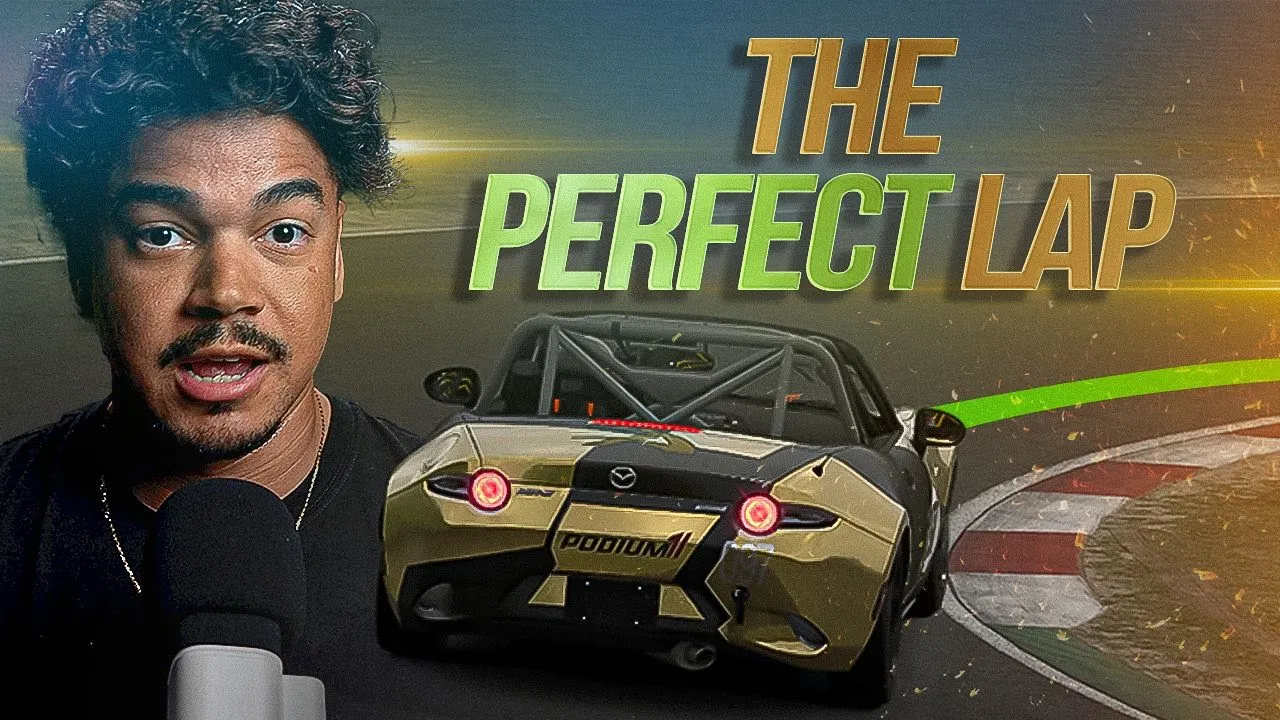
How to Drive the Perfect Lap: What Elite Sim Racers Actually Do Different
Suellio Almeida
•
Thursday, August 28, 2025
The Perfect Lap Doesn't Exist (But You Can Get Close)
Let me kill a myth right now.
There is no such thing as a perfect lap. Even the world's fastest drivers — F1 champions, IMSA pros, top 0.01% sim racers — make micro-errors on every single lap. The difference? They know which mistakes to accept and which ones cost tenths.
Your job isn't to eliminate all error. It's to stack acceptable errors on top of each other while avoiding the catastrophic ones. That's the real skill.
What Actually Separates a Fast Lap from a Record Lap
The gap between your best lap and an alien lap isn't what you think it is.
It's not raw speed. It's not balls-to-the-wall bravery. It's consistency of execution across three things:
Vision — Where you're looking determines when you start every input. Look late, brake late, turn late, everything cascades. The aliens are seeing apexes and exits while you're still processing corner entry.
Braking pressure application — Not how hard you brake. How you modulate pressure through the entire braking zone. Most drivers treat the pedal like an on/off switch. Elite drivers are playing a piano.
Rotation management — Understanding when the car needs to rotate and when it needs to stabilize. You can't carry speed if the car is fighting you. You can't be fast if you're correcting mid-corner.
Get those three right, lap after lap, and you're in the top 1%. Miss any one of them, and you're wondering why you're two seconds off.
The Single Biggest Time Loss: Vision Discipline
Here's where most of you are bleeding time.
You're looking at the wrong place at the wrong time. And because you're looking wrong, everything downstream falls apart.
Listen: where you look dictates when you act. If your eyes are on the apex too early, you turn in too early. If you're staring at the braking marker, you hold brake too long. If you're not picking up the exit, you don't commit to throttle.
The hierarchy is simple:
1. Entry phase — Eyes to apex, peripheral on turn-in point
2. Mid-corner — Eyes to exit, peripheral tracking apex
3. Exit phase — Eyes to next braking zone or turn-in, peripheral confirming track position
Your eyes move in sequence. Always ahead of the car. Never chasing what's underneath you right now.
Try this: next session, film your eyes. Watch the replay. You'll be shocked how often you're looking at the wrong thing.
Braking Is Where Laps Are Won or Lost
You think the fast guys are just braking later. Wrong.
They're braking better. There's a massive difference.
The perfect braking zone has three phases:
Initial application — Maximum pressure, maximum deceleration. You're not easing into it. You're hitting it. This is where you scrub the most speed in the shortest distance.
Trail phase — Progressive release of pressure as you approach turn-in. This is where the magic happens. You're transferring load to the front, settling the platform, preparing rotation. You release too fast? Understeer. Too slow? You're slow.
Release point — The moment you're off brake entirely and committing to maintenance throttle or squeeze. This timing dictates your mid-corner speed. Miss it by 10 feet and you're managing understeer the rest of the corner.
Most of you are doing two-phase braking: hard, then off. That's why you're slow. The middle phase — that controlled, progressive release — is where elite drivers live.
Rotation: The Concept Nobody Explains Correctly
Rotation is the most misunderstood concept in sim racing.
Here's what it actually means: the car's willingness to change direction under your inputs.
When the car is rotating well, small steering corrections produce big direction changes. When it's not rotating, you're sawing at the wheel and the car is pushing wide.
You create rotation with load transfer. Front-loaded car (trail braking, weight forward) = more rotation. Rear-loaded car (on throttle, weight back) = less rotation, more stability.
The key skill: knowing when you need which state.
Turn-in to apex? You want rotation. You're still trail braking, weight is forward, front tires have grip, car is willing to rotate.
Apex to exit? You want stability. You're squeezing throttle, transferring weight rearward, asking the rear tires to put down power without stepping out.
The mistake: staying on brake too long (kills rotation at the wrong time) or getting off brake too early (car won't rotate, you understeer, lap ruined).
That transition point — the Maximum Rotation Point — is where fast laps are made. You nail that timing, corner after corner, and suddenly you're consistent.
The Sequence That Builds a Clean Lap
Let me walk you through one corner. The perfect execution.
Approach — Eyes to braking marker, but already scanning for apex. You know your braking point. You're not guessing.
Braking zone — Maximum initial pressure, then progressive release as eyes shift to apex. You feel the platform settle. Steering inputs are smooth because the car is stable.
Turn-in — Brake pressure nearly gone, just enough to keep weight forward. Single smooth steering application. Eyes tracking apex, peripheral already searching for exit.
Apex — Last bit of brake releases, maintenance throttle or immediate squeeze depending on corner type. Car is pointed at the exit. You're feeling grip, not hoping for it.
Exit — Progressive throttle application, unwinding steering as speed builds. Eyes already on next reference point. Corner done.
That sequence — when executed correctly — feels effortless. No drama. No corrections. Just smooth inputs, one after another, in rhythm.
That's what fast looks like. It doesn't feel fast. It feels clean.
Why Your Fast Laps Aren't Repeatable
You set a 2:02 and you're hyped. Next lap? 2:04. The lap after? 2:03.5.
What happened? You got lucky on the 2:02, that's what.
Fast laps built on inconsistent inputs aren't fast laps. They're anomalies. And anomalies don't win races.
Consistency comes from:
Reference point discipline — You brake at the same marker, turn at the same point, every single time. No variation. The car might behave slightly differently (fuel load, tire wear, track temp), but your inputs start from the same place.
Input smoothness — Your pedal and steering traces should look identical lap over lap. If they're all over the place, you're guessing. Guessing is slow.
Mental reset between corners — You made a mistake in Turn 4. Okay. Turn 5 is a new corner. You don't carry the error forward. You don't try to "make up time" by overdriving the next section. You execute Turn 5 perfectly, then move to Turn 6.
The aliens? They're running 2:01.8, 2:01.9, 2:01.7, 2:01.8. That's not luck. That's discipline.
The Real Skill: Acceptable Error Management
Here's the truth nobody wants to hear.
You will make mistakes. Every lap. Even your "perfect" lap has 3-4 small errors. The question is: are they acceptable?
Acceptable errors:
Apex 6 inches wide but exit is clean
Braking point 2 meters late but you compensate with pressure
Slight understeer mid-corner but you don't lose exit speed
Catastrophic errors:
Lock a tire on entry, flat-spot, lap over
Turn in too early, have to lift mid-corner, massive time loss
Get on throttle too early, rear steps out, you're in the wall or correcting for 3 corners
Elite drivers avoid catastrophic errors. They accept the small ones. They don't chase perfection — they chase clean execution with minimal cost.
You need to do the same. Stop trying to be perfect. Start trying to be acceptably imperfect, lap after lap after lap.
That's consistency. That's speed.
What Changes When You Stop Chasing Perfection
Once you internalize this — once you stop trying to drive the "perfect" lap and start executing clean, repeatable laps — everything shifts.
Your race pace improves because you're not overdriving. Your qualifying improves because you can stack 3-4 clean laps instead of one hero lap. Your confidence improves because you know what the car will do before you ask it to do it.
You stop being fast sometimes. You start being fast consistently.
And that's when your iRating climbs. That's when podiums stop being luck and start being expected.
Right?
Are You Training the Right Skills, or Just Grinding Laps?
Here's the question you need to answer honestly:
Are you actually improving, or are you just accumulating hours?
Because most sim racers are stuck in the same loop. Hotlap for 30 minutes, run a race, repeat. No structure. No progression. No feedback on what's actually broken in their driving.
You can grind 10,000 laps and stay at the same pace if you're practicing mistakes.
What would change if you had a system? A method that teaches you vision, braking modulation, rotation management, all layered in the right order? What if you could see exactly where you're losing time and how to fix it?
That's what we built at Almeida Racing Academy. Not random YouTube tips. A structured curriculum that takes you from fundamentals to advanced racecraft, step by step, with coach-led feedback.
You want to drive clean, repeatable, fast laps? You need to train like the top 1% train. With purpose. With guidance. With accountability.
— access the full Car Handling course, join the Discord, and see what structured training actually feels like.
Or keep grinding laps and hoping something clicks. Your call.
Sim Racing Academy Membership
Everything you need to stop guessing and start getting faster.
Starting at
$25
/mo
Car Handling Online Course
4 levels, full curriculum. Aimed to get you to top 1% in driving pace.
Racecraft Online Course
Overtaking, Defending, Race Strategy
Live coaching + on-track practice
Bi-weekly pro-coach workshops (recorded — never miss one) plus on-track Pit Parties to practice racecraft with a coach.
Plus These Bonuses
13,000+ Member Community
League Racing
Advanced MX-5 Mini Course
Racing Technique Development Guide
The Motor Racing Book (260 pages)
Think & Behave Like a Pro Driver — Mini eBook
How to Drive the Perfect Lap: What Elite Sim Racers Actually Do Different
Suellio Almeida
•
Thursday, August 28, 2025
The Perfect Lap Doesn't Exist (But You Can Get Close)
Let me kill a myth right now.
There is no such thing as a perfect lap. Even the world's fastest drivers — F1 champions, IMSA pros, top 0.01% sim racers — make micro-errors on every single lap. The difference? They know which mistakes to accept and which ones cost tenths.
Your job isn't to eliminate all error. It's to stack acceptable errors on top of each other while avoiding the catastrophic ones. That's the real skill.
What Actually Separates a Fast Lap from a Record Lap
The gap between your best lap and an alien lap isn't what you think it is.
It's not raw speed. It's not balls-to-the-wall bravery. It's consistency of execution across three things:
Vision — Where you're looking determines when you start every input. Look late, brake late, turn late, everything cascades. The aliens are seeing apexes and exits while you're still processing corner entry.
Braking pressure application — Not how hard you brake. How you modulate pressure through the entire braking zone. Most drivers treat the pedal like an on/off switch. Elite drivers are playing a piano.
Rotation management — Understanding when the car needs to rotate and when it needs to stabilize. You can't carry speed if the car is fighting you. You can't be fast if you're correcting mid-corner.
Get those three right, lap after lap, and you're in the top 1%. Miss any one of them, and you're wondering why you're two seconds off.
The Single Biggest Time Loss: Vision Discipline
Here's where most of you are bleeding time.
You're looking at the wrong place at the wrong time. And because you're looking wrong, everything downstream falls apart.
Listen: where you look dictates when you act. If your eyes are on the apex too early, you turn in too early. If you're staring at the braking marker, you hold brake too long. If you're not picking up the exit, you don't commit to throttle.
The hierarchy is simple:
1. Entry phase — Eyes to apex, peripheral on turn-in point
2. Mid-corner — Eyes to exit, peripheral tracking apex
3. Exit phase — Eyes to next braking zone or turn-in, peripheral confirming track position
Your eyes move in sequence. Always ahead of the car. Never chasing what's underneath you right now.
Try this: next session, film your eyes. Watch the replay. You'll be shocked how often you're looking at the wrong thing.
Braking Is Where Laps Are Won or Lost
You think the fast guys are just braking later. Wrong.
They're braking better. There's a massive difference.
The perfect braking zone has three phases:
Initial application — Maximum pressure, maximum deceleration. You're not easing into it. You're hitting it. This is where you scrub the most speed in the shortest distance.
Trail phase — Progressive release of pressure as you approach turn-in. This is where the magic happens. You're transferring load to the front, settling the platform, preparing rotation. You release too fast? Understeer. Too slow? You're slow.
Release point — The moment you're off brake entirely and committing to maintenance throttle or squeeze. This timing dictates your mid-corner speed. Miss it by 10 feet and you're managing understeer the rest of the corner.
Most of you are doing two-phase braking: hard, then off. That's why you're slow. The middle phase — that controlled, progressive release — is where elite drivers live.
Rotation: The Concept Nobody Explains Correctly
Rotation is the most misunderstood concept in sim racing.
Here's what it actually means: the car's willingness to change direction under your inputs.
When the car is rotating well, small steering corrections produce big direction changes. When it's not rotating, you're sawing at the wheel and the car is pushing wide.
You create rotation with load transfer. Front-loaded car (trail braking, weight forward) = more rotation. Rear-loaded car (on throttle, weight back) = less rotation, more stability.
The key skill: knowing when you need which state.
Turn-in to apex? You want rotation. You're still trail braking, weight is forward, front tires have grip, car is willing to rotate.
Apex to exit? You want stability. You're squeezing throttle, transferring weight rearward, asking the rear tires to put down power without stepping out.
The mistake: staying on brake too long (kills rotation at the wrong time) or getting off brake too early (car won't rotate, you understeer, lap ruined).
That transition point — the Maximum Rotation Point — is where fast laps are made. You nail that timing, corner after corner, and suddenly you're consistent.
The Sequence That Builds a Clean Lap
Let me walk you through one corner. The perfect execution.
Approach — Eyes to braking marker, but already scanning for apex. You know your braking point. You're not guessing.
Braking zone — Maximum initial pressure, then progressive release as eyes shift to apex. You feel the platform settle. Steering inputs are smooth because the car is stable.
Turn-in — Brake pressure nearly gone, just enough to keep weight forward. Single smooth steering application. Eyes tracking apex, peripheral already searching for exit.
Apex — Last bit of brake releases, maintenance throttle or immediate squeeze depending on corner type. Car is pointed at the exit. You're feeling grip, not hoping for it.
Exit — Progressive throttle application, unwinding steering as speed builds. Eyes already on next reference point. Corner done.
That sequence — when executed correctly — feels effortless. No drama. No corrections. Just smooth inputs, one after another, in rhythm.
That's what fast looks like. It doesn't feel fast. It feels clean.
Why Your Fast Laps Aren't Repeatable
You set a 2:02 and you're hyped. Next lap? 2:04. The lap after? 2:03.5.
What happened? You got lucky on the 2:02, that's what.
Fast laps built on inconsistent inputs aren't fast laps. They're anomalies. And anomalies don't win races.
Consistency comes from:
Reference point discipline — You brake at the same marker, turn at the same point, every single time. No variation. The car might behave slightly differently (fuel load, tire wear, track temp), but your inputs start from the same place.
Input smoothness — Your pedal and steering traces should look identical lap over lap. If they're all over the place, you're guessing. Guessing is slow.
Mental reset between corners — You made a mistake in Turn 4. Okay. Turn 5 is a new corner. You don't carry the error forward. You don't try to "make up time" by overdriving the next section. You execute Turn 5 perfectly, then move to Turn 6.
The aliens? They're running 2:01.8, 2:01.9, 2:01.7, 2:01.8. That's not luck. That's discipline.
The Real Skill: Acceptable Error Management
Here's the truth nobody wants to hear.
You will make mistakes. Every lap. Even your "perfect" lap has 3-4 small errors. The question is: are they acceptable?
Acceptable errors:
Apex 6 inches wide but exit is clean
Braking point 2 meters late but you compensate with pressure
Slight understeer mid-corner but you don't lose exit speed
Catastrophic errors:
Lock a tire on entry, flat-spot, lap over
Turn in too early, have to lift mid-corner, massive time loss
Get on throttle too early, rear steps out, you're in the wall or correcting for 3 corners
Elite drivers avoid catastrophic errors. They accept the small ones. They don't chase perfection — they chase clean execution with minimal cost.
You need to do the same. Stop trying to be perfect. Start trying to be acceptably imperfect, lap after lap after lap.
That's consistency. That's speed.
What Changes When You Stop Chasing Perfection
Once you internalize this — once you stop trying to drive the "perfect" lap and start executing clean, repeatable laps — everything shifts.
Your race pace improves because you're not overdriving. Your qualifying improves because you can stack 3-4 clean laps instead of one hero lap. Your confidence improves because you know what the car will do before you ask it to do it.
You stop being fast sometimes. You start being fast consistently.
And that's when your iRating climbs. That's when podiums stop being luck and start being expected.
Right?
Are You Training the Right Skills, or Just Grinding Laps?
Here's the question you need to answer honestly:
Are you actually improving, or are you just accumulating hours?
Because most sim racers are stuck in the same loop. Hotlap for 30 minutes, run a race, repeat. No structure. No progression. No feedback on what's actually broken in their driving.
You can grind 10,000 laps and stay at the same pace if you're practicing mistakes.
What would change if you had a system? A method that teaches you vision, braking modulation, rotation management, all layered in the right order? What if you could see exactly where you're losing time and how to fix it?
That's what we built at Almeida Racing Academy. Not random YouTube tips. A structured curriculum that takes you from fundamentals to advanced racecraft, step by step, with coach-led feedback.
You want to drive clean, repeatable, fast laps? You need to train like the top 1% train. With purpose. With guidance. With accountability.
— access the full Car Handling course, join the Discord, and see what structured training actually feels like.
Or keep grinding laps and hoping something clicks. Your call.
Sim Racing Academy Membership
Everything you need to stop guessing and start getting faster.
Starting at
$25
/mo
Car Handling Online Course
4 levels, full curriculum. Aimed to get you to top 1% in driving pace.
Racecraft Online Course
Overtaking, Defending, Race Strategy
Live coaching + on-track practice
Bi-weekly pro-coach workshops (recorded — never miss one) plus on-track Pit Parties to practice racecraft with a coach.
Plus These Bonuses
13,000+ Member Community
League Racing
Advanced MX-5 Mini Course
Racing Technique Development Guide
The Motor Racing Book (260 pages)
Think & Behave Like a Pro Driver — Mini eBook
How to Drive the Perfect Lap: What Elite Sim Racers Actually Do Different
Suellio Almeida
•
Thursday, August 28, 2025
The Perfect Lap Doesn't Exist (But You Can Get Close)
Let me kill a myth right now.
There is no such thing as a perfect lap. Even the world's fastest drivers — F1 champions, IMSA pros, top 0.01% sim racers — make micro-errors on every single lap. The difference? They know which mistakes to accept and which ones cost tenths.
Your job isn't to eliminate all error. It's to stack acceptable errors on top of each other while avoiding the catastrophic ones. That's the real skill.
What Actually Separates a Fast Lap from a Record Lap
The gap between your best lap and an alien lap isn't what you think it is.
It's not raw speed. It's not balls-to-the-wall bravery. It's consistency of execution across three things:
Vision — Where you're looking determines when you start every input. Look late, brake late, turn late, everything cascades. The aliens are seeing apexes and exits while you're still processing corner entry.
Braking pressure application — Not how hard you brake. How you modulate pressure through the entire braking zone. Most drivers treat the pedal like an on/off switch. Elite drivers are playing a piano.
Rotation management — Understanding when the car needs to rotate and when it needs to stabilize. You can't carry speed if the car is fighting you. You can't be fast if you're correcting mid-corner.
Get those three right, lap after lap, and you're in the top 1%. Miss any one of them, and you're wondering why you're two seconds off.
The Single Biggest Time Loss: Vision Discipline
Here's where most of you are bleeding time.
You're looking at the wrong place at the wrong time. And because you're looking wrong, everything downstream falls apart.
Listen: where you look dictates when you act. If your eyes are on the apex too early, you turn in too early. If you're staring at the braking marker, you hold brake too long. If you're not picking up the exit, you don't commit to throttle.
The hierarchy is simple:
1. Entry phase — Eyes to apex, peripheral on turn-in point
2. Mid-corner — Eyes to exit, peripheral tracking apex
3. Exit phase — Eyes to next braking zone or turn-in, peripheral confirming track position
Your eyes move in sequence. Always ahead of the car. Never chasing what's underneath you right now.
Try this: next session, film your eyes. Watch the replay. You'll be shocked how often you're looking at the wrong thing.
Braking Is Where Laps Are Won or Lost
You think the fast guys are just braking later. Wrong.
They're braking better. There's a massive difference.
The perfect braking zone has three phases:
Initial application — Maximum pressure, maximum deceleration. You're not easing into it. You're hitting it. This is where you scrub the most speed in the shortest distance.
Trail phase — Progressive release of pressure as you approach turn-in. This is where the magic happens. You're transferring load to the front, settling the platform, preparing rotation. You release too fast? Understeer. Too slow? You're slow.
Release point — The moment you're off brake entirely and committing to maintenance throttle or squeeze. This timing dictates your mid-corner speed. Miss it by 10 feet and you're managing understeer the rest of the corner.
Most of you are doing two-phase braking: hard, then off. That's why you're slow. The middle phase — that controlled, progressive release — is where elite drivers live.
Rotation: The Concept Nobody Explains Correctly
Rotation is the most misunderstood concept in sim racing.
Here's what it actually means: the car's willingness to change direction under your inputs.
When the car is rotating well, small steering corrections produce big direction changes. When it's not rotating, you're sawing at the wheel and the car is pushing wide.
You create rotation with load transfer. Front-loaded car (trail braking, weight forward) = more rotation. Rear-loaded car (on throttle, weight back) = less rotation, more stability.
The key skill: knowing when you need which state.
Turn-in to apex? You want rotation. You're still trail braking, weight is forward, front tires have grip, car is willing to rotate.
Apex to exit? You want stability. You're squeezing throttle, transferring weight rearward, asking the rear tires to put down power without stepping out.
The mistake: staying on brake too long (kills rotation at the wrong time) or getting off brake too early (car won't rotate, you understeer, lap ruined).
That transition point — the Maximum Rotation Point — is where fast laps are made. You nail that timing, corner after corner, and suddenly you're consistent.
The Sequence That Builds a Clean Lap
Let me walk you through one corner. The perfect execution.
Approach — Eyes to braking marker, but already scanning for apex. You know your braking point. You're not guessing.
Braking zone — Maximum initial pressure, then progressive release as eyes shift to apex. You feel the platform settle. Steering inputs are smooth because the car is stable.
Turn-in — Brake pressure nearly gone, just enough to keep weight forward. Single smooth steering application. Eyes tracking apex, peripheral already searching for exit.
Apex — Last bit of brake releases, maintenance throttle or immediate squeeze depending on corner type. Car is pointed at the exit. You're feeling grip, not hoping for it.
Exit — Progressive throttle application, unwinding steering as speed builds. Eyes already on next reference point. Corner done.
That sequence — when executed correctly — feels effortless. No drama. No corrections. Just smooth inputs, one after another, in rhythm.
That's what fast looks like. It doesn't feel fast. It feels clean.
Why Your Fast Laps Aren't Repeatable
You set a 2:02 and you're hyped. Next lap? 2:04. The lap after? 2:03.5.
What happened? You got lucky on the 2:02, that's what.
Fast laps built on inconsistent inputs aren't fast laps. They're anomalies. And anomalies don't win races.
Consistency comes from:
Reference point discipline — You brake at the same marker, turn at the same point, every single time. No variation. The car might behave slightly differently (fuel load, tire wear, track temp), but your inputs start from the same place.
Input smoothness — Your pedal and steering traces should look identical lap over lap. If they're all over the place, you're guessing. Guessing is slow.
Mental reset between corners — You made a mistake in Turn 4. Okay. Turn 5 is a new corner. You don't carry the error forward. You don't try to "make up time" by overdriving the next section. You execute Turn 5 perfectly, then move to Turn 6.
The aliens? They're running 2:01.8, 2:01.9, 2:01.7, 2:01.8. That's not luck. That's discipline.
The Real Skill: Acceptable Error Management
Here's the truth nobody wants to hear.
You will make mistakes. Every lap. Even your "perfect" lap has 3-4 small errors. The question is: are they acceptable?
Acceptable errors:
Apex 6 inches wide but exit is clean
Braking point 2 meters late but you compensate with pressure
Slight understeer mid-corner but you don't lose exit speed
Catastrophic errors:
Lock a tire on entry, flat-spot, lap over
Turn in too early, have to lift mid-corner, massive time loss
Get on throttle too early, rear steps out, you're in the wall or correcting for 3 corners
Elite drivers avoid catastrophic errors. They accept the small ones. They don't chase perfection — they chase clean execution with minimal cost.
You need to do the same. Stop trying to be perfect. Start trying to be acceptably imperfect, lap after lap after lap.
That's consistency. That's speed.
What Changes When You Stop Chasing Perfection
Once you internalize this — once you stop trying to drive the "perfect" lap and start executing clean, repeatable laps — everything shifts.
Your race pace improves because you're not overdriving. Your qualifying improves because you can stack 3-4 clean laps instead of one hero lap. Your confidence improves because you know what the car will do before you ask it to do it.
You stop being fast sometimes. You start being fast consistently.
And that's when your iRating climbs. That's when podiums stop being luck and start being expected.
Right?
Are You Training the Right Skills, or Just Grinding Laps?
Here's the question you need to answer honestly:
Are you actually improving, or are you just accumulating hours?
Because most sim racers are stuck in the same loop. Hotlap for 30 minutes, run a race, repeat. No structure. No progression. No feedback on what's actually broken in their driving.
You can grind 10,000 laps and stay at the same pace if you're practicing mistakes.
What would change if you had a system? A method that teaches you vision, braking modulation, rotation management, all layered in the right order? What if you could see exactly where you're losing time and how to fix it?
That's what we built at Almeida Racing Academy. Not random YouTube tips. A structured curriculum that takes you from fundamentals to advanced racecraft, step by step, with coach-led feedback.
You want to drive clean, repeatable, fast laps? You need to train like the top 1% train. With purpose. With guidance. With accountability.
— access the full Car Handling course, join the Discord, and see what structured training actually feels like.
Or keep grinding laps and hoping something clicks. Your call.
Sim Racing Academy Membership
Everything you need to stop guessing and start getting faster.
Starting at
$25
/mo
Car Handling Online Course
4 levels, full curriculum. Aimed to get you to top 1% in driving pace.
Racecraft Online Course
Overtaking, Defending, Race Strategy
Live coaching + on-track practice
Bi-weekly pro-coach workshops (recorded — never miss one) plus on-track Pit Parties to practice racecraft with a coach.
Plus These Bonuses
13,000+ Member Community
League Racing
Advanced MX-5 Mini Course
Racing Technique Development Guide
The Motor Racing Book (260 pages)
Think & Behave Like a Pro Driver — Mini eBook