
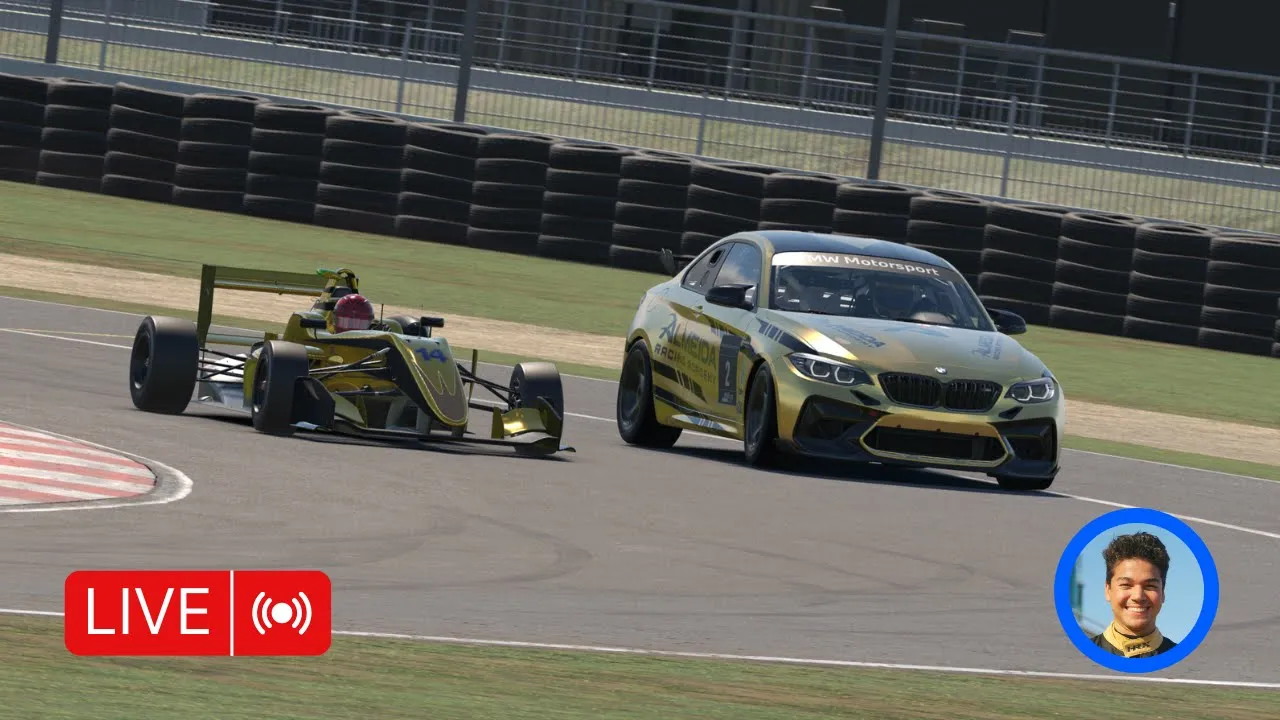
How to Drive Formula 4: Coaching Kyle from 1:27.8 to 1:26.5 at Brands Hatch
Suellio Almeida
•
Wednesday, June 25, 2025
Kyle's Problem: Fast Everywhere Except Where It Matters
Kyle came to me running 1:27.8s at Brands Hatch Indy in the Tatuus F4. Decent pace. Clean laps. But he was leaving over a second on the table.
The issue? He was braking early. Way too early. And once you're early on the brakes in a winged car, everything downstream falls apart — your entry speed suffers, your rotation is compromised, your exit is slow. You're fighting the car instead of using it.
Here's what I saw in his telemetry: conservative brake points, lifting where he should be committed, and hesitation through Druids — one of the most critical corners on this circuit.
Formula 4 isn't a street car. It's not even a GT3. The aero loads up under braking. The tires are designed to work at threshold. If you're not using that, you're not driving the car — you're passenger.
The Fix: Brake Later, Brake Harder, Trust the Platform
First thing I told Kyle: "Stop being polite with the brake pedal."
In a Formula 4 car, you need to hit the brakes hard and late. The downforce doesn't build until you're at speed. The later you brake, the more the aero helps you. The harder you brake, the more weight transfers forward, loading the front tires and giving you turn-in.
We focused on three specific zones:
Druids (Turn 1): Kyle was braking at the 100m board. Way too early. I moved his brake point to the 75m board. Sounds aggressive? It is. But the car can handle it. What I want you to do is trust the initial bite, commit to the entry, and let the car rotate naturally under braking.
Graham Hill Bend (Turn 3): He was lifting mid-corner. That kills your minimum speed and destroys your exit onto the straight. I had him stay flat longer, then brake harder and later. The key here is carrying more speed into the corner and using trail braking to rotate the car — not lifting and hoping.
Clearways (Final Corner): This is your money corner. It leads onto the longest straight. Kyle was being timid on entry, which meant he was slow everywhere that mattered. I pushed him to brake deeper, get the car rotated early, and maximize exit speed. You can see it in the telemetry — he gained half a second just from commitment here.
Here's the thing about Formula 4 cars: they're designed to be driven at the limit. If you're not occasionally locking a tire or feeling the rear step out under trail braking, you're not pushing hard enough. The car will tell you when you've gone too far. Until then, keep pushing.
The Technique: Trail Braking and Maximum Rotation Point
This isn't just "brake later." That's half the equation.
The real skill is trail braking — carrying brake pressure past turn-in to keep weight on the front tires and help the car rotate. In a Formula 4 car, you're not just slowing down. You're using the brakes as a steering tool.
Here's how I coached Kyle through it:
1. Initial brake application: Hard and late. You want maximum deceleration while the aero is still working.
2. Turn-in: Start releasing brake pressure as you turn in, but don't come off completely. Keep enough pressure to maintain front grip.
3. Maximum Rotation Point: This is the moment where the car is most responsive to steering input. You should be at or near minimum speed here, with just a touch of brake still applied.
4. Release and accelerate: As the car settles and you unwind steering, come off the brakes completely and get back to throttle. Hard.
Kyle's mistake was releasing the brakes too early. That meant he was asking the car to rotate without enough front grip. The result? Understeer, scrubbing speed, slow exits.
Once he learned to hold brake pressure deeper into the corner, everything clicked. The car started doing what it was designed to do — rotate on command, hold the line, and drive out clean.
The Result: 1:26.5 and a Completely Different Driver
After three sessions of focused work on brake points and trail braking technique, Kyle dropped from a 1:27.8 to a 1:26.5.
That's 1.3 seconds. In a Formula 4 car at Brands Hatch Indy, that's the difference between midpack and podium pace.
But more importantly, Kyle now understands how to drive a winged car. He's not guessing anymore. He knows where to brake, how hard to brake, and how to use that brake pressure to control the car's behavior through the corner.
That's the difference between hoping for a fast lap and building fast laps consistently.
What Would Change If You Trained Like This?
How long have you been running the same lap times? Three weeks? Three months?
You know the track. You know the car. But you're still not finding that next second. You watch aliens on YouTube and think, "They're just faster." But they're not. They're doing specific things you're not doing — and no one's showing you what those things are.
Here's the truth: you can't coach yourself out of a plateau. You need someone who can look at your data, see what you're missing, and give you the exact fix. Not general advice. Not "try braking later." The specific brake point, the specific technique, the specific adjustment that unlocks your pace.
That's what Kyle got. That's what every driver I coach gets. And that's what you're leaving on the table by trying to figure this out alone.
If you're serious about breaking through — if you want to know exactly what's costing you time and how to fix it — let's work together. One session. Your data, your car, your track. I'll show you what you're missing.
Sim Racing Academy Membership
Everything you need to stop guessing and start getting faster.
Starting at
$25
/mo
Car Handling Online Course
4 levels, full curriculum. Aimed to get you to top 1% in driving pace.
Racecraft Online Course
Overtaking, Defending, Race Strategy
Live coaching + on-track practice
Bi-weekly pro-coach workshops (recorded — never miss one) plus on-track Pit Parties to practice racecraft with a coach.
Plus These Bonuses
13,000+ Member Community
League Racing
Advanced MX-5 Mini Course
Racing Technique Development Guide
The Motor Racing Book (260 pages)
Think & Behave Like a Pro Driver — Mini eBook
How to Drive Formula 4: Coaching Kyle from 1:27.8 to 1:26.5 at Brands Hatch
Suellio Almeida
•
Wednesday, June 25, 2025
Kyle's Problem: Fast Everywhere Except Where It Matters
Kyle came to me running 1:27.8s at Brands Hatch Indy in the Tatuus F4. Decent pace. Clean laps. But he was leaving over a second on the table.
The issue? He was braking early. Way too early. And once you're early on the brakes in a winged car, everything downstream falls apart — your entry speed suffers, your rotation is compromised, your exit is slow. You're fighting the car instead of using it.
Here's what I saw in his telemetry: conservative brake points, lifting where he should be committed, and hesitation through Druids — one of the most critical corners on this circuit.
Formula 4 isn't a street car. It's not even a GT3. The aero loads up under braking. The tires are designed to work at threshold. If you're not using that, you're not driving the car — you're passenger.
The Fix: Brake Later, Brake Harder, Trust the Platform
First thing I told Kyle: "Stop being polite with the brake pedal."
In a Formula 4 car, you need to hit the brakes hard and late. The downforce doesn't build until you're at speed. The later you brake, the more the aero helps you. The harder you brake, the more weight transfers forward, loading the front tires and giving you turn-in.
We focused on three specific zones:
Druids (Turn 1): Kyle was braking at the 100m board. Way too early. I moved his brake point to the 75m board. Sounds aggressive? It is. But the car can handle it. What I want you to do is trust the initial bite, commit to the entry, and let the car rotate naturally under braking.
Graham Hill Bend (Turn 3): He was lifting mid-corner. That kills your minimum speed and destroys your exit onto the straight. I had him stay flat longer, then brake harder and later. The key here is carrying more speed into the corner and using trail braking to rotate the car — not lifting and hoping.
Clearways (Final Corner): This is your money corner. It leads onto the longest straight. Kyle was being timid on entry, which meant he was slow everywhere that mattered. I pushed him to brake deeper, get the car rotated early, and maximize exit speed. You can see it in the telemetry — he gained half a second just from commitment here.
Here's the thing about Formula 4 cars: they're designed to be driven at the limit. If you're not occasionally locking a tire or feeling the rear step out under trail braking, you're not pushing hard enough. The car will tell you when you've gone too far. Until then, keep pushing.
The Technique: Trail Braking and Maximum Rotation Point
This isn't just "brake later." That's half the equation.
The real skill is trail braking — carrying brake pressure past turn-in to keep weight on the front tires and help the car rotate. In a Formula 4 car, you're not just slowing down. You're using the brakes as a steering tool.
Here's how I coached Kyle through it:
1. Initial brake application: Hard and late. You want maximum deceleration while the aero is still working.
2. Turn-in: Start releasing brake pressure as you turn in, but don't come off completely. Keep enough pressure to maintain front grip.
3. Maximum Rotation Point: This is the moment where the car is most responsive to steering input. You should be at or near minimum speed here, with just a touch of brake still applied.
4. Release and accelerate: As the car settles and you unwind steering, come off the brakes completely and get back to throttle. Hard.
Kyle's mistake was releasing the brakes too early. That meant he was asking the car to rotate without enough front grip. The result? Understeer, scrubbing speed, slow exits.
Once he learned to hold brake pressure deeper into the corner, everything clicked. The car started doing what it was designed to do — rotate on command, hold the line, and drive out clean.
The Result: 1:26.5 and a Completely Different Driver
After three sessions of focused work on brake points and trail braking technique, Kyle dropped from a 1:27.8 to a 1:26.5.
That's 1.3 seconds. In a Formula 4 car at Brands Hatch Indy, that's the difference between midpack and podium pace.
But more importantly, Kyle now understands how to drive a winged car. He's not guessing anymore. He knows where to brake, how hard to brake, and how to use that brake pressure to control the car's behavior through the corner.
That's the difference between hoping for a fast lap and building fast laps consistently.
What Would Change If You Trained Like This?
How long have you been running the same lap times? Three weeks? Three months?
You know the track. You know the car. But you're still not finding that next second. You watch aliens on YouTube and think, "They're just faster." But they're not. They're doing specific things you're not doing — and no one's showing you what those things are.
Here's the truth: you can't coach yourself out of a plateau. You need someone who can look at your data, see what you're missing, and give you the exact fix. Not general advice. Not "try braking later." The specific brake point, the specific technique, the specific adjustment that unlocks your pace.
That's what Kyle got. That's what every driver I coach gets. And that's what you're leaving on the table by trying to figure this out alone.
If you're serious about breaking through — if you want to know exactly what's costing you time and how to fix it — let's work together. One session. Your data, your car, your track. I'll show you what you're missing.
Sim Racing Academy Membership
Everything you need to stop guessing and start getting faster.
Starting at
$25
/mo
Car Handling Online Course
4 levels, full curriculum. Aimed to get you to top 1% in driving pace.
Racecraft Online Course
Overtaking, Defending, Race Strategy
Live coaching + on-track practice
Bi-weekly pro-coach workshops (recorded — never miss one) plus on-track Pit Parties to practice racecraft with a coach.
Plus These Bonuses
13,000+ Member Community
League Racing
Advanced MX-5 Mini Course
Racing Technique Development Guide
The Motor Racing Book (260 pages)
Think & Behave Like a Pro Driver — Mini eBook
How to Drive Formula 4: Coaching Kyle from 1:27.8 to 1:26.5 at Brands Hatch
Suellio Almeida
•
Wednesday, June 25, 2025
Kyle's Problem: Fast Everywhere Except Where It Matters
Kyle came to me running 1:27.8s at Brands Hatch Indy in the Tatuus F4. Decent pace. Clean laps. But he was leaving over a second on the table.
The issue? He was braking early. Way too early. And once you're early on the brakes in a winged car, everything downstream falls apart — your entry speed suffers, your rotation is compromised, your exit is slow. You're fighting the car instead of using it.
Here's what I saw in his telemetry: conservative brake points, lifting where he should be committed, and hesitation through Druids — one of the most critical corners on this circuit.
Formula 4 isn't a street car. It's not even a GT3. The aero loads up under braking. The tires are designed to work at threshold. If you're not using that, you're not driving the car — you're passenger.
The Fix: Brake Later, Brake Harder, Trust the Platform
First thing I told Kyle: "Stop being polite with the brake pedal."
In a Formula 4 car, you need to hit the brakes hard and late. The downforce doesn't build until you're at speed. The later you brake, the more the aero helps you. The harder you brake, the more weight transfers forward, loading the front tires and giving you turn-in.
We focused on three specific zones:
Druids (Turn 1): Kyle was braking at the 100m board. Way too early. I moved his brake point to the 75m board. Sounds aggressive? It is. But the car can handle it. What I want you to do is trust the initial bite, commit to the entry, and let the car rotate naturally under braking.
Graham Hill Bend (Turn 3): He was lifting mid-corner. That kills your minimum speed and destroys your exit onto the straight. I had him stay flat longer, then brake harder and later. The key here is carrying more speed into the corner and using trail braking to rotate the car — not lifting and hoping.
Clearways (Final Corner): This is your money corner. It leads onto the longest straight. Kyle was being timid on entry, which meant he was slow everywhere that mattered. I pushed him to brake deeper, get the car rotated early, and maximize exit speed. You can see it in the telemetry — he gained half a second just from commitment here.
Here's the thing about Formula 4 cars: they're designed to be driven at the limit. If you're not occasionally locking a tire or feeling the rear step out under trail braking, you're not pushing hard enough. The car will tell you when you've gone too far. Until then, keep pushing.
The Technique: Trail Braking and Maximum Rotation Point
This isn't just "brake later." That's half the equation.
The real skill is trail braking — carrying brake pressure past turn-in to keep weight on the front tires and help the car rotate. In a Formula 4 car, you're not just slowing down. You're using the brakes as a steering tool.
Here's how I coached Kyle through it:
1. Initial brake application: Hard and late. You want maximum deceleration while the aero is still working.
2. Turn-in: Start releasing brake pressure as you turn in, but don't come off completely. Keep enough pressure to maintain front grip.
3. Maximum Rotation Point: This is the moment where the car is most responsive to steering input. You should be at or near minimum speed here, with just a touch of brake still applied.
4. Release and accelerate: As the car settles and you unwind steering, come off the brakes completely and get back to throttle. Hard.
Kyle's mistake was releasing the brakes too early. That meant he was asking the car to rotate without enough front grip. The result? Understeer, scrubbing speed, slow exits.
Once he learned to hold brake pressure deeper into the corner, everything clicked. The car started doing what it was designed to do — rotate on command, hold the line, and drive out clean.
The Result: 1:26.5 and a Completely Different Driver
After three sessions of focused work on brake points and trail braking technique, Kyle dropped from a 1:27.8 to a 1:26.5.
That's 1.3 seconds. In a Formula 4 car at Brands Hatch Indy, that's the difference between midpack and podium pace.
But more importantly, Kyle now understands how to drive a winged car. He's not guessing anymore. He knows where to brake, how hard to brake, and how to use that brake pressure to control the car's behavior through the corner.
That's the difference between hoping for a fast lap and building fast laps consistently.
What Would Change If You Trained Like This?
How long have you been running the same lap times? Three weeks? Three months?
You know the track. You know the car. But you're still not finding that next second. You watch aliens on YouTube and think, "They're just faster." But they're not. They're doing specific things you're not doing — and no one's showing you what those things are.
Here's the truth: you can't coach yourself out of a plateau. You need someone who can look at your data, see what you're missing, and give you the exact fix. Not general advice. Not "try braking later." The specific brake point, the specific technique, the specific adjustment that unlocks your pace.
That's what Kyle got. That's what every driver I coach gets. And that's what you're leaving on the table by trying to figure this out alone.
If you're serious about breaking through — if you want to know exactly what's costing you time and how to fix it — let's work together. One session. Your data, your car, your track. I'll show you what you're missing.
Sim Racing Academy Membership
Everything you need to stop guessing and start getting faster.
Starting at
$25
/mo
Car Handling Online Course
4 levels, full curriculum. Aimed to get you to top 1% in driving pace.
Racecraft Online Course
Overtaking, Defending, Race Strategy
Live coaching + on-track practice
Bi-weekly pro-coach workshops (recorded — never miss one) plus on-track Pit Parties to practice racecraft with a coach.
Plus These Bonuses
13,000+ Member Community
League Racing
Advanced MX-5 Mini Course
Racing Technique Development Guide
The Motor Racing Book (260 pages)
Think & Behave Like a Pro Driver — Mini eBook