
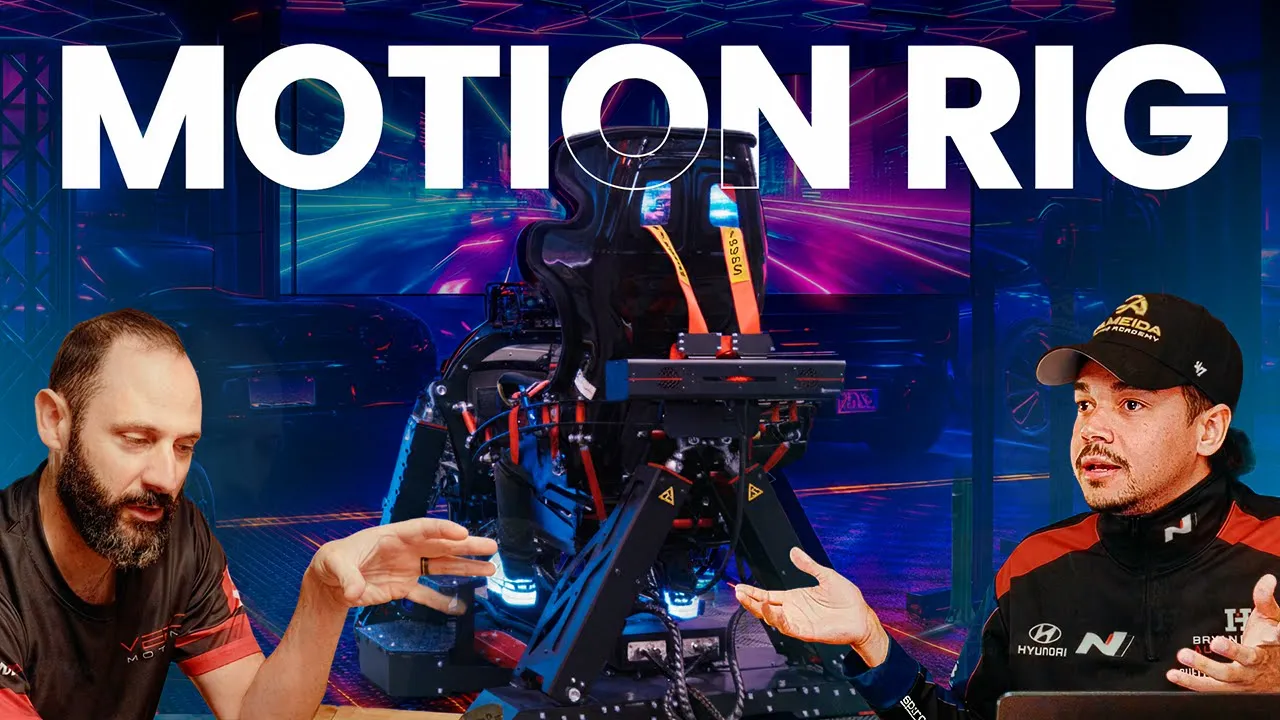
Does Motion Make You Faster in Racing? A Real Driver's Take on Motion Rigs
Suellio Almeida
•
Wednesday, October 29, 2025
The Motion Rig Question Everyone Gets Wrong
Let me start with something that's going to upset some people: motion does not inherently make you faster.
I know. You've seen the YouTube videos. The Instagram reels. Professional drivers praising their motion rigs. Companies claiming their platform will "unlock your full potential."
But here's what they're not telling you.
Motion is immersion. Motion is experience. Motion is incredible for enjoyment and for understanding what a real car feels like. What motion is NOT is a magic bullet for lap times.
And I can say this with confidence because I've driven on everything — from basic wheel-and-pedal setups to full six-axis motion rigs worth more than most people's cars. I've also raced real Radicals, real TCR cars, real prototypes.
The question isn't whether motion feels good. It does. The question is: does it make you faster?
What Motion Actually Does (and Doesn't Do)
Let's break down the physics of what's happening.
In a real car, your body receives vestibular input — your inner ear feels acceleration, braking, cornering forces. Your body instinctively knows when the car is at the limit because you physically feel it.
A motion rig tries to replicate this. The problem? It can't.
Even the most advanced motion platforms can't produce the G-forces of real racing. They use motion cues — tilting, surging, heaving — to trick your brain into feeling something similar. And honestly, the high-end ones do it really well.
But here's the critical part: the information you need to be fast is already in the simulator without motion.
The force feedback in your wheel. The tire sounds. The visual cues of weight transfer. The way the car responds to your inputs. All of that data is there. Motion just presents it differently.
So when does motion help?
When Motion Actually Makes a Difference
Realism and transferability.
If you're using sim racing to prepare for real-world driving — and I mean actually preparing, not just dreaming about it — motion helps with the transition.
Why? Because in a real car, you're not relying solely on visual or steering wheel feedback. Your body is part of the input system. If you've only ever driven on a static rig, the first time you feel real G-forces can be overwhelming. Your brain has to process new information while also trying to drive fast.
Motion helps bridge that gap. Not perfectly, but noticeably.
I've coached drivers who went from static rigs to motion and then into real cars. The ones with motion experience adapted faster. They weren't shocked by the physical sensations. They could focus on racecraft instead of just surviving the experience.
But — and this is huge — they weren't faster in the sim because of motion.
Their lap times on a static rig versus a motion rig? Nearly identical once they adjusted to each platform.
Why Some Drivers Swear Motion Makes Them Faster
Here's what actually happens when someone gets a motion rig and suddenly "gets faster."
They get more engaged.
Motion is visceral. It's exciting. When you're fully immersed, you concentrate harder. You drive with more intention. You feel connected to the car in a way that makes you want to improve.
That mental engagement? That's what makes you faster. Not the motion itself.
I've seen the same thing happen with VR. Drivers upgrade to VR and their lap times improve. Is it because VR has some secret advantage? No. It's because they're more immersed, more focused, more present in the moment.
If you're half-checked-out on a static rig, staring at a monitor while your mind wanders, yeah — motion might wake you up. But that's not motion making you faster. That's you finally paying attention.
The Real Cost-Benefit Analysis
Let's talk money.
A decent entry-level motion platform — something like a Next Level Racing V3 — starts around $1,500-$2,000. Mid-tier rigs like the DOF Reality platforms run $3,000-$5,000. High-end six-axis systems? We're talking $10,000 to $30,000+.
For that money, you could:
Upgrade to direct drive wheelbase with pro-level pedals
Build a full triple-screen or VR setup with high refresh rates
Get a year of professional coaching with real data analysis
Enter multiple real-world track days or club races
So ask yourself: what will give you the biggest skill improvement for your investment?
If you're already fast, already consistent, already maximizing your potential on a static rig, and you want motion for immersion and crossover to real racing — go for it. It's an incredible experience.
But if you're still struggling with trail braking, racecraft, consistency, or understanding weight transfer? Motion is not the answer.
Your money is better spent on coaching, better pedals with a loadcell, or actual practice time with structured training.
Who Should Actually Buy a Motion Rig
Let me be clear about who benefits most from motion:
1. Drivers transitioning to real motorsports. If you're serious about going from sim to real racing, motion helps your body adapt to physical sensations. It's not required, but it smooths the transition.
2. Drivers who can already extract maximum performance from a static rig. If you're top-split iRacing, competitive in leagues, consistently fast — motion adds immersion without sacrificing anything. You've already optimized the inputs that matter.
3. Drivers who want the ultimate experience and can afford it. If money isn't the limiting factor and you want sim racing to feel as close to real as possible, motion is worth it. Just don't expect it to make you faster magically.
Who shouldn't buy motion yet?
Anyone still learning fundamentals. Anyone blaming their rig for their lap times. Anyone who hasn't maximized their current setup's potential.
Fix your technique first. Upgrade your hardware second.
The Brutal Truth About Sim Racing Performance
Here's what no one wants to hear:
The top sim racers in the world — the guys running 9,000+ iRating, winning championships, getting signed to esports teams — most of them are on static rigs.
Why? Because speed comes from understanding vehicle dynamics, racecraft, consistency, and mental performance. Not from hardware.
You know what actually makes you faster?
Learning proper trail braking technique
Understanding weight transfer and rotation points
Building consistency through structured practice
Analyzing your data to find where you're losing time
Developing racecraft and spatial awareness
Training your vision and reaction systems
Motion doesn't teach you any of that. Motion just makes the experience more immersive while you do the actual work.
The Question You Should Be Asking Instead
Forget motion for a second.
Ask yourself: What's actually holding me back right now?
Is it your rig? Or is it your racecraft? Your consistency? Your ability to read the car under trail braking? Your mental game when things get close?
Because I can tell you from coaching thousands of drivers — the limitation is almost never the hardware.
I've seen drivers on Logitech G29 wheels outpace drivers on $10,000 setups. I've coached F1 engineers who struggled with basics. I've watched complete beginners transform their driving in weeks with the right training.
The common thread? They focused on skill development, not gear.
Motion rigs are incredible technology. They're genuinely impressive. They make sim racing more immersive and help bridge the gap to real-world driving.
But they don't replace proper training. They don't replace understanding. They don't replace deliberate practice.
So What Actually Makes You Faster?
You already know the answer.
Skill does. Knowledge does. Practice with purpose does.
If you took the money you'd spend on a motion rig and instead invested it in structured coaching, courses that teach actual technique, and focused practice sessions — you'd see bigger gains in a month than motion would give you in a year.
That's not an opinion. That's what I've watched happen with thousands of drivers at Almeida Racing Academy.
Drivers who were stuck at 2,000 iRating breaking into 4,000+. Drivers who couldn't keep the car on track suddenly running consistent top-10 finishes. Drivers making the jump from sim to real motorsports because they built the foundation that matters.
Not because they had the fanciest rig. Because they had the skills.
What's Actually Holding You Back Right Now?
Be honest with yourself.
If you got a motion rig tomorrow, would it fix your trail braking? Would it teach you how to read weight transfer? Would it make you consistent under pressure?
Or would you just be making the same mistakes — but feeling them more vividly?
Because here's the thing: you don't need motion to get faster. You need structure.
You need someone to show you what you're doing wrong and exactly how to fix it. You need courses built by actual racing drivers who've made the jump from sim to real. You need a training system that turns random practice into measurable improvement.
That's what we built Almeida Racing Academy for.
We've coached over 36,000 students. Drivers who've gone from beginner to competitive. Drivers who've made the jump to real racing. Drivers who finally broke through plateaus they'd been stuck at for years.
And not one of them needed a motion rig to do it.
Want to know what they did need? A system that works.
You can start today — completely free. Sign up for a free account and get immediate access to our Car Handling Fundamentals course. Eleven lessons that cover weight transfer, trail braking, rotation points, and the physics that actually make you fast.
No credit card. No upsell pressure. Just real coaching from someone who's raced at the professional level and coached thousands of drivers to breakthrough results.
Stop waiting for the perfect rig. Start building the skills that actually matter.
and see what structured training can do for your driving — no motion rig required.
Sim Racing Academy Membership
Everything you need to stop guessing and start getting faster.
Starting at
$25
/mo
Car Handling Online Course
4 levels, full curriculum. Aimed to get you to top 1% in driving pace.
Racecraft Online Course
Overtaking, Defending, Race Strategy
Live coaching + on-track practice
Bi-weekly pro-coach workshops (recorded — never miss one) plus on-track Pit Parties to practice racecraft with a coach.
Plus These Bonuses
13,000+ Member Community
League Racing
Advanced MX-5 Mini Course
Racing Technique Development Guide
The Motor Racing Book (260 pages)
Think & Behave Like a Pro Driver — Mini eBook
Does Motion Make You Faster in Racing? A Real Driver's Take on Motion Rigs
Suellio Almeida
•
Wednesday, October 29, 2025
The Motion Rig Question Everyone Gets Wrong
Let me start with something that's going to upset some people: motion does not inherently make you faster.
I know. You've seen the YouTube videos. The Instagram reels. Professional drivers praising their motion rigs. Companies claiming their platform will "unlock your full potential."
But here's what they're not telling you.
Motion is immersion. Motion is experience. Motion is incredible for enjoyment and for understanding what a real car feels like. What motion is NOT is a magic bullet for lap times.
And I can say this with confidence because I've driven on everything — from basic wheel-and-pedal setups to full six-axis motion rigs worth more than most people's cars. I've also raced real Radicals, real TCR cars, real prototypes.
The question isn't whether motion feels good. It does. The question is: does it make you faster?
What Motion Actually Does (and Doesn't Do)
Let's break down the physics of what's happening.
In a real car, your body receives vestibular input — your inner ear feels acceleration, braking, cornering forces. Your body instinctively knows when the car is at the limit because you physically feel it.
A motion rig tries to replicate this. The problem? It can't.
Even the most advanced motion platforms can't produce the G-forces of real racing. They use motion cues — tilting, surging, heaving — to trick your brain into feeling something similar. And honestly, the high-end ones do it really well.
But here's the critical part: the information you need to be fast is already in the simulator without motion.
The force feedback in your wheel. The tire sounds. The visual cues of weight transfer. The way the car responds to your inputs. All of that data is there. Motion just presents it differently.
So when does motion help?
When Motion Actually Makes a Difference
Realism and transferability.
If you're using sim racing to prepare for real-world driving — and I mean actually preparing, not just dreaming about it — motion helps with the transition.
Why? Because in a real car, you're not relying solely on visual or steering wheel feedback. Your body is part of the input system. If you've only ever driven on a static rig, the first time you feel real G-forces can be overwhelming. Your brain has to process new information while also trying to drive fast.
Motion helps bridge that gap. Not perfectly, but noticeably.
I've coached drivers who went from static rigs to motion and then into real cars. The ones with motion experience adapted faster. They weren't shocked by the physical sensations. They could focus on racecraft instead of just surviving the experience.
But — and this is huge — they weren't faster in the sim because of motion.
Their lap times on a static rig versus a motion rig? Nearly identical once they adjusted to each platform.
Why Some Drivers Swear Motion Makes Them Faster
Here's what actually happens when someone gets a motion rig and suddenly "gets faster."
They get more engaged.
Motion is visceral. It's exciting. When you're fully immersed, you concentrate harder. You drive with more intention. You feel connected to the car in a way that makes you want to improve.
That mental engagement? That's what makes you faster. Not the motion itself.
I've seen the same thing happen with VR. Drivers upgrade to VR and their lap times improve. Is it because VR has some secret advantage? No. It's because they're more immersed, more focused, more present in the moment.
If you're half-checked-out on a static rig, staring at a monitor while your mind wanders, yeah — motion might wake you up. But that's not motion making you faster. That's you finally paying attention.
The Real Cost-Benefit Analysis
Let's talk money.
A decent entry-level motion platform — something like a Next Level Racing V3 — starts around $1,500-$2,000. Mid-tier rigs like the DOF Reality platforms run $3,000-$5,000. High-end six-axis systems? We're talking $10,000 to $30,000+.
For that money, you could:
Upgrade to direct drive wheelbase with pro-level pedals
Build a full triple-screen or VR setup with high refresh rates
Get a year of professional coaching with real data analysis
Enter multiple real-world track days or club races
So ask yourself: what will give you the biggest skill improvement for your investment?
If you're already fast, already consistent, already maximizing your potential on a static rig, and you want motion for immersion and crossover to real racing — go for it. It's an incredible experience.
But if you're still struggling with trail braking, racecraft, consistency, or understanding weight transfer? Motion is not the answer.
Your money is better spent on coaching, better pedals with a loadcell, or actual practice time with structured training.
Who Should Actually Buy a Motion Rig
Let me be clear about who benefits most from motion:
1. Drivers transitioning to real motorsports. If you're serious about going from sim to real racing, motion helps your body adapt to physical sensations. It's not required, but it smooths the transition.
2. Drivers who can already extract maximum performance from a static rig. If you're top-split iRacing, competitive in leagues, consistently fast — motion adds immersion without sacrificing anything. You've already optimized the inputs that matter.
3. Drivers who want the ultimate experience and can afford it. If money isn't the limiting factor and you want sim racing to feel as close to real as possible, motion is worth it. Just don't expect it to make you faster magically.
Who shouldn't buy motion yet?
Anyone still learning fundamentals. Anyone blaming their rig for their lap times. Anyone who hasn't maximized their current setup's potential.
Fix your technique first. Upgrade your hardware second.
The Brutal Truth About Sim Racing Performance
Here's what no one wants to hear:
The top sim racers in the world — the guys running 9,000+ iRating, winning championships, getting signed to esports teams — most of them are on static rigs.
Why? Because speed comes from understanding vehicle dynamics, racecraft, consistency, and mental performance. Not from hardware.
You know what actually makes you faster?
Learning proper trail braking technique
Understanding weight transfer and rotation points
Building consistency through structured practice
Analyzing your data to find where you're losing time
Developing racecraft and spatial awareness
Training your vision and reaction systems
Motion doesn't teach you any of that. Motion just makes the experience more immersive while you do the actual work.
The Question You Should Be Asking Instead
Forget motion for a second.
Ask yourself: What's actually holding me back right now?
Is it your rig? Or is it your racecraft? Your consistency? Your ability to read the car under trail braking? Your mental game when things get close?
Because I can tell you from coaching thousands of drivers — the limitation is almost never the hardware.
I've seen drivers on Logitech G29 wheels outpace drivers on $10,000 setups. I've coached F1 engineers who struggled with basics. I've watched complete beginners transform their driving in weeks with the right training.
The common thread? They focused on skill development, not gear.
Motion rigs are incredible technology. They're genuinely impressive. They make sim racing more immersive and help bridge the gap to real-world driving.
But they don't replace proper training. They don't replace understanding. They don't replace deliberate practice.
So What Actually Makes You Faster?
You already know the answer.
Skill does. Knowledge does. Practice with purpose does.
If you took the money you'd spend on a motion rig and instead invested it in structured coaching, courses that teach actual technique, and focused practice sessions — you'd see bigger gains in a month than motion would give you in a year.
That's not an opinion. That's what I've watched happen with thousands of drivers at Almeida Racing Academy.
Drivers who were stuck at 2,000 iRating breaking into 4,000+. Drivers who couldn't keep the car on track suddenly running consistent top-10 finishes. Drivers making the jump from sim to real motorsports because they built the foundation that matters.
Not because they had the fanciest rig. Because they had the skills.
What's Actually Holding You Back Right Now?
Be honest with yourself.
If you got a motion rig tomorrow, would it fix your trail braking? Would it teach you how to read weight transfer? Would it make you consistent under pressure?
Or would you just be making the same mistakes — but feeling them more vividly?
Because here's the thing: you don't need motion to get faster. You need structure.
You need someone to show you what you're doing wrong and exactly how to fix it. You need courses built by actual racing drivers who've made the jump from sim to real. You need a training system that turns random practice into measurable improvement.
That's what we built Almeida Racing Academy for.
We've coached over 36,000 students. Drivers who've gone from beginner to competitive. Drivers who've made the jump to real racing. Drivers who finally broke through plateaus they'd been stuck at for years.
And not one of them needed a motion rig to do it.
Want to know what they did need? A system that works.
You can start today — completely free. Sign up for a free account and get immediate access to our Car Handling Fundamentals course. Eleven lessons that cover weight transfer, trail braking, rotation points, and the physics that actually make you fast.
No credit card. No upsell pressure. Just real coaching from someone who's raced at the professional level and coached thousands of drivers to breakthrough results.
Stop waiting for the perfect rig. Start building the skills that actually matter.
and see what structured training can do for your driving — no motion rig required.
Sim Racing Academy Membership
Everything you need to stop guessing and start getting faster.
Starting at
$25
/mo
Car Handling Online Course
4 levels, full curriculum. Aimed to get you to top 1% in driving pace.
Racecraft Online Course
Overtaking, Defending, Race Strategy
Live coaching + on-track practice
Bi-weekly pro-coach workshops (recorded — never miss one) plus on-track Pit Parties to practice racecraft with a coach.
Plus These Bonuses
13,000+ Member Community
League Racing
Advanced MX-5 Mini Course
Racing Technique Development Guide
The Motor Racing Book (260 pages)
Think & Behave Like a Pro Driver — Mini eBook
Does Motion Make You Faster in Racing? A Real Driver's Take on Motion Rigs
Suellio Almeida
•
Wednesday, October 29, 2025
The Motion Rig Question Everyone Gets Wrong
Let me start with something that's going to upset some people: motion does not inherently make you faster.
I know. You've seen the YouTube videos. The Instagram reels. Professional drivers praising their motion rigs. Companies claiming their platform will "unlock your full potential."
But here's what they're not telling you.
Motion is immersion. Motion is experience. Motion is incredible for enjoyment and for understanding what a real car feels like. What motion is NOT is a magic bullet for lap times.
And I can say this with confidence because I've driven on everything — from basic wheel-and-pedal setups to full six-axis motion rigs worth more than most people's cars. I've also raced real Radicals, real TCR cars, real prototypes.
The question isn't whether motion feels good. It does. The question is: does it make you faster?
What Motion Actually Does (and Doesn't Do)
Let's break down the physics of what's happening.
In a real car, your body receives vestibular input — your inner ear feels acceleration, braking, cornering forces. Your body instinctively knows when the car is at the limit because you physically feel it.
A motion rig tries to replicate this. The problem? It can't.
Even the most advanced motion platforms can't produce the G-forces of real racing. They use motion cues — tilting, surging, heaving — to trick your brain into feeling something similar. And honestly, the high-end ones do it really well.
But here's the critical part: the information you need to be fast is already in the simulator without motion.
The force feedback in your wheel. The tire sounds. The visual cues of weight transfer. The way the car responds to your inputs. All of that data is there. Motion just presents it differently.
So when does motion help?
When Motion Actually Makes a Difference
Realism and transferability.
If you're using sim racing to prepare for real-world driving — and I mean actually preparing, not just dreaming about it — motion helps with the transition.
Why? Because in a real car, you're not relying solely on visual or steering wheel feedback. Your body is part of the input system. If you've only ever driven on a static rig, the first time you feel real G-forces can be overwhelming. Your brain has to process new information while also trying to drive fast.
Motion helps bridge that gap. Not perfectly, but noticeably.
I've coached drivers who went from static rigs to motion and then into real cars. The ones with motion experience adapted faster. They weren't shocked by the physical sensations. They could focus on racecraft instead of just surviving the experience.
But — and this is huge — they weren't faster in the sim because of motion.
Their lap times on a static rig versus a motion rig? Nearly identical once they adjusted to each platform.
Why Some Drivers Swear Motion Makes Them Faster
Here's what actually happens when someone gets a motion rig and suddenly "gets faster."
They get more engaged.
Motion is visceral. It's exciting. When you're fully immersed, you concentrate harder. You drive with more intention. You feel connected to the car in a way that makes you want to improve.
That mental engagement? That's what makes you faster. Not the motion itself.
I've seen the same thing happen with VR. Drivers upgrade to VR and their lap times improve. Is it because VR has some secret advantage? No. It's because they're more immersed, more focused, more present in the moment.
If you're half-checked-out on a static rig, staring at a monitor while your mind wanders, yeah — motion might wake you up. But that's not motion making you faster. That's you finally paying attention.
The Real Cost-Benefit Analysis
Let's talk money.
A decent entry-level motion platform — something like a Next Level Racing V3 — starts around $1,500-$2,000. Mid-tier rigs like the DOF Reality platforms run $3,000-$5,000. High-end six-axis systems? We're talking $10,000 to $30,000+.
For that money, you could:
Upgrade to direct drive wheelbase with pro-level pedals
Build a full triple-screen or VR setup with high refresh rates
Get a year of professional coaching with real data analysis
Enter multiple real-world track days or club races
So ask yourself: what will give you the biggest skill improvement for your investment?
If you're already fast, already consistent, already maximizing your potential on a static rig, and you want motion for immersion and crossover to real racing — go for it. It's an incredible experience.
But if you're still struggling with trail braking, racecraft, consistency, or understanding weight transfer? Motion is not the answer.
Your money is better spent on coaching, better pedals with a loadcell, or actual practice time with structured training.
Who Should Actually Buy a Motion Rig
Let me be clear about who benefits most from motion:
1. Drivers transitioning to real motorsports. If you're serious about going from sim to real racing, motion helps your body adapt to physical sensations. It's not required, but it smooths the transition.
2. Drivers who can already extract maximum performance from a static rig. If you're top-split iRacing, competitive in leagues, consistently fast — motion adds immersion without sacrificing anything. You've already optimized the inputs that matter.
3. Drivers who want the ultimate experience and can afford it. If money isn't the limiting factor and you want sim racing to feel as close to real as possible, motion is worth it. Just don't expect it to make you faster magically.
Who shouldn't buy motion yet?
Anyone still learning fundamentals. Anyone blaming their rig for their lap times. Anyone who hasn't maximized their current setup's potential.
Fix your technique first. Upgrade your hardware second.
The Brutal Truth About Sim Racing Performance
Here's what no one wants to hear:
The top sim racers in the world — the guys running 9,000+ iRating, winning championships, getting signed to esports teams — most of them are on static rigs.
Why? Because speed comes from understanding vehicle dynamics, racecraft, consistency, and mental performance. Not from hardware.
You know what actually makes you faster?
Learning proper trail braking technique
Understanding weight transfer and rotation points
Building consistency through structured practice
Analyzing your data to find where you're losing time
Developing racecraft and spatial awareness
Training your vision and reaction systems
Motion doesn't teach you any of that. Motion just makes the experience more immersive while you do the actual work.
The Question You Should Be Asking Instead
Forget motion for a second.
Ask yourself: What's actually holding me back right now?
Is it your rig? Or is it your racecraft? Your consistency? Your ability to read the car under trail braking? Your mental game when things get close?
Because I can tell you from coaching thousands of drivers — the limitation is almost never the hardware.
I've seen drivers on Logitech G29 wheels outpace drivers on $10,000 setups. I've coached F1 engineers who struggled with basics. I've watched complete beginners transform their driving in weeks with the right training.
The common thread? They focused on skill development, not gear.
Motion rigs are incredible technology. They're genuinely impressive. They make sim racing more immersive and help bridge the gap to real-world driving.
But they don't replace proper training. They don't replace understanding. They don't replace deliberate practice.
So What Actually Makes You Faster?
You already know the answer.
Skill does. Knowledge does. Practice with purpose does.
If you took the money you'd spend on a motion rig and instead invested it in structured coaching, courses that teach actual technique, and focused practice sessions — you'd see bigger gains in a month than motion would give you in a year.
That's not an opinion. That's what I've watched happen with thousands of drivers at Almeida Racing Academy.
Drivers who were stuck at 2,000 iRating breaking into 4,000+. Drivers who couldn't keep the car on track suddenly running consistent top-10 finishes. Drivers making the jump from sim to real motorsports because they built the foundation that matters.
Not because they had the fanciest rig. Because they had the skills.
What's Actually Holding You Back Right Now?
Be honest with yourself.
If you got a motion rig tomorrow, would it fix your trail braking? Would it teach you how to read weight transfer? Would it make you consistent under pressure?
Or would you just be making the same mistakes — but feeling them more vividly?
Because here's the thing: you don't need motion to get faster. You need structure.
You need someone to show you what you're doing wrong and exactly how to fix it. You need courses built by actual racing drivers who've made the jump from sim to real. You need a training system that turns random practice into measurable improvement.
That's what we built Almeida Racing Academy for.
We've coached over 36,000 students. Drivers who've gone from beginner to competitive. Drivers who've made the jump to real racing. Drivers who finally broke through plateaus they'd been stuck at for years.
And not one of them needed a motion rig to do it.
Want to know what they did need? A system that works.
You can start today — completely free. Sign up for a free account and get immediate access to our Car Handling Fundamentals course. Eleven lessons that cover weight transfer, trail braking, rotation points, and the physics that actually make you fast.
No credit card. No upsell pressure. Just real coaching from someone who's raced at the professional level and coached thousands of drivers to breakthrough results.
Stop waiting for the perfect rig. Start building the skills that actually matter.
and see what structured training can do for your driving — no motion rig required.
Sim Racing Academy Membership
Everything you need to stop guessing and start getting faster.
Starting at
$25
/mo
Car Handling Online Course
4 levels, full curriculum. Aimed to get you to top 1% in driving pace.
Racecraft Online Course
Overtaking, Defending, Race Strategy
Live coaching + on-track practice
Bi-weekly pro-coach workshops (recorded — never miss one) plus on-track Pit Parties to practice racecraft with a coach.
Plus These Bonuses
13,000+ Member Community
League Racing
Advanced MX-5 Mini Course
Racing Technique Development Guide
The Motor Racing Book (260 pages)
Think & Behave Like a Pro Driver — Mini eBook