
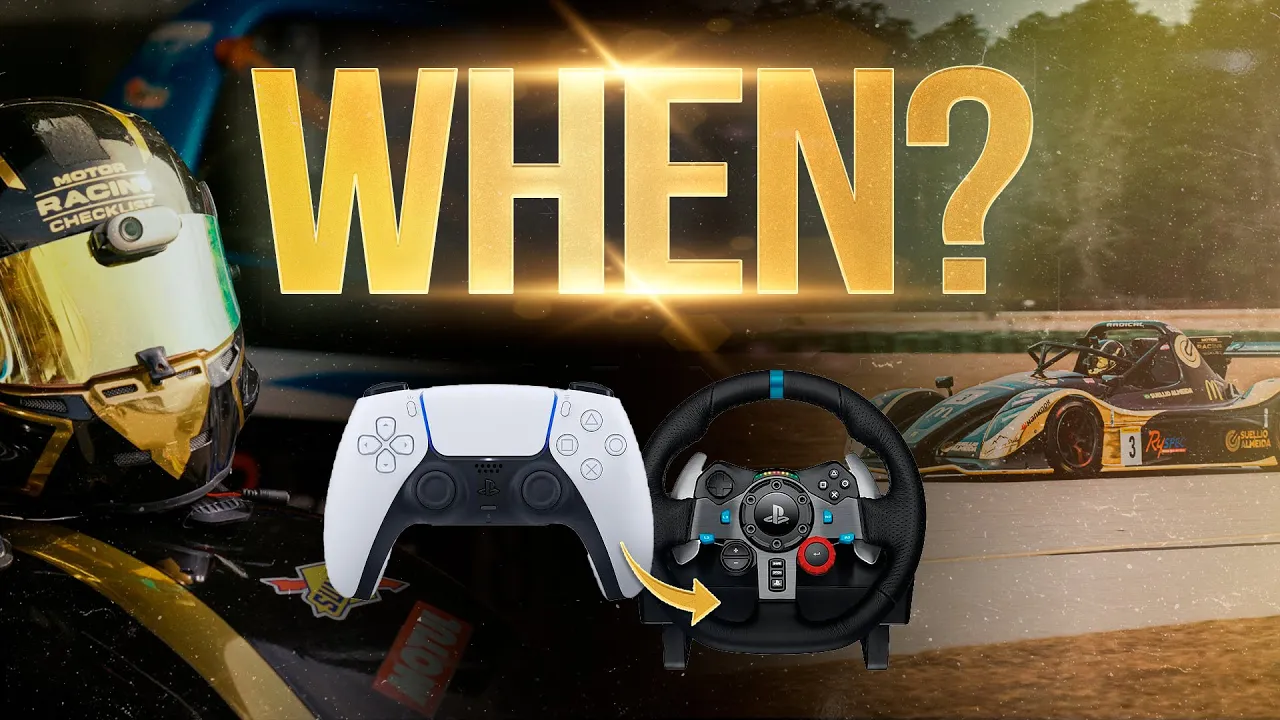
Controller to Steering Wheel — When Should You Actually Upgrade?
Suellio Almeida
•
Thursday, March 21, 2024
The Controller Question Every Sim Racer Asks
You're enjoying Gran Turismo or Forza. Getting competitive. Winning races. Then someone tells you, "You need a wheel to get serious."
Is that true?
Depends on what you're chasing.
If you're racing for fun, controller works. If you're trying to understand actual car control — weight transfer, rotation, trail braking — a wheel changes everything.
Let me explain.
What a Controller Can and Can't Teach You
Controllers are intuitive. Pick it up, you're racing in seconds. No setup, no desk clamp, no wheelbase calibration.
But here's what you're missing: feel.
With a controller, you're guessing at grip levels. You brake, turn, throttle — but you're reacting to visual cues only. The screen tells you when you've gone too far.
With a wheel, you feel the limit. The force feedback communicates weight transfer. You sense understeer building before you see it. You learn to modulate braking pressure because the pedal resists your input.
That's the gap. Controllers make you fast in the game world. Wheels teach you how cars actually work.
If you want to become a better driver — not just win races in GT7 — the wheel is mandatory.
When You're Ready for a Wheel (And When You're Not)
Don't buy a wheel because someone on Reddit said you should.
Buy a wheel when:
You're serious about improving as a driver, not just playing games.
You want to understand car physics — how braking affects rotation, how throttle controls oversteer.
You're racing sims like iRacing, Assetto Corsa Competizione, or rFactor 2 where physics accuracy matters.
You're thinking about real-world racing and want transferable skills.
Stick with the controller if:
You race casually for fun.
You're on Gran Turismo or Forza and not planning to move to serious sims.
You don't have space or budget for a proper setup.
Here's the thing: a wheel is an investment in skill development, not just better lap times. If that doesn't excite you, save your money.
The Budget Reality — What You Actually Need
Let's talk price.
You can get a Logitech G923 for around $300. Entry-level, belt-driven, loud as hell. But it works.
You get:
Functional force feedback
Loadcell brake pedal option (important for consistency)
Compatibility with GT7, Forza, iRacing, ACC
It's not premium. The force feedback is rough. But it teaches you the fundamentals.
If you want something better — smoother feedback, better build quality — you're looking at the Logitech G PRO or Fanatec CSL DD. We're talking $600-$1,000 now.
Worth it?
If you're racing 5+ hours a week and treating this like real training, yes. If you're racing twice a month, probably not.
The upgrade that matters most isn't the wheelbase — it's loadcell pedals. Consistent braking pressure changes everything. You can get a G923 with a loadcell brake upgrade for under $400 total. That's the sweet spot for serious beginners.
What Actually Changes When You Switch
First week with a wheel: you'll be slower. Way slower.
Your muscle memory is built on thumb sticks. Now you're steering with your arms, braking with your leg, dealing with force feedback kicking back at you.
It feels unnatural.
Stick with it.
By week two, you start feeling the car. You sense when the front tires are about to wash out. You learn to trail brake because the pedal pressure gives you confidence. You rotate the car on entry because you feel the weight shift.
That's when it clicks.
You're not just driving the car on screen — you're controlling a machine with physics. Trail braking actually works. Throttle modulation prevents snap oversteer. You understand why techniques work, not just that they work.
This is how you go from game player to actual driver.
The Simulator That Matches the Wheel
Here's the uncomfortable truth: if you buy a wheel to race Gran Turismo, you're wasting 70% of its potential.
GT7 is an incredible game. Beautiful graphics. Great car list. But the physics aren't real enough to justify a $500 wheel setup.
You want a wheel? Race iRacing.
iRacing's force feedback is absurd. The tire model communicates grip levels. You feel camber changes through corners. The brake pedal matters because trail braking actually controls rotation.
This is where the wheel becomes a training tool, not just a game controller.
Assetto Corsa Competizione is another option. GT3 racing, laser-scanned tracks, real-world handling. The physics reward proper technique.
If you're serious about skill development, the sim matters as much as the wheel.
The Real Reason Drivers Upgrade
Let's be honest.
You're not just buying a wheel for better lap times. You're buying it because you want to feel like a racing driver.
That's valid.
The immersion is insane. Sitting in a rig, hands on a wheel, pedals under your feet — it hits different. You're not playing a game. You're training.
That mindset shift is what unlocks progress.
But here's the catch: the gear won't make you fast. Understanding what the gear is teaching you makes you fast.
A wheel gives you feedback. You still need to know how to interpret it. That's where coaching, structured training, and proper technique come in.
Gear gets you in the door. Knowledge gets you on the podium.
So When Do You Pull the Trigger?
Right now, ask yourself:
Are you racing to relax and have fun? Stick with the controller. No shame in that.
Or are you racing because you want to become a better driver? You want to understand car control, nail consistent braking, learn racecraft that transfers to real life?
Then the wheel is your next step.
Start with a Logitech G923 + loadcell brake. Budget-friendly, functional, teaches you the fundamentals.
Race iRacing or Assetto Corsa Competizione. Sims that reward real technique.
Commit to the learning curve. First two weeks will be rough. Push through.
And if you're serious about this — if you want to actually understand what the wheel is telling you — you need structure.
What Happens When You Have the Gear But Not the Skills?
You just dropped $500 on a wheel setup. Bolted it to your desk. Fired up iRacing.
And you're getting destroyed.
Not because the wheel is bad. Because you don't know how to use it yet.
You're braking too early because you don't trust the grip. You're understeering through every corner because you haven't learned trail braking. You're inconsistent because you're mashing inputs instead of being smooth.
The wheel gives you feedback. But if you don't know what that feedback means, you're just collecting data you can't interpret.
That's the gap most sim racers never close. They upgrade the gear but never upgrade the knowledge.
What would change if you had both?
What if you understood weight transfer and how to manipulate it with brake pressure? What if you learned the Maximum Rotation Point — that exact moment where trail braking sets the car for apex? What if you stopped guessing at racecraft and started racing with actual technique?
That's what structured training does. It turns hardware into skill.
We built the Almeida Racing Academy Free Account for exactly this. You get the Car Handling course — 11 lessons breaking down weight transfer, trail braking, rotation, understeer recovery, all the fundamentals you need to actually use your new wheel.
No guesswork. No YouTube rabbit holes. Just clear, coach-led instruction from a professional racing driver.
The wheel is step one. Learning how to drive it is step two.
— because the gear is only as good as the driver behind it.
Sim Racing Academy Membership
Everything you need to stop guessing and start getting faster.
Starting at
$25
/mo
Car Handling Online Course
4 levels, full curriculum. Aimed to get you to top 1% in driving pace.
Racecraft Online Course
Overtaking, Defending, Race Strategy
Live coaching + on-track practice
Bi-weekly pro-coach workshops (recorded — never miss one) plus on-track Pit Parties to practice racecraft with a coach.
Plus These Bonuses
13,000+ Member Community
League Racing
Advanced MX-5 Mini Course
Racing Technique Development Guide
The Motor Racing Book (260 pages)
Think & Behave Like a Pro Driver — Mini eBook
Controller to Steering Wheel — When Should You Actually Upgrade?
Suellio Almeida
•
Thursday, March 21, 2024
The Controller Question Every Sim Racer Asks
You're enjoying Gran Turismo or Forza. Getting competitive. Winning races. Then someone tells you, "You need a wheel to get serious."
Is that true?
Depends on what you're chasing.
If you're racing for fun, controller works. If you're trying to understand actual car control — weight transfer, rotation, trail braking — a wheel changes everything.
Let me explain.
What a Controller Can and Can't Teach You
Controllers are intuitive. Pick it up, you're racing in seconds. No setup, no desk clamp, no wheelbase calibration.
But here's what you're missing: feel.
With a controller, you're guessing at grip levels. You brake, turn, throttle — but you're reacting to visual cues only. The screen tells you when you've gone too far.
With a wheel, you feel the limit. The force feedback communicates weight transfer. You sense understeer building before you see it. You learn to modulate braking pressure because the pedal resists your input.
That's the gap. Controllers make you fast in the game world. Wheels teach you how cars actually work.
If you want to become a better driver — not just win races in GT7 — the wheel is mandatory.
When You're Ready for a Wheel (And When You're Not)
Don't buy a wheel because someone on Reddit said you should.
Buy a wheel when:
You're serious about improving as a driver, not just playing games.
You want to understand car physics — how braking affects rotation, how throttle controls oversteer.
You're racing sims like iRacing, Assetto Corsa Competizione, or rFactor 2 where physics accuracy matters.
You're thinking about real-world racing and want transferable skills.
Stick with the controller if:
You race casually for fun.
You're on Gran Turismo or Forza and not planning to move to serious sims.
You don't have space or budget for a proper setup.
Here's the thing: a wheel is an investment in skill development, not just better lap times. If that doesn't excite you, save your money.
The Budget Reality — What You Actually Need
Let's talk price.
You can get a Logitech G923 for around $300. Entry-level, belt-driven, loud as hell. But it works.
You get:
Functional force feedback
Loadcell brake pedal option (important for consistency)
Compatibility with GT7, Forza, iRacing, ACC
It's not premium. The force feedback is rough. But it teaches you the fundamentals.
If you want something better — smoother feedback, better build quality — you're looking at the Logitech G PRO or Fanatec CSL DD. We're talking $600-$1,000 now.
Worth it?
If you're racing 5+ hours a week and treating this like real training, yes. If you're racing twice a month, probably not.
The upgrade that matters most isn't the wheelbase — it's loadcell pedals. Consistent braking pressure changes everything. You can get a G923 with a loadcell brake upgrade for under $400 total. That's the sweet spot for serious beginners.
What Actually Changes When You Switch
First week with a wheel: you'll be slower. Way slower.
Your muscle memory is built on thumb sticks. Now you're steering with your arms, braking with your leg, dealing with force feedback kicking back at you.
It feels unnatural.
Stick with it.
By week two, you start feeling the car. You sense when the front tires are about to wash out. You learn to trail brake because the pedal pressure gives you confidence. You rotate the car on entry because you feel the weight shift.
That's when it clicks.
You're not just driving the car on screen — you're controlling a machine with physics. Trail braking actually works. Throttle modulation prevents snap oversteer. You understand why techniques work, not just that they work.
This is how you go from game player to actual driver.
The Simulator That Matches the Wheel
Here's the uncomfortable truth: if you buy a wheel to race Gran Turismo, you're wasting 70% of its potential.
GT7 is an incredible game. Beautiful graphics. Great car list. But the physics aren't real enough to justify a $500 wheel setup.
You want a wheel? Race iRacing.
iRacing's force feedback is absurd. The tire model communicates grip levels. You feel camber changes through corners. The brake pedal matters because trail braking actually controls rotation.
This is where the wheel becomes a training tool, not just a game controller.
Assetto Corsa Competizione is another option. GT3 racing, laser-scanned tracks, real-world handling. The physics reward proper technique.
If you're serious about skill development, the sim matters as much as the wheel.
The Real Reason Drivers Upgrade
Let's be honest.
You're not just buying a wheel for better lap times. You're buying it because you want to feel like a racing driver.
That's valid.
The immersion is insane. Sitting in a rig, hands on a wheel, pedals under your feet — it hits different. You're not playing a game. You're training.
That mindset shift is what unlocks progress.
But here's the catch: the gear won't make you fast. Understanding what the gear is teaching you makes you fast.
A wheel gives you feedback. You still need to know how to interpret it. That's where coaching, structured training, and proper technique come in.
Gear gets you in the door. Knowledge gets you on the podium.
So When Do You Pull the Trigger?
Right now, ask yourself:
Are you racing to relax and have fun? Stick with the controller. No shame in that.
Or are you racing because you want to become a better driver? You want to understand car control, nail consistent braking, learn racecraft that transfers to real life?
Then the wheel is your next step.
Start with a Logitech G923 + loadcell brake. Budget-friendly, functional, teaches you the fundamentals.
Race iRacing or Assetto Corsa Competizione. Sims that reward real technique.
Commit to the learning curve. First two weeks will be rough. Push through.
And if you're serious about this — if you want to actually understand what the wheel is telling you — you need structure.
What Happens When You Have the Gear But Not the Skills?
You just dropped $500 on a wheel setup. Bolted it to your desk. Fired up iRacing.
And you're getting destroyed.
Not because the wheel is bad. Because you don't know how to use it yet.
You're braking too early because you don't trust the grip. You're understeering through every corner because you haven't learned trail braking. You're inconsistent because you're mashing inputs instead of being smooth.
The wheel gives you feedback. But if you don't know what that feedback means, you're just collecting data you can't interpret.
That's the gap most sim racers never close. They upgrade the gear but never upgrade the knowledge.
What would change if you had both?
What if you understood weight transfer and how to manipulate it with brake pressure? What if you learned the Maximum Rotation Point — that exact moment where trail braking sets the car for apex? What if you stopped guessing at racecraft and started racing with actual technique?
That's what structured training does. It turns hardware into skill.
We built the Almeida Racing Academy Free Account for exactly this. You get the Car Handling course — 11 lessons breaking down weight transfer, trail braking, rotation, understeer recovery, all the fundamentals you need to actually use your new wheel.
No guesswork. No YouTube rabbit holes. Just clear, coach-led instruction from a professional racing driver.
The wheel is step one. Learning how to drive it is step two.
— because the gear is only as good as the driver behind it.
Sim Racing Academy Membership
Everything you need to stop guessing and start getting faster.
Starting at
$25
/mo
Car Handling Online Course
4 levels, full curriculum. Aimed to get you to top 1% in driving pace.
Racecraft Online Course
Overtaking, Defending, Race Strategy
Live coaching + on-track practice
Bi-weekly pro-coach workshops (recorded — never miss one) plus on-track Pit Parties to practice racecraft with a coach.
Plus These Bonuses
13,000+ Member Community
League Racing
Advanced MX-5 Mini Course
Racing Technique Development Guide
The Motor Racing Book (260 pages)
Think & Behave Like a Pro Driver — Mini eBook
Controller to Steering Wheel — When Should You Actually Upgrade?
Suellio Almeida
•
Thursday, March 21, 2024
The Controller Question Every Sim Racer Asks
You're enjoying Gran Turismo or Forza. Getting competitive. Winning races. Then someone tells you, "You need a wheel to get serious."
Is that true?
Depends on what you're chasing.
If you're racing for fun, controller works. If you're trying to understand actual car control — weight transfer, rotation, trail braking — a wheel changes everything.
Let me explain.
What a Controller Can and Can't Teach You
Controllers are intuitive. Pick it up, you're racing in seconds. No setup, no desk clamp, no wheelbase calibration.
But here's what you're missing: feel.
With a controller, you're guessing at grip levels. You brake, turn, throttle — but you're reacting to visual cues only. The screen tells you when you've gone too far.
With a wheel, you feel the limit. The force feedback communicates weight transfer. You sense understeer building before you see it. You learn to modulate braking pressure because the pedal resists your input.
That's the gap. Controllers make you fast in the game world. Wheels teach you how cars actually work.
If you want to become a better driver — not just win races in GT7 — the wheel is mandatory.
When You're Ready for a Wheel (And When You're Not)
Don't buy a wheel because someone on Reddit said you should.
Buy a wheel when:
You're serious about improving as a driver, not just playing games.
You want to understand car physics — how braking affects rotation, how throttle controls oversteer.
You're racing sims like iRacing, Assetto Corsa Competizione, or rFactor 2 where physics accuracy matters.
You're thinking about real-world racing and want transferable skills.
Stick with the controller if:
You race casually for fun.
You're on Gran Turismo or Forza and not planning to move to serious sims.
You don't have space or budget for a proper setup.
Here's the thing: a wheel is an investment in skill development, not just better lap times. If that doesn't excite you, save your money.
The Budget Reality — What You Actually Need
Let's talk price.
You can get a Logitech G923 for around $300. Entry-level, belt-driven, loud as hell. But it works.
You get:
Functional force feedback
Loadcell brake pedal option (important for consistency)
Compatibility with GT7, Forza, iRacing, ACC
It's not premium. The force feedback is rough. But it teaches you the fundamentals.
If you want something better — smoother feedback, better build quality — you're looking at the Logitech G PRO or Fanatec CSL DD. We're talking $600-$1,000 now.
Worth it?
If you're racing 5+ hours a week and treating this like real training, yes. If you're racing twice a month, probably not.
The upgrade that matters most isn't the wheelbase — it's loadcell pedals. Consistent braking pressure changes everything. You can get a G923 with a loadcell brake upgrade for under $400 total. That's the sweet spot for serious beginners.
What Actually Changes When You Switch
First week with a wheel: you'll be slower. Way slower.
Your muscle memory is built on thumb sticks. Now you're steering with your arms, braking with your leg, dealing with force feedback kicking back at you.
It feels unnatural.
Stick with it.
By week two, you start feeling the car. You sense when the front tires are about to wash out. You learn to trail brake because the pedal pressure gives you confidence. You rotate the car on entry because you feel the weight shift.
That's when it clicks.
You're not just driving the car on screen — you're controlling a machine with physics. Trail braking actually works. Throttle modulation prevents snap oversteer. You understand why techniques work, not just that they work.
This is how you go from game player to actual driver.
The Simulator That Matches the Wheel
Here's the uncomfortable truth: if you buy a wheel to race Gran Turismo, you're wasting 70% of its potential.
GT7 is an incredible game. Beautiful graphics. Great car list. But the physics aren't real enough to justify a $500 wheel setup.
You want a wheel? Race iRacing.
iRacing's force feedback is absurd. The tire model communicates grip levels. You feel camber changes through corners. The brake pedal matters because trail braking actually controls rotation.
This is where the wheel becomes a training tool, not just a game controller.
Assetto Corsa Competizione is another option. GT3 racing, laser-scanned tracks, real-world handling. The physics reward proper technique.
If you're serious about skill development, the sim matters as much as the wheel.
The Real Reason Drivers Upgrade
Let's be honest.
You're not just buying a wheel for better lap times. You're buying it because you want to feel like a racing driver.
That's valid.
The immersion is insane. Sitting in a rig, hands on a wheel, pedals under your feet — it hits different. You're not playing a game. You're training.
That mindset shift is what unlocks progress.
But here's the catch: the gear won't make you fast. Understanding what the gear is teaching you makes you fast.
A wheel gives you feedback. You still need to know how to interpret it. That's where coaching, structured training, and proper technique come in.
Gear gets you in the door. Knowledge gets you on the podium.
So When Do You Pull the Trigger?
Right now, ask yourself:
Are you racing to relax and have fun? Stick with the controller. No shame in that.
Or are you racing because you want to become a better driver? You want to understand car control, nail consistent braking, learn racecraft that transfers to real life?
Then the wheel is your next step.
Start with a Logitech G923 + loadcell brake. Budget-friendly, functional, teaches you the fundamentals.
Race iRacing or Assetto Corsa Competizione. Sims that reward real technique.
Commit to the learning curve. First two weeks will be rough. Push through.
And if you're serious about this — if you want to actually understand what the wheel is telling you — you need structure.
What Happens When You Have the Gear But Not the Skills?
You just dropped $500 on a wheel setup. Bolted it to your desk. Fired up iRacing.
And you're getting destroyed.
Not because the wheel is bad. Because you don't know how to use it yet.
You're braking too early because you don't trust the grip. You're understeering through every corner because you haven't learned trail braking. You're inconsistent because you're mashing inputs instead of being smooth.
The wheel gives you feedback. But if you don't know what that feedback means, you're just collecting data you can't interpret.
That's the gap most sim racers never close. They upgrade the gear but never upgrade the knowledge.
What would change if you had both?
What if you understood weight transfer and how to manipulate it with brake pressure? What if you learned the Maximum Rotation Point — that exact moment where trail braking sets the car for apex? What if you stopped guessing at racecraft and started racing with actual technique?
That's what structured training does. It turns hardware into skill.
We built the Almeida Racing Academy Free Account for exactly this. You get the Car Handling course — 11 lessons breaking down weight transfer, trail braking, rotation, understeer recovery, all the fundamentals you need to actually use your new wheel.
No guesswork. No YouTube rabbit holes. Just clear, coach-led instruction from a professional racing driver.
The wheel is step one. Learning how to drive it is step two.
— because the gear is only as good as the driver behind it.
Sim Racing Academy Membership
Everything you need to stop guessing and start getting faster.
Starting at
$25
/mo
Car Handling Online Course
4 levels, full curriculum. Aimed to get you to top 1% in driving pace.
Racecraft Online Course
Overtaking, Defending, Race Strategy
Live coaching + on-track practice
Bi-weekly pro-coach workshops (recorded — never miss one) plus on-track Pit Parties to practice racecraft with a coach.
Plus These Bonuses
13,000+ Member Community
League Racing
Advanced MX-5 Mini Course
Racing Technique Development Guide
The Motor Racing Book (260 pages)
Think & Behave Like a Pro Driver — Mini eBook