
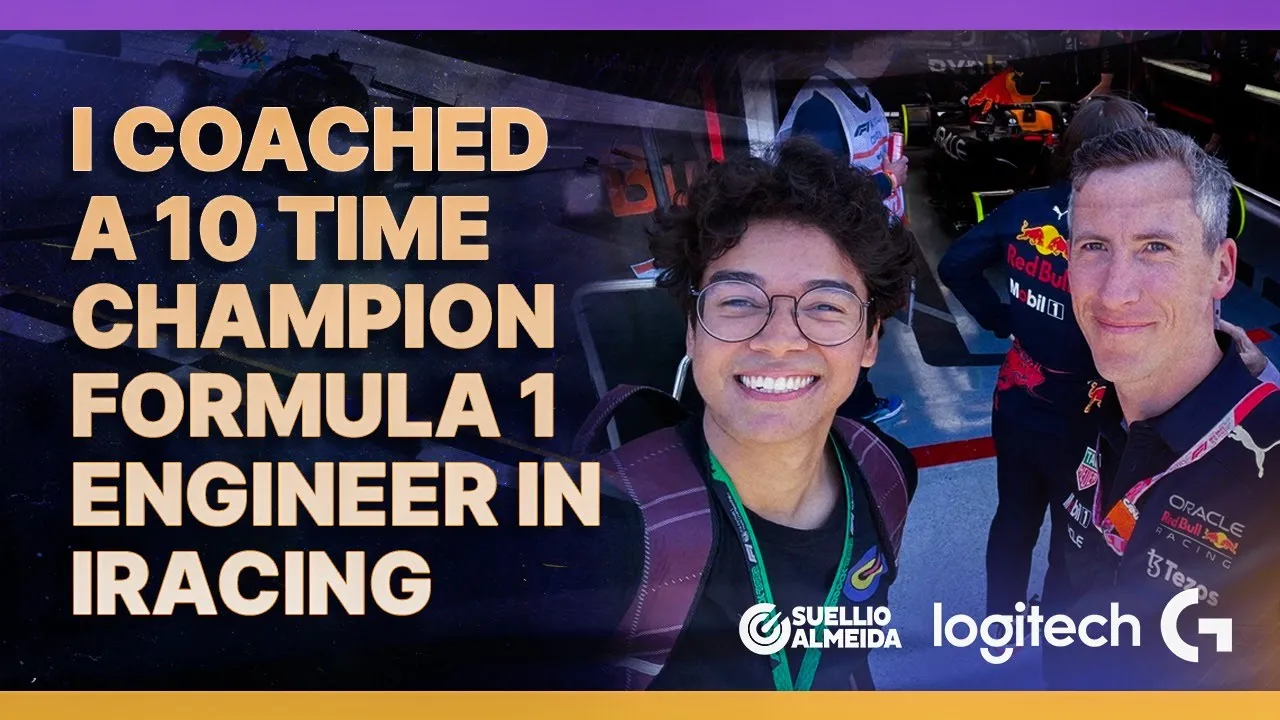
Coaching a Real F1 Engineer in Sim Racing: What Happens When Data Meets Driving
Suellio Almeida
•
Monday, January 23, 2023
The Gap Between Knowing and Doing
You can understand every concept in racing theory. You can read the telemetry. You can analyze the data like a professional engineer.
And still brake in the wrong place.
That's what I discovered when I sat down with an F1 engineer for a coaching session. This wasn't a beginner who needed the basics explained. This was someone who designs racing cars, who understands weight transfer and tire dynamics at a level most of us will never reach.
But sim racing exposed the truth: knowledge doesn't equal execution.
The Student: An F1 Engineer Who Knows Too Much
He came to the session with something most students don't have — a deep understanding of vehicle dynamics. He could explain exactly what the car was doing and why.
The problem? He was overthinking every input.
When you know everything that's happening with weight transfer, tire slip angles, and aerodynamic balance, it's easy to get paralyzed by the options. Should I brake here or there? How much steering angle is optimal? Am I loading the front tires correctly?
Meanwhile, the lap time suffered.
We were running the Radical SR10 at Road Atlanta — a high-downforce car on a technical track. His times were respectable. But I could see the hesitation in his inputs. He was thinking his way around the track instead of driving it.
The Diagnosis: Braking Points and Confidence
Okay, so I pulled up his telemetry against a reference lap.
The issue jumped out immediately: inconsistent braking points.
Turn 1, Turn 3, Turn 7 — every braking zone showed variation lap to lap. Sometimes early, sometimes late, never committed. When you're searching for the limit, you can't find it if you're not repeating the same input.
"You see this?"
I pointed at the brake trace. It wandered like a drunk driver.
"You're not picking a marker and trusting it. You're recalculating every lap. That's not how you build speed — that's how you stay slow."
He knew the theory. But confidence in execution was missing.
The other issue: mid-corner speed. He was leaving time on the table through the long, sweeping corners because he wasn't fully committing to the throttle. The car had more grip than he was using. The data showed it. The car was capable. He wasn't trusting it.
The Fix: Pick Your Markers, Trust the Car
Here's what I told him:
"Stop thinking. Pick one braking marker for each corner. Commit to it for three laps in a row. I don't care if it feels early. I don't care if you think you can brake later. Consistency first, speed second."
We went corner by corner:
Turn 1: Brake at the 3 board. Not the 2, not the 4. The 3. Every single lap.
Turn 3: Brake at the end of the curbing on the left. Same spot, same pressure, every lap.
Turn 7: Brake when you see the start of the inside curb. Lock it in.
Then I addressed the mid-corner throttle issue.
"The car has downforce. More speed creates more grip. You're lifting when you should be holding. The car will stick. Let it work."
Simple instructions. No complex theory. Just: pick the spot, trust the car, repeat.
The Result: From Overthinking to Overdelivering
Three laps later, the telemetry transformed.
Braking traces tightened up. Same marker, same pressure, lap after lap. The consistency unlocked the next step — he could finally start pushing the braking point deeper because he had a baseline to work from.
Mid-corner speeds increased. He trusted the downforce. The car rotated better because he was carrying more entry speed and holding throttle through the apex.
Lap time dropped by over a second.
Not because he learned something new. Because he stopped overthinking what he already knew.
That's the lesson: You can have all the knowledge in the world, but racing is execution under pressure. The engineer in him wanted to optimize every variable. The driver in him needed to simplify and commit.
What This Means for You
You don't need to be an F1 engineer to fall into this trap.
How many times have you watched a tutorial, understood the concept perfectly, then went out and drove the same old way?
How many times have you analyzed your telemetry, seen exactly where you're losing time, and still couldn't fix it on track?
Knowledge without application is just noise.
The fastest drivers aren't the ones who know the most theory. They're the ones who can execute the fundamentals consistently, lap after lap, under pressure. They pick their markers. They trust their inputs. They commit.
If an F1 engineer needed coaching to bridge that gap, what makes you think you don't?
Are You Stuck Knowing What to Do But Not How to Do It?
You've watched the videos. You've read the guides. You understand trail braking, weight transfer, racing lines.
So why isn't your lap time dropping?
Because knowing and doing are two different skills — and you can't coach yourself through the gap. You need someone watching your telemetry, calling out the specific hesitation, the inconsistent marker, the one input that's costing you a second per lap.
That's what 1:1 coaching does. It cuts through the theory and forces execution.
I've coached over 36,000 students. F1 engineers. Complete beginners. Top-split iRacers. The common thread? They all needed an outside perspective to see what they couldn't see themselves.
If you're serious about breaking through your plateau, stop guessing. Book a session. Let's find the gap between what you know and what you do.
Sim Racing Academy Membership
Everything you need to stop guessing and start getting faster.
Starting at
$25
/mo
Car Handling Online Course
4 levels, full curriculum. Aimed to get you to top 1% in driving pace.
Racecraft Online Course
Overtaking, Defending, Race Strategy
Live coaching + on-track practice
Bi-weekly pro-coach workshops (recorded — never miss one) plus on-track Pit Parties to practice racecraft with a coach.
Plus These Bonuses
13,000+ Member Community
League Racing
Advanced MX-5 Mini Course
Racing Technique Development Guide
The Motor Racing Book (260 pages)
Think & Behave Like a Pro Driver — Mini eBook
Coaching a Real F1 Engineer in Sim Racing: What Happens When Data Meets Driving
Suellio Almeida
•
Monday, January 23, 2023
The Gap Between Knowing and Doing
You can understand every concept in racing theory. You can read the telemetry. You can analyze the data like a professional engineer.
And still brake in the wrong place.
That's what I discovered when I sat down with an F1 engineer for a coaching session. This wasn't a beginner who needed the basics explained. This was someone who designs racing cars, who understands weight transfer and tire dynamics at a level most of us will never reach.
But sim racing exposed the truth: knowledge doesn't equal execution.
The Student: An F1 Engineer Who Knows Too Much
He came to the session with something most students don't have — a deep understanding of vehicle dynamics. He could explain exactly what the car was doing and why.
The problem? He was overthinking every input.
When you know everything that's happening with weight transfer, tire slip angles, and aerodynamic balance, it's easy to get paralyzed by the options. Should I brake here or there? How much steering angle is optimal? Am I loading the front tires correctly?
Meanwhile, the lap time suffered.
We were running the Radical SR10 at Road Atlanta — a high-downforce car on a technical track. His times were respectable. But I could see the hesitation in his inputs. He was thinking his way around the track instead of driving it.
The Diagnosis: Braking Points and Confidence
Okay, so I pulled up his telemetry against a reference lap.
The issue jumped out immediately: inconsistent braking points.
Turn 1, Turn 3, Turn 7 — every braking zone showed variation lap to lap. Sometimes early, sometimes late, never committed. When you're searching for the limit, you can't find it if you're not repeating the same input.
"You see this?"
I pointed at the brake trace. It wandered like a drunk driver.
"You're not picking a marker and trusting it. You're recalculating every lap. That's not how you build speed — that's how you stay slow."
He knew the theory. But confidence in execution was missing.
The other issue: mid-corner speed. He was leaving time on the table through the long, sweeping corners because he wasn't fully committing to the throttle. The car had more grip than he was using. The data showed it. The car was capable. He wasn't trusting it.
The Fix: Pick Your Markers, Trust the Car
Here's what I told him:
"Stop thinking. Pick one braking marker for each corner. Commit to it for three laps in a row. I don't care if it feels early. I don't care if you think you can brake later. Consistency first, speed second."
We went corner by corner:
Turn 1: Brake at the 3 board. Not the 2, not the 4. The 3. Every single lap.
Turn 3: Brake at the end of the curbing on the left. Same spot, same pressure, every lap.
Turn 7: Brake when you see the start of the inside curb. Lock it in.
Then I addressed the mid-corner throttle issue.
"The car has downforce. More speed creates more grip. You're lifting when you should be holding. The car will stick. Let it work."
Simple instructions. No complex theory. Just: pick the spot, trust the car, repeat.
The Result: From Overthinking to Overdelivering
Three laps later, the telemetry transformed.
Braking traces tightened up. Same marker, same pressure, lap after lap. The consistency unlocked the next step — he could finally start pushing the braking point deeper because he had a baseline to work from.
Mid-corner speeds increased. He trusted the downforce. The car rotated better because he was carrying more entry speed and holding throttle through the apex.
Lap time dropped by over a second.
Not because he learned something new. Because he stopped overthinking what he already knew.
That's the lesson: You can have all the knowledge in the world, but racing is execution under pressure. The engineer in him wanted to optimize every variable. The driver in him needed to simplify and commit.
What This Means for You
You don't need to be an F1 engineer to fall into this trap.
How many times have you watched a tutorial, understood the concept perfectly, then went out and drove the same old way?
How many times have you analyzed your telemetry, seen exactly where you're losing time, and still couldn't fix it on track?
Knowledge without application is just noise.
The fastest drivers aren't the ones who know the most theory. They're the ones who can execute the fundamentals consistently, lap after lap, under pressure. They pick their markers. They trust their inputs. They commit.
If an F1 engineer needed coaching to bridge that gap, what makes you think you don't?
Are You Stuck Knowing What to Do But Not How to Do It?
You've watched the videos. You've read the guides. You understand trail braking, weight transfer, racing lines.
So why isn't your lap time dropping?
Because knowing and doing are two different skills — and you can't coach yourself through the gap. You need someone watching your telemetry, calling out the specific hesitation, the inconsistent marker, the one input that's costing you a second per lap.
That's what 1:1 coaching does. It cuts through the theory and forces execution.
I've coached over 36,000 students. F1 engineers. Complete beginners. Top-split iRacers. The common thread? They all needed an outside perspective to see what they couldn't see themselves.
If you're serious about breaking through your plateau, stop guessing. Book a session. Let's find the gap between what you know and what you do.
Sim Racing Academy Membership
Everything you need to stop guessing and start getting faster.
Starting at
$25
/mo
Car Handling Online Course
4 levels, full curriculum. Aimed to get you to top 1% in driving pace.
Racecraft Online Course
Overtaking, Defending, Race Strategy
Live coaching + on-track practice
Bi-weekly pro-coach workshops (recorded — never miss one) plus on-track Pit Parties to practice racecraft with a coach.
Plus These Bonuses
13,000+ Member Community
League Racing
Advanced MX-5 Mini Course
Racing Technique Development Guide
The Motor Racing Book (260 pages)
Think & Behave Like a Pro Driver — Mini eBook
Coaching a Real F1 Engineer in Sim Racing: What Happens When Data Meets Driving
Suellio Almeida
•
Monday, January 23, 2023
The Gap Between Knowing and Doing
You can understand every concept in racing theory. You can read the telemetry. You can analyze the data like a professional engineer.
And still brake in the wrong place.
That's what I discovered when I sat down with an F1 engineer for a coaching session. This wasn't a beginner who needed the basics explained. This was someone who designs racing cars, who understands weight transfer and tire dynamics at a level most of us will never reach.
But sim racing exposed the truth: knowledge doesn't equal execution.
The Student: An F1 Engineer Who Knows Too Much
He came to the session with something most students don't have — a deep understanding of vehicle dynamics. He could explain exactly what the car was doing and why.
The problem? He was overthinking every input.
When you know everything that's happening with weight transfer, tire slip angles, and aerodynamic balance, it's easy to get paralyzed by the options. Should I brake here or there? How much steering angle is optimal? Am I loading the front tires correctly?
Meanwhile, the lap time suffered.
We were running the Radical SR10 at Road Atlanta — a high-downforce car on a technical track. His times were respectable. But I could see the hesitation in his inputs. He was thinking his way around the track instead of driving it.
The Diagnosis: Braking Points and Confidence
Okay, so I pulled up his telemetry against a reference lap.
The issue jumped out immediately: inconsistent braking points.
Turn 1, Turn 3, Turn 7 — every braking zone showed variation lap to lap. Sometimes early, sometimes late, never committed. When you're searching for the limit, you can't find it if you're not repeating the same input.
"You see this?"
I pointed at the brake trace. It wandered like a drunk driver.
"You're not picking a marker and trusting it. You're recalculating every lap. That's not how you build speed — that's how you stay slow."
He knew the theory. But confidence in execution was missing.
The other issue: mid-corner speed. He was leaving time on the table through the long, sweeping corners because he wasn't fully committing to the throttle. The car had more grip than he was using. The data showed it. The car was capable. He wasn't trusting it.
The Fix: Pick Your Markers, Trust the Car
Here's what I told him:
"Stop thinking. Pick one braking marker for each corner. Commit to it for three laps in a row. I don't care if it feels early. I don't care if you think you can brake later. Consistency first, speed second."
We went corner by corner:
Turn 1: Brake at the 3 board. Not the 2, not the 4. The 3. Every single lap.
Turn 3: Brake at the end of the curbing on the left. Same spot, same pressure, every lap.
Turn 7: Brake when you see the start of the inside curb. Lock it in.
Then I addressed the mid-corner throttle issue.
"The car has downforce. More speed creates more grip. You're lifting when you should be holding. The car will stick. Let it work."
Simple instructions. No complex theory. Just: pick the spot, trust the car, repeat.
The Result: From Overthinking to Overdelivering
Three laps later, the telemetry transformed.
Braking traces tightened up. Same marker, same pressure, lap after lap. The consistency unlocked the next step — he could finally start pushing the braking point deeper because he had a baseline to work from.
Mid-corner speeds increased. He trusted the downforce. The car rotated better because he was carrying more entry speed and holding throttle through the apex.
Lap time dropped by over a second.
Not because he learned something new. Because he stopped overthinking what he already knew.
That's the lesson: You can have all the knowledge in the world, but racing is execution under pressure. The engineer in him wanted to optimize every variable. The driver in him needed to simplify and commit.
What This Means for You
You don't need to be an F1 engineer to fall into this trap.
How many times have you watched a tutorial, understood the concept perfectly, then went out and drove the same old way?
How many times have you analyzed your telemetry, seen exactly where you're losing time, and still couldn't fix it on track?
Knowledge without application is just noise.
The fastest drivers aren't the ones who know the most theory. They're the ones who can execute the fundamentals consistently, lap after lap, under pressure. They pick their markers. They trust their inputs. They commit.
If an F1 engineer needed coaching to bridge that gap, what makes you think you don't?
Are You Stuck Knowing What to Do But Not How to Do It?
You've watched the videos. You've read the guides. You understand trail braking, weight transfer, racing lines.
So why isn't your lap time dropping?
Because knowing and doing are two different skills — and you can't coach yourself through the gap. You need someone watching your telemetry, calling out the specific hesitation, the inconsistent marker, the one input that's costing you a second per lap.
That's what 1:1 coaching does. It cuts through the theory and forces execution.
I've coached over 36,000 students. F1 engineers. Complete beginners. Top-split iRacers. The common thread? They all needed an outside perspective to see what they couldn't see themselves.
If you're serious about breaking through your plateau, stop guessing. Book a session. Let's find the gap between what you know and what you do.
Sim Racing Academy Membership
Everything you need to stop guessing and start getting faster.
Starting at
$25
/mo
Car Handling Online Course
4 levels, full curriculum. Aimed to get you to top 1% in driving pace.
Racecraft Online Course
Overtaking, Defending, Race Strategy
Live coaching + on-track practice
Bi-weekly pro-coach workshops (recorded — never miss one) plus on-track Pit Parties to practice racecraft with a coach.
Plus These Bonuses
13,000+ Member Community
League Racing
Advanced MX-5 Mini Course
Racing Technique Development Guide
The Motor Racing Book (260 pages)
Think & Behave Like a Pro Driver — Mini eBook