
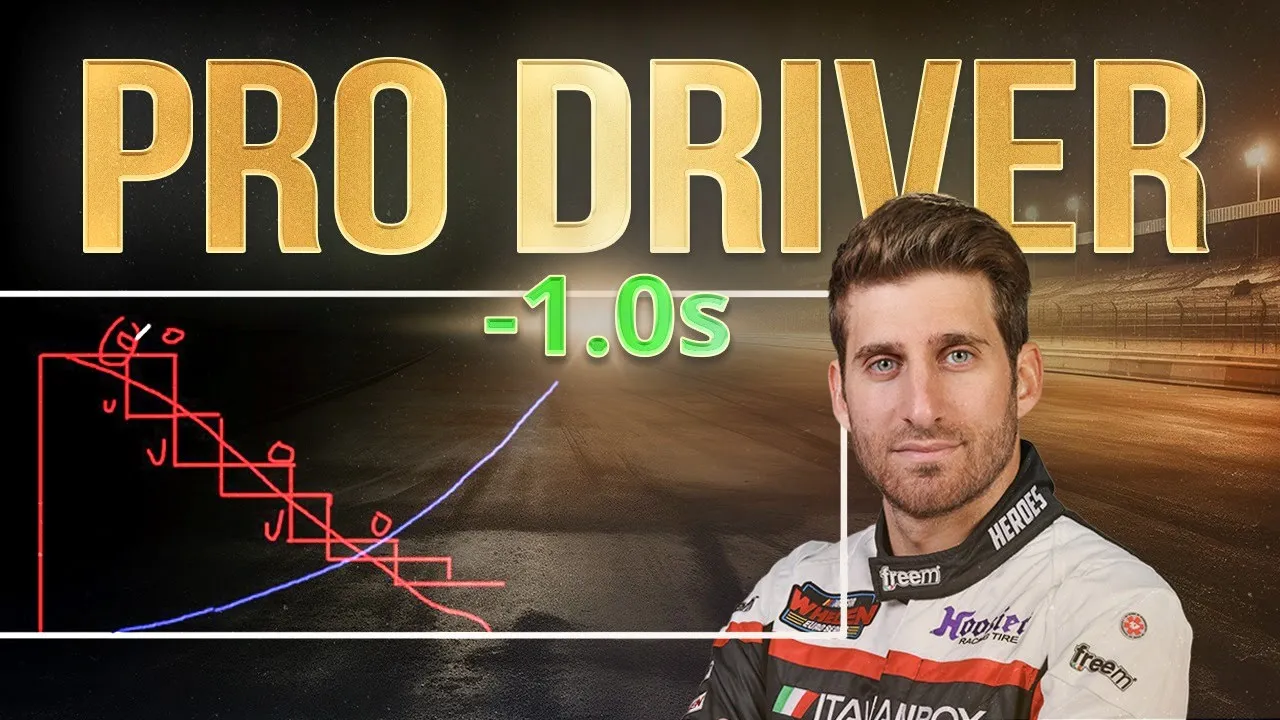
Coaching a Professional Race Car Driver: When Real-World Experience Meets Sim Racing Reality
Suellio Almeida
•
Saturday, December 16, 2023
The Student: A Pro Driver Who Knows What Fast Feels Like
Let me set the scene for you.
The driver sitting across from me in this coaching session isn't a typical sim racer grinding iRating. He's a professional race car driver with real-world podiums. He knows what a car feels like at the limit. He's felt G-forces compress his chest through fast sweepers. He's made split-second decisions in wheel-to-wheel racing at 150 mph.
But here's the thing — sim racing is its own discipline.
Real-world experience gives you an incredible foundation. You understand weight transfer intuitively. You know how a car rotates. You've felt understeer push you wide and oversteer snap the rear. That muscle memory is real.
But the sim demands precision you can't feel through your body. You need visual reference points. You need to trust data over sensation. And sometimes, the techniques that work in a real cockpit need translation to work through a wheel and screen.
The Gap: Fast Intuition vs. Optimized Execution
We're looking at Monza. Classic track. Fast, flowing, unforgiving.
As I pull up his telemetry next to the optimal line, I can see it immediately — he's quick. His racing instincts are sharp. But there's time on the table. Not because he's slow. Because his reference points are slightly off, and in sim racing, "slightly off" costs you two-tenths per corner.
Look at his braking into Turn 1.
He's braking late — good aggression. But he's 10 meters past the optimal braking point. In a real car, you might get away with that because you can feel the weight shift forward and modulate. In the sim, that late braking forces him to carry too much speed into the corner, which means he has to slow mid-corner to make the apex.
That kills your exit speed.
You see this pattern in every corner. He's trusting his instincts, which are good, but the precision isn't there yet. His turn-in points vary by 5-10 meters lap to lap. His throttle application is aggressive but inconsistent.
He's fast. But he's not consistent.
The Fix: Rebuilding Visual Reference Points
"Okay, so here's what I want you to do," I told him.
"We're going to nail down your braking markers. I don't care what feels right — we're going to use visual cues that work every single lap."
Turn 1: Brake at the 100-meter board. Not when it feels right. At that board.
Turn 3: Turn in when you see the inside curbing align with that specific trackside object. Not earlier. Not later. That exact moment.
Parabolica: Your eyes need to be looking at the exit while you're still at the apex. If you're looking at the apex, you're already late.
This is the translation layer between real and sim. In a real car, your inner ear and your body give you feedback loops. In the sim, you rebuild those loops through visual precision and data trust.
We ran three laps with the new reference points.
The Result: Precision Unlocks Pace
His first lap with the new markers? Still quick, but he's thinking. Processing.
Second lap? You can see it click. His braking points are locked. His turn-in is hitting the same spot every corner. His mid-corner speed is higher because he's not correcting — he's flowing.
Third lap? Fastest lap of the session. By four-tenths.
Four-tenths at Monza is massive. That's the difference between front-row qualifying and mid-pack. That's the gap between a podium and sixth place.
"That's much better," I told him. "You see how the lap time dropped when the inputs got consistent?"
He got it. You could hear it in his voice. The frustration of feeling fast but not seeing the lap time evaporated. Because now he had the method.
This is what separates good drivers from great sim racers. Good drivers rely on feel and instinct. Great sim racers build systems. They create repeatability. They trust the data even when instinct screams something different.
What Every Sim Racer Can Learn From This Session
If a professional race car driver benefits from coaching, what does that tell you?
It tells you that speed isn't just talent. It's not just hours. It's structured improvement. It's having someone point out the 10 meters you're losing that you can't see yourself.
You don't need to be a pro to apply this. You need three things:
1. Visual reference points that don't change. Not "when it feels right." When you see X landmark, you do Y input. Every lap.
2. Data to challenge your instincts. Your brain lies to you. It tells you you're braking at the same spot every lap. Telemetry doesn't lie. Use it.
3. Consistency before aggression. Hit your marks first. Then push the marks forward. If you can't repeat a lap within a tenth, you're not ready to go faster — you're just getting lucky.
This driver had all the raw ingredients. Racecraft. Car control. Fearlessness. What he needed was the translation — how to take that real-world speed and channel it through the precision lens of sim racing.
That's coaching. That's what changes a 1:42 driver into a 1:40 driver. Not magic. Not secrets. Just seeing what you can't see and building the system to fix it.
How Much Faster Could You Be With The Right Reference Points?
You've got the instincts. You've put in the hours. You know your car, you know your tracks.
But are you actually improving, or are you just reinforcing the same habits that keep you stuck?
If a professional driver gains four-tenths from dialing in his reference points, how much time are you leaving on the track right now? What would change if someone could watch your telemetry and say, "There. That's where you're losing it. Here's exactly how to fix it."
You can keep grinding laps and hoping it clicks. Or you can fast-track the process with someone who's already walked this path.
That's what 1:1 coaching does. You get direct feedback from drivers who've coached 36,000+ students, broken into the top 0.03% of iRacing, and raced everything from Radicals to IMSA TCR cars. We don't guess. We look at your data, identify the exact lap time killers, and give you a specific action plan.
Book your 1:1 coaching session here
— because fast enough isn't fast enough.
Sim Racing Academy Membership
Everything you need to stop guessing and start getting faster.
Starting at
$25
/mo
Car Handling Online Course
4 levels, full curriculum. Aimed to get you to top 1% in driving pace.
Racecraft Online Course
Overtaking, Defending, Race Strategy
Live coaching + on-track practice
Bi-weekly pro-coach workshops (recorded — never miss one) plus on-track Pit Parties to practice racecraft with a coach.
Plus These Bonuses
13,000+ Member Community
League Racing
Advanced MX-5 Mini Course
Racing Technique Development Guide
The Motor Racing Book (260 pages)
Think & Behave Like a Pro Driver — Mini eBook
Coaching a Professional Race Car Driver: When Real-World Experience Meets Sim Racing Reality
Suellio Almeida
•
Saturday, December 16, 2023
The Student: A Pro Driver Who Knows What Fast Feels Like
Let me set the scene for you.
The driver sitting across from me in this coaching session isn't a typical sim racer grinding iRating. He's a professional race car driver with real-world podiums. He knows what a car feels like at the limit. He's felt G-forces compress his chest through fast sweepers. He's made split-second decisions in wheel-to-wheel racing at 150 mph.
But here's the thing — sim racing is its own discipline.
Real-world experience gives you an incredible foundation. You understand weight transfer intuitively. You know how a car rotates. You've felt understeer push you wide and oversteer snap the rear. That muscle memory is real.
But the sim demands precision you can't feel through your body. You need visual reference points. You need to trust data over sensation. And sometimes, the techniques that work in a real cockpit need translation to work through a wheel and screen.
The Gap: Fast Intuition vs. Optimized Execution
We're looking at Monza. Classic track. Fast, flowing, unforgiving.
As I pull up his telemetry next to the optimal line, I can see it immediately — he's quick. His racing instincts are sharp. But there's time on the table. Not because he's slow. Because his reference points are slightly off, and in sim racing, "slightly off" costs you two-tenths per corner.
Look at his braking into Turn 1.
He's braking late — good aggression. But he's 10 meters past the optimal braking point. In a real car, you might get away with that because you can feel the weight shift forward and modulate. In the sim, that late braking forces him to carry too much speed into the corner, which means he has to slow mid-corner to make the apex.
That kills your exit speed.
You see this pattern in every corner. He's trusting his instincts, which are good, but the precision isn't there yet. His turn-in points vary by 5-10 meters lap to lap. His throttle application is aggressive but inconsistent.
He's fast. But he's not consistent.
The Fix: Rebuilding Visual Reference Points
"Okay, so here's what I want you to do," I told him.
"We're going to nail down your braking markers. I don't care what feels right — we're going to use visual cues that work every single lap."
Turn 1: Brake at the 100-meter board. Not when it feels right. At that board.
Turn 3: Turn in when you see the inside curbing align with that specific trackside object. Not earlier. Not later. That exact moment.
Parabolica: Your eyes need to be looking at the exit while you're still at the apex. If you're looking at the apex, you're already late.
This is the translation layer between real and sim. In a real car, your inner ear and your body give you feedback loops. In the sim, you rebuild those loops through visual precision and data trust.
We ran three laps with the new reference points.
The Result: Precision Unlocks Pace
His first lap with the new markers? Still quick, but he's thinking. Processing.
Second lap? You can see it click. His braking points are locked. His turn-in is hitting the same spot every corner. His mid-corner speed is higher because he's not correcting — he's flowing.
Third lap? Fastest lap of the session. By four-tenths.
Four-tenths at Monza is massive. That's the difference between front-row qualifying and mid-pack. That's the gap between a podium and sixth place.
"That's much better," I told him. "You see how the lap time dropped when the inputs got consistent?"
He got it. You could hear it in his voice. The frustration of feeling fast but not seeing the lap time evaporated. Because now he had the method.
This is what separates good drivers from great sim racers. Good drivers rely on feel and instinct. Great sim racers build systems. They create repeatability. They trust the data even when instinct screams something different.
What Every Sim Racer Can Learn From This Session
If a professional race car driver benefits from coaching, what does that tell you?
It tells you that speed isn't just talent. It's not just hours. It's structured improvement. It's having someone point out the 10 meters you're losing that you can't see yourself.
You don't need to be a pro to apply this. You need three things:
1. Visual reference points that don't change. Not "when it feels right." When you see X landmark, you do Y input. Every lap.
2. Data to challenge your instincts. Your brain lies to you. It tells you you're braking at the same spot every lap. Telemetry doesn't lie. Use it.
3. Consistency before aggression. Hit your marks first. Then push the marks forward. If you can't repeat a lap within a tenth, you're not ready to go faster — you're just getting lucky.
This driver had all the raw ingredients. Racecraft. Car control. Fearlessness. What he needed was the translation — how to take that real-world speed and channel it through the precision lens of sim racing.
That's coaching. That's what changes a 1:42 driver into a 1:40 driver. Not magic. Not secrets. Just seeing what you can't see and building the system to fix it.
How Much Faster Could You Be With The Right Reference Points?
You've got the instincts. You've put in the hours. You know your car, you know your tracks.
But are you actually improving, or are you just reinforcing the same habits that keep you stuck?
If a professional driver gains four-tenths from dialing in his reference points, how much time are you leaving on the track right now? What would change if someone could watch your telemetry and say, "There. That's where you're losing it. Here's exactly how to fix it."
You can keep grinding laps and hoping it clicks. Or you can fast-track the process with someone who's already walked this path.
That's what 1:1 coaching does. You get direct feedback from drivers who've coached 36,000+ students, broken into the top 0.03% of iRacing, and raced everything from Radicals to IMSA TCR cars. We don't guess. We look at your data, identify the exact lap time killers, and give you a specific action plan.
Book your 1:1 coaching session here
— because fast enough isn't fast enough.
Sim Racing Academy Membership
Everything you need to stop guessing and start getting faster.
Starting at
$25
/mo
Car Handling Online Course
4 levels, full curriculum. Aimed to get you to top 1% in driving pace.
Racecraft Online Course
Overtaking, Defending, Race Strategy
Live coaching + on-track practice
Bi-weekly pro-coach workshops (recorded — never miss one) plus on-track Pit Parties to practice racecraft with a coach.
Plus These Bonuses
13,000+ Member Community
League Racing
Advanced MX-5 Mini Course
Racing Technique Development Guide
The Motor Racing Book (260 pages)
Think & Behave Like a Pro Driver — Mini eBook
Coaching a Professional Race Car Driver: When Real-World Experience Meets Sim Racing Reality
Suellio Almeida
•
Saturday, December 16, 2023
The Student: A Pro Driver Who Knows What Fast Feels Like
Let me set the scene for you.
The driver sitting across from me in this coaching session isn't a typical sim racer grinding iRating. He's a professional race car driver with real-world podiums. He knows what a car feels like at the limit. He's felt G-forces compress his chest through fast sweepers. He's made split-second decisions in wheel-to-wheel racing at 150 mph.
But here's the thing — sim racing is its own discipline.
Real-world experience gives you an incredible foundation. You understand weight transfer intuitively. You know how a car rotates. You've felt understeer push you wide and oversteer snap the rear. That muscle memory is real.
But the sim demands precision you can't feel through your body. You need visual reference points. You need to trust data over sensation. And sometimes, the techniques that work in a real cockpit need translation to work through a wheel and screen.
The Gap: Fast Intuition vs. Optimized Execution
We're looking at Monza. Classic track. Fast, flowing, unforgiving.
As I pull up his telemetry next to the optimal line, I can see it immediately — he's quick. His racing instincts are sharp. But there's time on the table. Not because he's slow. Because his reference points are slightly off, and in sim racing, "slightly off" costs you two-tenths per corner.
Look at his braking into Turn 1.
He's braking late — good aggression. But he's 10 meters past the optimal braking point. In a real car, you might get away with that because you can feel the weight shift forward and modulate. In the sim, that late braking forces him to carry too much speed into the corner, which means he has to slow mid-corner to make the apex.
That kills your exit speed.
You see this pattern in every corner. He's trusting his instincts, which are good, but the precision isn't there yet. His turn-in points vary by 5-10 meters lap to lap. His throttle application is aggressive but inconsistent.
He's fast. But he's not consistent.
The Fix: Rebuilding Visual Reference Points
"Okay, so here's what I want you to do," I told him.
"We're going to nail down your braking markers. I don't care what feels right — we're going to use visual cues that work every single lap."
Turn 1: Brake at the 100-meter board. Not when it feels right. At that board.
Turn 3: Turn in when you see the inside curbing align with that specific trackside object. Not earlier. Not later. That exact moment.
Parabolica: Your eyes need to be looking at the exit while you're still at the apex. If you're looking at the apex, you're already late.
This is the translation layer between real and sim. In a real car, your inner ear and your body give you feedback loops. In the sim, you rebuild those loops through visual precision and data trust.
We ran three laps with the new reference points.
The Result: Precision Unlocks Pace
His first lap with the new markers? Still quick, but he's thinking. Processing.
Second lap? You can see it click. His braking points are locked. His turn-in is hitting the same spot every corner. His mid-corner speed is higher because he's not correcting — he's flowing.
Third lap? Fastest lap of the session. By four-tenths.
Four-tenths at Monza is massive. That's the difference between front-row qualifying and mid-pack. That's the gap between a podium and sixth place.
"That's much better," I told him. "You see how the lap time dropped when the inputs got consistent?"
He got it. You could hear it in his voice. The frustration of feeling fast but not seeing the lap time evaporated. Because now he had the method.
This is what separates good drivers from great sim racers. Good drivers rely on feel and instinct. Great sim racers build systems. They create repeatability. They trust the data even when instinct screams something different.
What Every Sim Racer Can Learn From This Session
If a professional race car driver benefits from coaching, what does that tell you?
It tells you that speed isn't just talent. It's not just hours. It's structured improvement. It's having someone point out the 10 meters you're losing that you can't see yourself.
You don't need to be a pro to apply this. You need three things:
1. Visual reference points that don't change. Not "when it feels right." When you see X landmark, you do Y input. Every lap.
2. Data to challenge your instincts. Your brain lies to you. It tells you you're braking at the same spot every lap. Telemetry doesn't lie. Use it.
3. Consistency before aggression. Hit your marks first. Then push the marks forward. If you can't repeat a lap within a tenth, you're not ready to go faster — you're just getting lucky.
This driver had all the raw ingredients. Racecraft. Car control. Fearlessness. What he needed was the translation — how to take that real-world speed and channel it through the precision lens of sim racing.
That's coaching. That's what changes a 1:42 driver into a 1:40 driver. Not magic. Not secrets. Just seeing what you can't see and building the system to fix it.
How Much Faster Could You Be With The Right Reference Points?
You've got the instincts. You've put in the hours. You know your car, you know your tracks.
But are you actually improving, or are you just reinforcing the same habits that keep you stuck?
If a professional driver gains four-tenths from dialing in his reference points, how much time are you leaving on the track right now? What would change if someone could watch your telemetry and say, "There. That's where you're losing it. Here's exactly how to fix it."
You can keep grinding laps and hoping it clicks. Or you can fast-track the process with someone who's already walked this path.
That's what 1:1 coaching does. You get direct feedback from drivers who've coached 36,000+ students, broken into the top 0.03% of iRacing, and raced everything from Radicals to IMSA TCR cars. We don't guess. We look at your data, identify the exact lap time killers, and give you a specific action plan.
Book your 1:1 coaching session here
— because fast enough isn't fast enough.
Sim Racing Academy Membership
Everything you need to stop guessing and start getting faster.
Starting at
$25
/mo
Car Handling Online Course
4 levels, full curriculum. Aimed to get you to top 1% in driving pace.
Racecraft Online Course
Overtaking, Defending, Race Strategy
Live coaching + on-track practice
Bi-weekly pro-coach workshops (recorded — never miss one) plus on-track Pit Parties to practice racecraft with a coach.
Plus These Bonuses
13,000+ Member Community
League Racing
Advanced MX-5 Mini Course
Racing Technique Development Guide
The Motor Racing Book (260 pages)
Think & Behave Like a Pro Driver — Mini eBook