
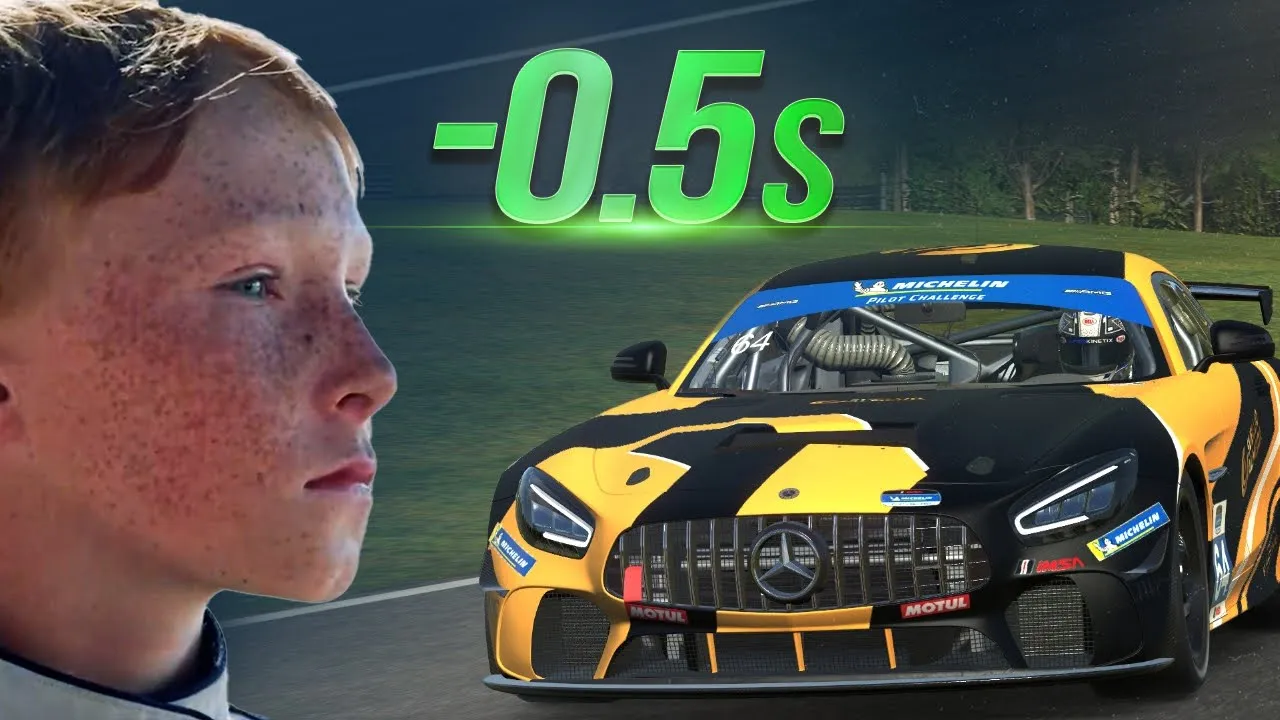
Coaching an 11-Year-Old Top 2% Sim Racer: Trail Braking and Throttle Control Breakdown
Suellio Almeida
•
Friday, December 27, 2024
The Student: 11 Years Old, Already Faster Than 98% of Sim Racers
Let me set the scene. I'm coaching an 11-year-old sim racer. Not just any kid messing around on a racing game — this driver is already in the top 2% of all sim racers globally. He's got raw speed. He's got instinct. But he's stuck.
He contacted Almeida Racing Academy because he knew something was off. He could feel it. Fast drivers always can. They hit a plateau, lap times stop dropping, and no amount of seat time fixes it. That's where coaching comes in.
We're working on Laguna Seca in a Formula Vee. Open-wheel, lightweight, momentum-based car. Unforgiving. If you miss your line or your braking point by even a few meters, you bleed time. For a driver this young to be competitive in this car? Already impressive. But there's always another level.
The Problem: Losing Time in Three Key Corners
I pulled up his telemetry and immediately spotted the issues. Three corners where he was hemorrhaging lap time:
1. Turn 2 — braking too early, not carrying enough speed
2. Turn 6 (the famous Corkscrew) — losing rotation mid-corner, fighting understeer
3. Turn 11 — hesitant on throttle application, exit speed suffering
Let me be clear: these aren't beginner mistakes. This is the gap between fast and consistently fast. Between top 2% and top 0.5%. The margins are tiny, but they compound. Over a 10-lap race? You're talking seconds.
I told him: "You're fast. But you're leaving time on the table because you're not maximizing your tools. Let's fix your trail braking and throttle control."
Turn 2: Braking Too Early, Missing Free Speed
First problem: Turn 2. He was braking way too early. I could see it in the data — he was hitting the brakes at the 150-meter board. Conservative. Safe. Slow.
"Okay, so what I want you to do is brake at the 100-meter board," I told him. "You're losing speed before you even turn in. You've got more grip than you think."
He was skeptical. Most drivers are when you tell them to brake later. It feels dangerous. But here's the thing: braking later isn't about being brave. It's about trusting the car's capability.
We also worked on trail braking deeper into the corner. He was releasing the brake too early, which meant he wasn't loading the front tires enough. No front load = no rotation. No rotation = understeery mess.
"Keep light brake pressure as you turn in," I explained. "You want to carry that weight on the front axle all the way to the apex. That's what gives you rotation."
Next lap? Immediate improvement. He braked 50 meters later, carried more mid-corner speed, and his minimum corner speed jumped. Just from trusting the car and using trail braking properly.
The Corkscrew: Fixing Understeer Through Rotation
Then we hit Turn 6 — the Corkscrew. One of the most iconic corners in motorsports. Blind downhill left-right. Absolute rotation killer if you get it wrong.
His issue? He was turning in too early and too aggressively, scrubbing off all his front tire grip. By mid-corner, the car was pushing wide. Understeer. He'd try to wrestle it back, lose more time, and limp out of the corner.
"You see what's happening here?" I asked, pointing at the telemetry. "You're asking the front tires to do too much work too soon. You need to be patient on turn-in."
The fix: delay the turn-in slightly and use smoother steering input. Let the car settle. Then, once the weight is loaded and the front tires are biting, you can rotate.
We also adjusted his throttle application. He was getting on the gas too aggressively before the car had rotated. That's a killer in low-power cars like the Formula Vee. You can't muscle your way out of rotation issues with throttle. You have to earn the rotation first, then apply power.
"Be smooth on the throttle," I told him. "You're not driving a GT3. This car rewards patience."
Next attempt? Night and day. He delayed turn-in, let the car rotate naturally, and his exit speed improved massively. The Corkscrew went from a time-loss corner to neutral. That's progress.
Turn 11: Confidence on Throttle Application
Last issue: Turn 11. Final corner before the front straight. If you mess this up, you lose time all the way to Turn 1. He was hesitant on the throttle. I could see it in the data — he'd get to the apex, then feather the throttle instead of committing.
"Why are you scared of the throttle here?" I asked.
"I don't want to lose the rear," he said.
Fair. But wrong.
"Okay, so here's the thing," I explained. "You're in a momentum car. The rear isn't going to step out unless you do something stupid. What you're doing right now is worse — you're bleeding exit speed because you're not trusting the grip."
The fix: commit to throttle earlier. As soon as the car is pointed at the exit, get on the gas. Not hesitant. Not feathering. Progressive, smooth, but committed.
We did three more laps focusing on that single corner. Each lap, he applied throttle earlier. Each lap, his exit speed improved. By the third lap, he was carrying 5 mph more onto the front straight. Five mph might not sound like much, but over a full lap? That's a tenth. Over a race? That's positions.
The Result: Faster, Smarter, More Consistent
By the end of the session, his lap times had dropped. Not by guessing. Not by "just sending it." By understanding trail braking mechanics, weight transfer, and throttle application timing.
He wasn't just faster. He was more consistent. That's the real win. Anyone can do one fast lap. Doing 20 fast laps in a row? That's technique.
Here's what we fixed:
Braking points: Moved from 150m to 100m in Turn 2 → gained speed
Trail braking depth: Kept front load longer → improved rotation
Turn-in timing: Delayed Corkscrew turn-in → eliminated understeer
Throttle confidence: Committed earlier in Turn 11 → better exit speed
And the kid? He got it. That's the thing about coaching talented drivers — they don't need to be told twice. You show them the why, they execute the how.
What This Teaches You (No Matter Your Age or iRating)
You don't need to be 11 years old or top 2% to apply these lessons. The principles are universal:
1. Trail braking is not optional. If you're not carrying brake pressure past turn-in, you're leaving rotation on the table.
2. Smooth is fast. Aggressive steering and throttle inputs feel fast. They're not. Smooth inputs let the tires do their job.
3. Trust the data. If telemetry says you're braking too early, you're braking too early. Your fear is lying to you.
4. Throttle application timing matters more than you think. Especially in momentum cars. Get on the gas too early? Understeer. Too late? Slow exit. Nail the timing? Free speed.
This 11-year-old is going to be insanely fast in a few years if he keeps training with purpose. But the same method works for anyone — beginner to pro. It's not about talent. It's about understanding the physics, applying the technique, and iterating.
How Long Are You Going to Keep Guessing?
Here's the question: how many more laps are you going to run before you figure out what's actually costing you time?
You can feel it, right? You know you're faster than your current lap times. You know there's something you're missing. But YouTube tutorials and trial-and-error only get you so far. Eventually, you need someone to look at your data, watch your inputs, and tell you: "Here. This is the problem. Fix this."
That's what 1:1 coaching does. It cuts through the guesswork. You send me your footage and telemetry. I analyze it. We jump on a call. I show you exactly what's costing you time and how to fix it. Not theory. Not generic advice. Your car, your track, your specific mistakes.
I've coached over 36,000 students. From complete beginners to drivers competing in real-world IMSA and F1 engineers looking to understand racecraft. The method works because it's specific, data-driven, and tailored to you.
If you're serious about dropping lap times and racing with confidence, stop guessing. Book a session. Let's fix what's holding you back.
Sim Racing Academy Membership
Everything you need to stop guessing and start getting faster.
Starting at
$25
/mo
Car Handling Online Course
4 levels, full curriculum. Aimed to get you to top 1% in driving pace.
Racecraft Online Course
Overtaking, Defending, Race Strategy
Live coaching + on-track practice
Bi-weekly pro-coach workshops (recorded — never miss one) plus on-track Pit Parties to practice racecraft with a coach.
Plus These Bonuses
13,000+ Member Community
League Racing
Advanced MX-5 Mini Course
Racing Technique Development Guide
The Motor Racing Book (260 pages)
Think & Behave Like a Pro Driver — Mini eBook
Coaching an 11-Year-Old Top 2% Sim Racer: Trail Braking and Throttle Control Breakdown
Suellio Almeida
•
Friday, December 27, 2024
The Student: 11 Years Old, Already Faster Than 98% of Sim Racers
Let me set the scene. I'm coaching an 11-year-old sim racer. Not just any kid messing around on a racing game — this driver is already in the top 2% of all sim racers globally. He's got raw speed. He's got instinct. But he's stuck.
He contacted Almeida Racing Academy because he knew something was off. He could feel it. Fast drivers always can. They hit a plateau, lap times stop dropping, and no amount of seat time fixes it. That's where coaching comes in.
We're working on Laguna Seca in a Formula Vee. Open-wheel, lightweight, momentum-based car. Unforgiving. If you miss your line or your braking point by even a few meters, you bleed time. For a driver this young to be competitive in this car? Already impressive. But there's always another level.
The Problem: Losing Time in Three Key Corners
I pulled up his telemetry and immediately spotted the issues. Three corners where he was hemorrhaging lap time:
1. Turn 2 — braking too early, not carrying enough speed
2. Turn 6 (the famous Corkscrew) — losing rotation mid-corner, fighting understeer
3. Turn 11 — hesitant on throttle application, exit speed suffering
Let me be clear: these aren't beginner mistakes. This is the gap between fast and consistently fast. Between top 2% and top 0.5%. The margins are tiny, but they compound. Over a 10-lap race? You're talking seconds.
I told him: "You're fast. But you're leaving time on the table because you're not maximizing your tools. Let's fix your trail braking and throttle control."
Turn 2: Braking Too Early, Missing Free Speed
First problem: Turn 2. He was braking way too early. I could see it in the data — he was hitting the brakes at the 150-meter board. Conservative. Safe. Slow.
"Okay, so what I want you to do is brake at the 100-meter board," I told him. "You're losing speed before you even turn in. You've got more grip than you think."
He was skeptical. Most drivers are when you tell them to brake later. It feels dangerous. But here's the thing: braking later isn't about being brave. It's about trusting the car's capability.
We also worked on trail braking deeper into the corner. He was releasing the brake too early, which meant he wasn't loading the front tires enough. No front load = no rotation. No rotation = understeery mess.
"Keep light brake pressure as you turn in," I explained. "You want to carry that weight on the front axle all the way to the apex. That's what gives you rotation."
Next lap? Immediate improvement. He braked 50 meters later, carried more mid-corner speed, and his minimum corner speed jumped. Just from trusting the car and using trail braking properly.
The Corkscrew: Fixing Understeer Through Rotation
Then we hit Turn 6 — the Corkscrew. One of the most iconic corners in motorsports. Blind downhill left-right. Absolute rotation killer if you get it wrong.
His issue? He was turning in too early and too aggressively, scrubbing off all his front tire grip. By mid-corner, the car was pushing wide. Understeer. He'd try to wrestle it back, lose more time, and limp out of the corner.
"You see what's happening here?" I asked, pointing at the telemetry. "You're asking the front tires to do too much work too soon. You need to be patient on turn-in."
The fix: delay the turn-in slightly and use smoother steering input. Let the car settle. Then, once the weight is loaded and the front tires are biting, you can rotate.
We also adjusted his throttle application. He was getting on the gas too aggressively before the car had rotated. That's a killer in low-power cars like the Formula Vee. You can't muscle your way out of rotation issues with throttle. You have to earn the rotation first, then apply power.
"Be smooth on the throttle," I told him. "You're not driving a GT3. This car rewards patience."
Next attempt? Night and day. He delayed turn-in, let the car rotate naturally, and his exit speed improved massively. The Corkscrew went from a time-loss corner to neutral. That's progress.
Turn 11: Confidence on Throttle Application
Last issue: Turn 11. Final corner before the front straight. If you mess this up, you lose time all the way to Turn 1. He was hesitant on the throttle. I could see it in the data — he'd get to the apex, then feather the throttle instead of committing.
"Why are you scared of the throttle here?" I asked.
"I don't want to lose the rear," he said.
Fair. But wrong.
"Okay, so here's the thing," I explained. "You're in a momentum car. The rear isn't going to step out unless you do something stupid. What you're doing right now is worse — you're bleeding exit speed because you're not trusting the grip."
The fix: commit to throttle earlier. As soon as the car is pointed at the exit, get on the gas. Not hesitant. Not feathering. Progressive, smooth, but committed.
We did three more laps focusing on that single corner. Each lap, he applied throttle earlier. Each lap, his exit speed improved. By the third lap, he was carrying 5 mph more onto the front straight. Five mph might not sound like much, but over a full lap? That's a tenth. Over a race? That's positions.
The Result: Faster, Smarter, More Consistent
By the end of the session, his lap times had dropped. Not by guessing. Not by "just sending it." By understanding trail braking mechanics, weight transfer, and throttle application timing.
He wasn't just faster. He was more consistent. That's the real win. Anyone can do one fast lap. Doing 20 fast laps in a row? That's technique.
Here's what we fixed:
Braking points: Moved from 150m to 100m in Turn 2 → gained speed
Trail braking depth: Kept front load longer → improved rotation
Turn-in timing: Delayed Corkscrew turn-in → eliminated understeer
Throttle confidence: Committed earlier in Turn 11 → better exit speed
And the kid? He got it. That's the thing about coaching talented drivers — they don't need to be told twice. You show them the why, they execute the how.
What This Teaches You (No Matter Your Age or iRating)
You don't need to be 11 years old or top 2% to apply these lessons. The principles are universal:
1. Trail braking is not optional. If you're not carrying brake pressure past turn-in, you're leaving rotation on the table.
2. Smooth is fast. Aggressive steering and throttle inputs feel fast. They're not. Smooth inputs let the tires do their job.
3. Trust the data. If telemetry says you're braking too early, you're braking too early. Your fear is lying to you.
4. Throttle application timing matters more than you think. Especially in momentum cars. Get on the gas too early? Understeer. Too late? Slow exit. Nail the timing? Free speed.
This 11-year-old is going to be insanely fast in a few years if he keeps training with purpose. But the same method works for anyone — beginner to pro. It's not about talent. It's about understanding the physics, applying the technique, and iterating.
How Long Are You Going to Keep Guessing?
Here's the question: how many more laps are you going to run before you figure out what's actually costing you time?
You can feel it, right? You know you're faster than your current lap times. You know there's something you're missing. But YouTube tutorials and trial-and-error only get you so far. Eventually, you need someone to look at your data, watch your inputs, and tell you: "Here. This is the problem. Fix this."
That's what 1:1 coaching does. It cuts through the guesswork. You send me your footage and telemetry. I analyze it. We jump on a call. I show you exactly what's costing you time and how to fix it. Not theory. Not generic advice. Your car, your track, your specific mistakes.
I've coached over 36,000 students. From complete beginners to drivers competing in real-world IMSA and F1 engineers looking to understand racecraft. The method works because it's specific, data-driven, and tailored to you.
If you're serious about dropping lap times and racing with confidence, stop guessing. Book a session. Let's fix what's holding you back.
Sim Racing Academy Membership
Everything you need to stop guessing and start getting faster.
Starting at
$25
/mo
Car Handling Online Course
4 levels, full curriculum. Aimed to get you to top 1% in driving pace.
Racecraft Online Course
Overtaking, Defending, Race Strategy
Live coaching + on-track practice
Bi-weekly pro-coach workshops (recorded — never miss one) plus on-track Pit Parties to practice racecraft with a coach.
Plus These Bonuses
13,000+ Member Community
League Racing
Advanced MX-5 Mini Course
Racing Technique Development Guide
The Motor Racing Book (260 pages)
Think & Behave Like a Pro Driver — Mini eBook
Coaching an 11-Year-Old Top 2% Sim Racer: Trail Braking and Throttle Control Breakdown
Suellio Almeida
•
Friday, December 27, 2024
The Student: 11 Years Old, Already Faster Than 98% of Sim Racers
Let me set the scene. I'm coaching an 11-year-old sim racer. Not just any kid messing around on a racing game — this driver is already in the top 2% of all sim racers globally. He's got raw speed. He's got instinct. But he's stuck.
He contacted Almeida Racing Academy because he knew something was off. He could feel it. Fast drivers always can. They hit a plateau, lap times stop dropping, and no amount of seat time fixes it. That's where coaching comes in.
We're working on Laguna Seca in a Formula Vee. Open-wheel, lightweight, momentum-based car. Unforgiving. If you miss your line or your braking point by even a few meters, you bleed time. For a driver this young to be competitive in this car? Already impressive. But there's always another level.
The Problem: Losing Time in Three Key Corners
I pulled up his telemetry and immediately spotted the issues. Three corners where he was hemorrhaging lap time:
1. Turn 2 — braking too early, not carrying enough speed
2. Turn 6 (the famous Corkscrew) — losing rotation mid-corner, fighting understeer
3. Turn 11 — hesitant on throttle application, exit speed suffering
Let me be clear: these aren't beginner mistakes. This is the gap between fast and consistently fast. Between top 2% and top 0.5%. The margins are tiny, but they compound. Over a 10-lap race? You're talking seconds.
I told him: "You're fast. But you're leaving time on the table because you're not maximizing your tools. Let's fix your trail braking and throttle control."
Turn 2: Braking Too Early, Missing Free Speed
First problem: Turn 2. He was braking way too early. I could see it in the data — he was hitting the brakes at the 150-meter board. Conservative. Safe. Slow.
"Okay, so what I want you to do is brake at the 100-meter board," I told him. "You're losing speed before you even turn in. You've got more grip than you think."
He was skeptical. Most drivers are when you tell them to brake later. It feels dangerous. But here's the thing: braking later isn't about being brave. It's about trusting the car's capability.
We also worked on trail braking deeper into the corner. He was releasing the brake too early, which meant he wasn't loading the front tires enough. No front load = no rotation. No rotation = understeery mess.
"Keep light brake pressure as you turn in," I explained. "You want to carry that weight on the front axle all the way to the apex. That's what gives you rotation."
Next lap? Immediate improvement. He braked 50 meters later, carried more mid-corner speed, and his minimum corner speed jumped. Just from trusting the car and using trail braking properly.
The Corkscrew: Fixing Understeer Through Rotation
Then we hit Turn 6 — the Corkscrew. One of the most iconic corners in motorsports. Blind downhill left-right. Absolute rotation killer if you get it wrong.
His issue? He was turning in too early and too aggressively, scrubbing off all his front tire grip. By mid-corner, the car was pushing wide. Understeer. He'd try to wrestle it back, lose more time, and limp out of the corner.
"You see what's happening here?" I asked, pointing at the telemetry. "You're asking the front tires to do too much work too soon. You need to be patient on turn-in."
The fix: delay the turn-in slightly and use smoother steering input. Let the car settle. Then, once the weight is loaded and the front tires are biting, you can rotate.
We also adjusted his throttle application. He was getting on the gas too aggressively before the car had rotated. That's a killer in low-power cars like the Formula Vee. You can't muscle your way out of rotation issues with throttle. You have to earn the rotation first, then apply power.
"Be smooth on the throttle," I told him. "You're not driving a GT3. This car rewards patience."
Next attempt? Night and day. He delayed turn-in, let the car rotate naturally, and his exit speed improved massively. The Corkscrew went from a time-loss corner to neutral. That's progress.
Turn 11: Confidence on Throttle Application
Last issue: Turn 11. Final corner before the front straight. If you mess this up, you lose time all the way to Turn 1. He was hesitant on the throttle. I could see it in the data — he'd get to the apex, then feather the throttle instead of committing.
"Why are you scared of the throttle here?" I asked.
"I don't want to lose the rear," he said.
Fair. But wrong.
"Okay, so here's the thing," I explained. "You're in a momentum car. The rear isn't going to step out unless you do something stupid. What you're doing right now is worse — you're bleeding exit speed because you're not trusting the grip."
The fix: commit to throttle earlier. As soon as the car is pointed at the exit, get on the gas. Not hesitant. Not feathering. Progressive, smooth, but committed.
We did three more laps focusing on that single corner. Each lap, he applied throttle earlier. Each lap, his exit speed improved. By the third lap, he was carrying 5 mph more onto the front straight. Five mph might not sound like much, but over a full lap? That's a tenth. Over a race? That's positions.
The Result: Faster, Smarter, More Consistent
By the end of the session, his lap times had dropped. Not by guessing. Not by "just sending it." By understanding trail braking mechanics, weight transfer, and throttle application timing.
He wasn't just faster. He was more consistent. That's the real win. Anyone can do one fast lap. Doing 20 fast laps in a row? That's technique.
Here's what we fixed:
Braking points: Moved from 150m to 100m in Turn 2 → gained speed
Trail braking depth: Kept front load longer → improved rotation
Turn-in timing: Delayed Corkscrew turn-in → eliminated understeer
Throttle confidence: Committed earlier in Turn 11 → better exit speed
And the kid? He got it. That's the thing about coaching talented drivers — they don't need to be told twice. You show them the why, they execute the how.
What This Teaches You (No Matter Your Age or iRating)
You don't need to be 11 years old or top 2% to apply these lessons. The principles are universal:
1. Trail braking is not optional. If you're not carrying brake pressure past turn-in, you're leaving rotation on the table.
2. Smooth is fast. Aggressive steering and throttle inputs feel fast. They're not. Smooth inputs let the tires do their job.
3. Trust the data. If telemetry says you're braking too early, you're braking too early. Your fear is lying to you.
4. Throttle application timing matters more than you think. Especially in momentum cars. Get on the gas too early? Understeer. Too late? Slow exit. Nail the timing? Free speed.
This 11-year-old is going to be insanely fast in a few years if he keeps training with purpose. But the same method works for anyone — beginner to pro. It's not about talent. It's about understanding the physics, applying the technique, and iterating.
How Long Are You Going to Keep Guessing?
Here's the question: how many more laps are you going to run before you figure out what's actually costing you time?
You can feel it, right? You know you're faster than your current lap times. You know there's something you're missing. But YouTube tutorials and trial-and-error only get you so far. Eventually, you need someone to look at your data, watch your inputs, and tell you: "Here. This is the problem. Fix this."
That's what 1:1 coaching does. It cuts through the guesswork. You send me your footage and telemetry. I analyze it. We jump on a call. I show you exactly what's costing you time and how to fix it. Not theory. Not generic advice. Your car, your track, your specific mistakes.
I've coached over 36,000 students. From complete beginners to drivers competing in real-world IMSA and F1 engineers looking to understand racecraft. The method works because it's specific, data-driven, and tailored to you.
If you're serious about dropping lap times and racing with confidence, stop guessing. Book a session. Let's fix what's holding you back.
Sim Racing Academy Membership
Everything you need to stop guessing and start getting faster.
Starting at
$25
/mo
Car Handling Online Course
4 levels, full curriculum. Aimed to get you to top 1% in driving pace.
Racecraft Online Course
Overtaking, Defending, Race Strategy
Live coaching + on-track practice
Bi-weekly pro-coach workshops (recorded — never miss one) plus on-track Pit Parties to practice racecraft with a coach.
Plus These Bonuses
13,000+ Member Community
League Racing
Advanced MX-5 Mini Course
Racing Technique Development Guide
The Motor Racing Book (260 pages)
Think & Behave Like a Pro Driver — Mini eBook