
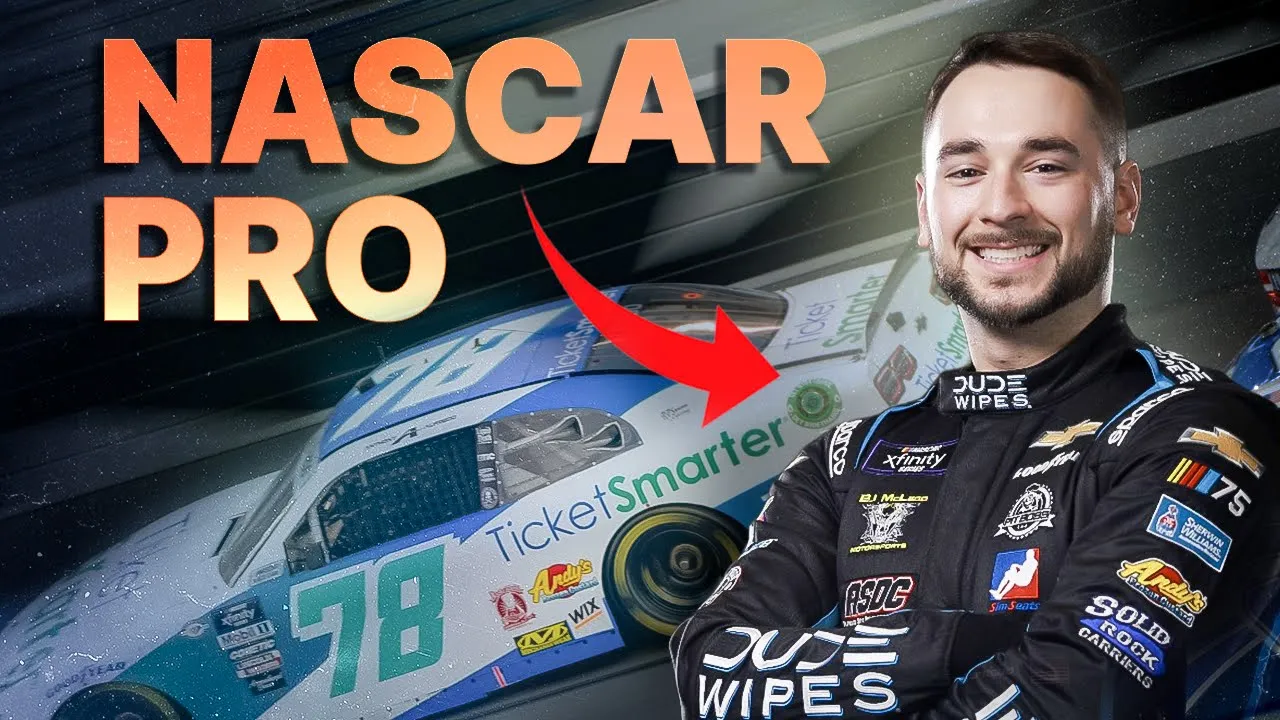
Can Sim Racing Coaching Improve a NASCAR Pro's Road Course Skills? | iRacing Coaching Session Breakdown
Suellio Almeida
•
Tuesday, April 25, 2023
The Challenge: Real Racing Speed Doesn't Always Translate
Connor isn't a beginner. He's a professional NASCAR driver with real-world racecraft, championship titles, and the muscle memory that comes from years of competition.
But on iRacing road courses? He was stuck at 3.5k iRating.
Here's the thing about real-world racing experience: it gives you insane situational awareness, fearlessness under pressure, and racecraft most sim racers will never have. But it doesn't automatically give you the precision techniques required for road racing at the top level.
Connor knew he had speed. He knew he had talent. But something wasn't clicking. He was fast enough to win races at his level — but not fast enough to compete with the aliens.
So we jumped on a call. One session. GT3 car. Watkins Glen. Let's see what's holding him back.
What I Saw in the First 30 Seconds of Telemetry
I pulled up Connor's telemetry from a qualifying lap. Before we even talked about racing line or braking points, I saw the problem.
He was overdriving the car.
Not in the way beginners overdrive — going too deep into corners and sliding everywhere. Connor's lines were clean. His inputs were smooth. But his braking zones were too aggressive for the speed he was carrying.
Here's what that looked like:
Turn 1 at Watkins Glen: Braking at the 3 marker, when he should've been braking at the 4.
Turn 5 (the uphill left-hander): Trying to carry so much speed that he'd understeer mid-corner and lose exit speed — the most important part of that turn.
Turn 11 (the final corner): Late on the brakes, which forced him to turn in late, which killed his momentum onto the front straight.
Every corner was costing him a few tenths. Add it up over a lap? 1.2 seconds.
That's the difference between 3.5k and 5k iRating.
I told him: "You're not losing time because you're slow. You're losing time because you're trying to go fast in the wrong places."
The Shift: Brake Earlier to Go Faster
This is the hardest thing for fast drivers to accept.
Braking earlier doesn't feel fast. It feels like you're leaving time on the table. It feels like you're being cautious.
But here's the physics: when you brake too late, you force the car into understeer. You scrub speed in the mid-corner. You delay your throttle application point. You sacrifice exit speed.
And in a GT3 car — or any car with a lot of aero and grip — exit speed is everything.
So I walked Connor through it, corner by corner.
Turn 1 — The Entry Sets Everything
Turn 1 at Watkins Glen is a high-speed right-hander. Connor was braking at the 3 board, trying to maximize his late braking.
The problem? He was arriving at the apex with too much mid-corner speed and not enough rotation. The car would push wide, he'd have to wait to get back on the throttle, and he'd lose speed down the entire back straight.
I told him: "Brake at the 4. Yes, it feels early. But watch what happens to your minimum speed and your throttle application point."
He tried it.
Lap time dropped by 0.3 seconds.
Not because he was going faster through Turn 1 — he was actually going slower at the apex. But he was getting on the throttle 0.2 seconds earlier and carrying 8 mph more onto the straight.
That's the game.
Turn 5 — Rotation Over Entry Speed
Turn 5 is an uphill left-hander that leads onto one of the fastest sections of the track. If you don't get a good exit here, you're losing time all the way through Turns 6, 7, 8, and 9.
Connor's instinct was to carry as much speed as possible into Turn 5. High minimum speed, aggressive turn-in.
But the car wouldn't rotate. It would understeer mid-corner, he'd have to unwind the wheel, and he'd be late on the throttle.
I had him try something counterintuitive: brake a little harder, carry less speed, but rotate the car more at the apex.
"Use trail braking to load the front tires. Get the car pointed. Then release the brake and let the car accelerate out."
He nailed it on the second attempt.
Minimum speed dropped by 2 mph. Exit speed increased by 6 mph.
That's the trade-off. You give up a little in the middle of the corner to gain a lot on the exit.
Turn 11 — The Lap Time Killer
The final corner at Watkins Glen is a long, sweeping right-hander onto the front straight. Get it wrong and you're slow for 8 seconds.
Connor was braking late, trying to maximize his entry. But he was turning in too late, which gave him a bad angle through the corner, which forced him to delay his throttle, which killed his speed onto the straight.
I told him: "Brake 10 meters earlier. Turn in earlier. Get the car pointing toward the exit as soon as possible. Your straight-line speed is more valuable than your corner entry speed."
He made the adjustment.
Exit speed increased by 4 mph. Lap time dropped another 0.4 seconds.
That one corner alone was worth nearly half a second. Not because he was driving harder — because he was driving smarter.
The Result: From 3.5k to Alien Pace in One Session
By the end of the session, Connor had dropped 1.2 seconds off his lap time.
He went from a 1:48.5 to a 1:47.3.
That's the difference between fighting for top 5 and fighting for podiums.
Here's what he said after the session:
"I knew I was leaving time on the table. I just didn't know where. Now I do. And I know how to fix it."
That's what coaching does. It gives you clarity.
You stop guessing. You stop blaming the car. You stop running the same lap over and over, hoping something will click.
You see the problem. You understand the fix. You execute.
The Technique: Why Brake Earlier, Throttle Earlier Wins
Let's break down the principle Connor learned — because it applies to every driver, every car, every track.
The Misconception: Late braking = fast lap times.
The Reality: Late braking often leads to mid-corner understeer, delayed throttle application, and slower exit speed.
Here's why:
1. When you brake late, you arrive at the corner with more speed than the tires can handle in the turn-in phase. The car understeers. You scrub speed.
2. When you scrub speed mid-corner, you delay your throttle application point. You're waiting for the car to settle instead of accelerating.
3. When you delay throttle application, you lose exit speed — and exit speed determines your speed for the entire next straight.
Now compare that to braking earlier:
1. You arrive at the apex with better rotation. The car is pointed where you want to go.
2. You can get on the throttle earlier because the car is stable and balanced.
3. Your exit speed is higher, which compounds over the entire lap.
The lap timer doesn't care how fast you were going into the corner. It cares how fast you were going out of the corner.
Exit speed is king.
What Real-World Racers Bring to Sim Racing
Here's what's interesting about coaching someone like Connor:
He didn't need to be taught racecraft. He didn't need to learn how to defend a position or how to read another driver's body language. He's been racing wheel-to-wheel at 180 mph for years.
What he needed was precision.
Real-world racing rewards aggression, instinct, and fearlessness. You feel the car. You react to the limit. You push.
Sim racing — especially at the alien level — rewards mathematical precision. The difference between a 5k driver and a 7k driver isn't bravery. It's optimization.
Every braking point is calculated. Every throttle application point is deliberate. Every racing line is tested in telemetry.
Connor had the instincts. He just needed to calibrate them for the specific demands of iRacing road racing.
And once he did? The speed was immediate.
The Mindset Shift That Unlocks Lap Time
The hardest part of this session wasn't the technique. It was the mindset shift.
Connor's instinct — like most fast drivers — was to push the limit everywhere. Brake as late as possible. Carry as much speed as possible. Attack every corner.
But speed isn't about attacking. It's about efficiency.
The fastest drivers don't try to go fast everywhere. They try to go fast in the places that matter most.
A slow entry to Turn 5? Doesn't matter — as long as the exit is fast.
A conservative braking point into Turn 11? Doesn't matter — as long as you're flat out onto the straight.
The lap timer doesn't measure effort. It measures results.
Once Connor internalized that, everything clicked.
He stopped trying to prove he was fast. He started trying to be correct.
And correctness, in racing, is speed.
Why One Session Isn't Enough
Connor dropped 1.2 seconds in one hour. That's huge.
But here's the truth: one session is just the beginning.
We identified the big problems. We fixed the low-hanging fruit. We gave him the roadmap.
But to go from 3.5k to 5k — or 5k to 7k — you need repetition. You need to internalize the techniques. You need to build new habits.
That's why the best drivers don't just do one coaching session and disappear. They train consistently. They review telemetry. They practice deliberately.
Speed isn't built in a day. It's built in a thousand laps where you're focused on one specific improvement at a time.
Connor now knows what to work on. He has the tools. He has the plan.
The rest is execution.
So What Would Change If You Had This Kind of Clarity?
How long have you been stuck at your current iRating?
How many laps have you run where you knew you were slow — but couldn't figure out why?
How many times have you blamed the car, the track, the other drivers — when the real issue was something you couldn't see in your own driving?
You're not slow because you lack talent. You're slow because you lack feedback.
Connor is a professional driver. He's won championships. He has more real-world experience than 99% of sim racers.
And he still needed someone to look at his telemetry and say: "Here's what you're missing."
Because you can't see your own blind spots. You can't analyze your own telemetry while you're driving. You can't coach yourself.
That's what coaching does. It shows you exactly where you're losing time — and exactly how to fix it.
No more guessing. No more YouTube rabbit holes. No more running the same lap 100 times and hoping something clicks.
You see the problem. You fix it. You go faster.
If a NASCAR pro can drop 1.2 seconds in one session, what could you do with someone analyzing your driving?
What if you finally understood why you're slow in that one corner? What if you learned how to brake later without understeering? What if you could look at your telemetry and know exactly what to change?
That's what 1:1 coaching with Almeida Racing Academy gives you.
One session. One car. One track. We find the time you're leaving on the table — and we show you how to take it back.
You can keep grinding alone. Or you can get the feedback that changes everything.
Sim Racing Academy Membership
Everything you need to stop guessing and start getting faster.
Starting at
$25
/mo
Car Handling Online Course
4 levels, full curriculum. Aimed to get you to top 1% in driving pace.
Racecraft Online Course
Overtaking, Defending, Race Strategy
Live coaching + on-track practice
Bi-weekly pro-coach workshops (recorded — never miss one) plus on-track Pit Parties to practice racecraft with a coach.
Plus These Bonuses
13,000+ Member Community
League Racing
Advanced MX-5 Mini Course
Racing Technique Development Guide
The Motor Racing Book (260 pages)
Think & Behave Like a Pro Driver — Mini eBook
Can Sim Racing Coaching Improve a NASCAR Pro's Road Course Skills? | iRacing Coaching Session Breakdown
Suellio Almeida
•
Tuesday, April 25, 2023
The Challenge: Real Racing Speed Doesn't Always Translate
Connor isn't a beginner. He's a professional NASCAR driver with real-world racecraft, championship titles, and the muscle memory that comes from years of competition.
But on iRacing road courses? He was stuck at 3.5k iRating.
Here's the thing about real-world racing experience: it gives you insane situational awareness, fearlessness under pressure, and racecraft most sim racers will never have. But it doesn't automatically give you the precision techniques required for road racing at the top level.
Connor knew he had speed. He knew he had talent. But something wasn't clicking. He was fast enough to win races at his level — but not fast enough to compete with the aliens.
So we jumped on a call. One session. GT3 car. Watkins Glen. Let's see what's holding him back.
What I Saw in the First 30 Seconds of Telemetry
I pulled up Connor's telemetry from a qualifying lap. Before we even talked about racing line or braking points, I saw the problem.
He was overdriving the car.
Not in the way beginners overdrive — going too deep into corners and sliding everywhere. Connor's lines were clean. His inputs were smooth. But his braking zones were too aggressive for the speed he was carrying.
Here's what that looked like:
Turn 1 at Watkins Glen: Braking at the 3 marker, when he should've been braking at the 4.
Turn 5 (the uphill left-hander): Trying to carry so much speed that he'd understeer mid-corner and lose exit speed — the most important part of that turn.
Turn 11 (the final corner): Late on the brakes, which forced him to turn in late, which killed his momentum onto the front straight.
Every corner was costing him a few tenths. Add it up over a lap? 1.2 seconds.
That's the difference between 3.5k and 5k iRating.
I told him: "You're not losing time because you're slow. You're losing time because you're trying to go fast in the wrong places."
The Shift: Brake Earlier to Go Faster
This is the hardest thing for fast drivers to accept.
Braking earlier doesn't feel fast. It feels like you're leaving time on the table. It feels like you're being cautious.
But here's the physics: when you brake too late, you force the car into understeer. You scrub speed in the mid-corner. You delay your throttle application point. You sacrifice exit speed.
And in a GT3 car — or any car with a lot of aero and grip — exit speed is everything.
So I walked Connor through it, corner by corner.
Turn 1 — The Entry Sets Everything
Turn 1 at Watkins Glen is a high-speed right-hander. Connor was braking at the 3 board, trying to maximize his late braking.
The problem? He was arriving at the apex with too much mid-corner speed and not enough rotation. The car would push wide, he'd have to wait to get back on the throttle, and he'd lose speed down the entire back straight.
I told him: "Brake at the 4. Yes, it feels early. But watch what happens to your minimum speed and your throttle application point."
He tried it.
Lap time dropped by 0.3 seconds.
Not because he was going faster through Turn 1 — he was actually going slower at the apex. But he was getting on the throttle 0.2 seconds earlier and carrying 8 mph more onto the straight.
That's the game.
Turn 5 — Rotation Over Entry Speed
Turn 5 is an uphill left-hander that leads onto one of the fastest sections of the track. If you don't get a good exit here, you're losing time all the way through Turns 6, 7, 8, and 9.
Connor's instinct was to carry as much speed as possible into Turn 5. High minimum speed, aggressive turn-in.
But the car wouldn't rotate. It would understeer mid-corner, he'd have to unwind the wheel, and he'd be late on the throttle.
I had him try something counterintuitive: brake a little harder, carry less speed, but rotate the car more at the apex.
"Use trail braking to load the front tires. Get the car pointed. Then release the brake and let the car accelerate out."
He nailed it on the second attempt.
Minimum speed dropped by 2 mph. Exit speed increased by 6 mph.
That's the trade-off. You give up a little in the middle of the corner to gain a lot on the exit.
Turn 11 — The Lap Time Killer
The final corner at Watkins Glen is a long, sweeping right-hander onto the front straight. Get it wrong and you're slow for 8 seconds.
Connor was braking late, trying to maximize his entry. But he was turning in too late, which gave him a bad angle through the corner, which forced him to delay his throttle, which killed his speed onto the straight.
I told him: "Brake 10 meters earlier. Turn in earlier. Get the car pointing toward the exit as soon as possible. Your straight-line speed is more valuable than your corner entry speed."
He made the adjustment.
Exit speed increased by 4 mph. Lap time dropped another 0.4 seconds.
That one corner alone was worth nearly half a second. Not because he was driving harder — because he was driving smarter.
The Result: From 3.5k to Alien Pace in One Session
By the end of the session, Connor had dropped 1.2 seconds off his lap time.
He went from a 1:48.5 to a 1:47.3.
That's the difference between fighting for top 5 and fighting for podiums.
Here's what he said after the session:
"I knew I was leaving time on the table. I just didn't know where. Now I do. And I know how to fix it."
That's what coaching does. It gives you clarity.
You stop guessing. You stop blaming the car. You stop running the same lap over and over, hoping something will click.
You see the problem. You understand the fix. You execute.
The Technique: Why Brake Earlier, Throttle Earlier Wins
Let's break down the principle Connor learned — because it applies to every driver, every car, every track.
The Misconception: Late braking = fast lap times.
The Reality: Late braking often leads to mid-corner understeer, delayed throttle application, and slower exit speed.
Here's why:
1. When you brake late, you arrive at the corner with more speed than the tires can handle in the turn-in phase. The car understeers. You scrub speed.
2. When you scrub speed mid-corner, you delay your throttle application point. You're waiting for the car to settle instead of accelerating.
3. When you delay throttle application, you lose exit speed — and exit speed determines your speed for the entire next straight.
Now compare that to braking earlier:
1. You arrive at the apex with better rotation. The car is pointed where you want to go.
2. You can get on the throttle earlier because the car is stable and balanced.
3. Your exit speed is higher, which compounds over the entire lap.
The lap timer doesn't care how fast you were going into the corner. It cares how fast you were going out of the corner.
Exit speed is king.
What Real-World Racers Bring to Sim Racing
Here's what's interesting about coaching someone like Connor:
He didn't need to be taught racecraft. He didn't need to learn how to defend a position or how to read another driver's body language. He's been racing wheel-to-wheel at 180 mph for years.
What he needed was precision.
Real-world racing rewards aggression, instinct, and fearlessness. You feel the car. You react to the limit. You push.
Sim racing — especially at the alien level — rewards mathematical precision. The difference between a 5k driver and a 7k driver isn't bravery. It's optimization.
Every braking point is calculated. Every throttle application point is deliberate. Every racing line is tested in telemetry.
Connor had the instincts. He just needed to calibrate them for the specific demands of iRacing road racing.
And once he did? The speed was immediate.
The Mindset Shift That Unlocks Lap Time
The hardest part of this session wasn't the technique. It was the mindset shift.
Connor's instinct — like most fast drivers — was to push the limit everywhere. Brake as late as possible. Carry as much speed as possible. Attack every corner.
But speed isn't about attacking. It's about efficiency.
The fastest drivers don't try to go fast everywhere. They try to go fast in the places that matter most.
A slow entry to Turn 5? Doesn't matter — as long as the exit is fast.
A conservative braking point into Turn 11? Doesn't matter — as long as you're flat out onto the straight.
The lap timer doesn't measure effort. It measures results.
Once Connor internalized that, everything clicked.
He stopped trying to prove he was fast. He started trying to be correct.
And correctness, in racing, is speed.
Why One Session Isn't Enough
Connor dropped 1.2 seconds in one hour. That's huge.
But here's the truth: one session is just the beginning.
We identified the big problems. We fixed the low-hanging fruit. We gave him the roadmap.
But to go from 3.5k to 5k — or 5k to 7k — you need repetition. You need to internalize the techniques. You need to build new habits.
That's why the best drivers don't just do one coaching session and disappear. They train consistently. They review telemetry. They practice deliberately.
Speed isn't built in a day. It's built in a thousand laps where you're focused on one specific improvement at a time.
Connor now knows what to work on. He has the tools. He has the plan.
The rest is execution.
So What Would Change If You Had This Kind of Clarity?
How long have you been stuck at your current iRating?
How many laps have you run where you knew you were slow — but couldn't figure out why?
How many times have you blamed the car, the track, the other drivers — when the real issue was something you couldn't see in your own driving?
You're not slow because you lack talent. You're slow because you lack feedback.
Connor is a professional driver. He's won championships. He has more real-world experience than 99% of sim racers.
And he still needed someone to look at his telemetry and say: "Here's what you're missing."
Because you can't see your own blind spots. You can't analyze your own telemetry while you're driving. You can't coach yourself.
That's what coaching does. It shows you exactly where you're losing time — and exactly how to fix it.
No more guessing. No more YouTube rabbit holes. No more running the same lap 100 times and hoping something clicks.
You see the problem. You fix it. You go faster.
If a NASCAR pro can drop 1.2 seconds in one session, what could you do with someone analyzing your driving?
What if you finally understood why you're slow in that one corner? What if you learned how to brake later without understeering? What if you could look at your telemetry and know exactly what to change?
That's what 1:1 coaching with Almeida Racing Academy gives you.
One session. One car. One track. We find the time you're leaving on the table — and we show you how to take it back.
You can keep grinding alone. Or you can get the feedback that changes everything.
Sim Racing Academy Membership
Everything you need to stop guessing and start getting faster.
Starting at
$25
/mo
Car Handling Online Course
4 levels, full curriculum. Aimed to get you to top 1% in driving pace.
Racecraft Online Course
Overtaking, Defending, Race Strategy
Live coaching + on-track practice
Bi-weekly pro-coach workshops (recorded — never miss one) plus on-track Pit Parties to practice racecraft with a coach.
Plus These Bonuses
13,000+ Member Community
League Racing
Advanced MX-5 Mini Course
Racing Technique Development Guide
The Motor Racing Book (260 pages)
Think & Behave Like a Pro Driver — Mini eBook
Can Sim Racing Coaching Improve a NASCAR Pro's Road Course Skills? | iRacing Coaching Session Breakdown
Suellio Almeida
•
Tuesday, April 25, 2023
The Challenge: Real Racing Speed Doesn't Always Translate
Connor isn't a beginner. He's a professional NASCAR driver with real-world racecraft, championship titles, and the muscle memory that comes from years of competition.
But on iRacing road courses? He was stuck at 3.5k iRating.
Here's the thing about real-world racing experience: it gives you insane situational awareness, fearlessness under pressure, and racecraft most sim racers will never have. But it doesn't automatically give you the precision techniques required for road racing at the top level.
Connor knew he had speed. He knew he had talent. But something wasn't clicking. He was fast enough to win races at his level — but not fast enough to compete with the aliens.
So we jumped on a call. One session. GT3 car. Watkins Glen. Let's see what's holding him back.
What I Saw in the First 30 Seconds of Telemetry
I pulled up Connor's telemetry from a qualifying lap. Before we even talked about racing line or braking points, I saw the problem.
He was overdriving the car.
Not in the way beginners overdrive — going too deep into corners and sliding everywhere. Connor's lines were clean. His inputs were smooth. But his braking zones were too aggressive for the speed he was carrying.
Here's what that looked like:
Turn 1 at Watkins Glen: Braking at the 3 marker, when he should've been braking at the 4.
Turn 5 (the uphill left-hander): Trying to carry so much speed that he'd understeer mid-corner and lose exit speed — the most important part of that turn.
Turn 11 (the final corner): Late on the brakes, which forced him to turn in late, which killed his momentum onto the front straight.
Every corner was costing him a few tenths. Add it up over a lap? 1.2 seconds.
That's the difference between 3.5k and 5k iRating.
I told him: "You're not losing time because you're slow. You're losing time because you're trying to go fast in the wrong places."
The Shift: Brake Earlier to Go Faster
This is the hardest thing for fast drivers to accept.
Braking earlier doesn't feel fast. It feels like you're leaving time on the table. It feels like you're being cautious.
But here's the physics: when you brake too late, you force the car into understeer. You scrub speed in the mid-corner. You delay your throttle application point. You sacrifice exit speed.
And in a GT3 car — or any car with a lot of aero and grip — exit speed is everything.
So I walked Connor through it, corner by corner.
Turn 1 — The Entry Sets Everything
Turn 1 at Watkins Glen is a high-speed right-hander. Connor was braking at the 3 board, trying to maximize his late braking.
The problem? He was arriving at the apex with too much mid-corner speed and not enough rotation. The car would push wide, he'd have to wait to get back on the throttle, and he'd lose speed down the entire back straight.
I told him: "Brake at the 4. Yes, it feels early. But watch what happens to your minimum speed and your throttle application point."
He tried it.
Lap time dropped by 0.3 seconds.
Not because he was going faster through Turn 1 — he was actually going slower at the apex. But he was getting on the throttle 0.2 seconds earlier and carrying 8 mph more onto the straight.
That's the game.
Turn 5 — Rotation Over Entry Speed
Turn 5 is an uphill left-hander that leads onto one of the fastest sections of the track. If you don't get a good exit here, you're losing time all the way through Turns 6, 7, 8, and 9.
Connor's instinct was to carry as much speed as possible into Turn 5. High minimum speed, aggressive turn-in.
But the car wouldn't rotate. It would understeer mid-corner, he'd have to unwind the wheel, and he'd be late on the throttle.
I had him try something counterintuitive: brake a little harder, carry less speed, but rotate the car more at the apex.
"Use trail braking to load the front tires. Get the car pointed. Then release the brake and let the car accelerate out."
He nailed it on the second attempt.
Minimum speed dropped by 2 mph. Exit speed increased by 6 mph.
That's the trade-off. You give up a little in the middle of the corner to gain a lot on the exit.
Turn 11 — The Lap Time Killer
The final corner at Watkins Glen is a long, sweeping right-hander onto the front straight. Get it wrong and you're slow for 8 seconds.
Connor was braking late, trying to maximize his entry. But he was turning in too late, which gave him a bad angle through the corner, which forced him to delay his throttle, which killed his speed onto the straight.
I told him: "Brake 10 meters earlier. Turn in earlier. Get the car pointing toward the exit as soon as possible. Your straight-line speed is more valuable than your corner entry speed."
He made the adjustment.
Exit speed increased by 4 mph. Lap time dropped another 0.4 seconds.
That one corner alone was worth nearly half a second. Not because he was driving harder — because he was driving smarter.
The Result: From 3.5k to Alien Pace in One Session
By the end of the session, Connor had dropped 1.2 seconds off his lap time.
He went from a 1:48.5 to a 1:47.3.
That's the difference between fighting for top 5 and fighting for podiums.
Here's what he said after the session:
"I knew I was leaving time on the table. I just didn't know where. Now I do. And I know how to fix it."
That's what coaching does. It gives you clarity.
You stop guessing. You stop blaming the car. You stop running the same lap over and over, hoping something will click.
You see the problem. You understand the fix. You execute.
The Technique: Why Brake Earlier, Throttle Earlier Wins
Let's break down the principle Connor learned — because it applies to every driver, every car, every track.
The Misconception: Late braking = fast lap times.
The Reality: Late braking often leads to mid-corner understeer, delayed throttle application, and slower exit speed.
Here's why:
1. When you brake late, you arrive at the corner with more speed than the tires can handle in the turn-in phase. The car understeers. You scrub speed.
2. When you scrub speed mid-corner, you delay your throttle application point. You're waiting for the car to settle instead of accelerating.
3. When you delay throttle application, you lose exit speed — and exit speed determines your speed for the entire next straight.
Now compare that to braking earlier:
1. You arrive at the apex with better rotation. The car is pointed where you want to go.
2. You can get on the throttle earlier because the car is stable and balanced.
3. Your exit speed is higher, which compounds over the entire lap.
The lap timer doesn't care how fast you were going into the corner. It cares how fast you were going out of the corner.
Exit speed is king.
What Real-World Racers Bring to Sim Racing
Here's what's interesting about coaching someone like Connor:
He didn't need to be taught racecraft. He didn't need to learn how to defend a position or how to read another driver's body language. He's been racing wheel-to-wheel at 180 mph for years.
What he needed was precision.
Real-world racing rewards aggression, instinct, and fearlessness. You feel the car. You react to the limit. You push.
Sim racing — especially at the alien level — rewards mathematical precision. The difference between a 5k driver and a 7k driver isn't bravery. It's optimization.
Every braking point is calculated. Every throttle application point is deliberate. Every racing line is tested in telemetry.
Connor had the instincts. He just needed to calibrate them for the specific demands of iRacing road racing.
And once he did? The speed was immediate.
The Mindset Shift That Unlocks Lap Time
The hardest part of this session wasn't the technique. It was the mindset shift.
Connor's instinct — like most fast drivers — was to push the limit everywhere. Brake as late as possible. Carry as much speed as possible. Attack every corner.
But speed isn't about attacking. It's about efficiency.
The fastest drivers don't try to go fast everywhere. They try to go fast in the places that matter most.
A slow entry to Turn 5? Doesn't matter — as long as the exit is fast.
A conservative braking point into Turn 11? Doesn't matter — as long as you're flat out onto the straight.
The lap timer doesn't measure effort. It measures results.
Once Connor internalized that, everything clicked.
He stopped trying to prove he was fast. He started trying to be correct.
And correctness, in racing, is speed.
Why One Session Isn't Enough
Connor dropped 1.2 seconds in one hour. That's huge.
But here's the truth: one session is just the beginning.
We identified the big problems. We fixed the low-hanging fruit. We gave him the roadmap.
But to go from 3.5k to 5k — or 5k to 7k — you need repetition. You need to internalize the techniques. You need to build new habits.
That's why the best drivers don't just do one coaching session and disappear. They train consistently. They review telemetry. They practice deliberately.
Speed isn't built in a day. It's built in a thousand laps where you're focused on one specific improvement at a time.
Connor now knows what to work on. He has the tools. He has the plan.
The rest is execution.
So What Would Change If You Had This Kind of Clarity?
How long have you been stuck at your current iRating?
How many laps have you run where you knew you were slow — but couldn't figure out why?
How many times have you blamed the car, the track, the other drivers — when the real issue was something you couldn't see in your own driving?
You're not slow because you lack talent. You're slow because you lack feedback.
Connor is a professional driver. He's won championships. He has more real-world experience than 99% of sim racers.
And he still needed someone to look at his telemetry and say: "Here's what you're missing."
Because you can't see your own blind spots. You can't analyze your own telemetry while you're driving. You can't coach yourself.
That's what coaching does. It shows you exactly where you're losing time — and exactly how to fix it.
No more guessing. No more YouTube rabbit holes. No more running the same lap 100 times and hoping something clicks.
You see the problem. You fix it. You go faster.
If a NASCAR pro can drop 1.2 seconds in one session, what could you do with someone analyzing your driving?
What if you finally understood why you're slow in that one corner? What if you learned how to brake later without understeering? What if you could look at your telemetry and know exactly what to change?
That's what 1:1 coaching with Almeida Racing Academy gives you.
One session. One car. One track. We find the time you're leaving on the table — and we show you how to take it back.
You can keep grinding alone. Or you can get the feedback that changes everything.
Sim Racing Academy Membership
Everything you need to stop guessing and start getting faster.
Starting at
$25
/mo
Car Handling Online Course
4 levels, full curriculum. Aimed to get you to top 1% in driving pace.
Racecraft Online Course
Overtaking, Defending, Race Strategy
Live coaching + on-track practice
Bi-weekly pro-coach workshops (recorded — never miss one) plus on-track Pit Parties to practice racecraft with a coach.
Plus These Bonuses
13,000+ Member Community
League Racing
Advanced MX-5 Mini Course
Racing Technique Development Guide
The Motor Racing Book (260 pages)
Think & Behave Like a Pro Driver — Mini eBook