
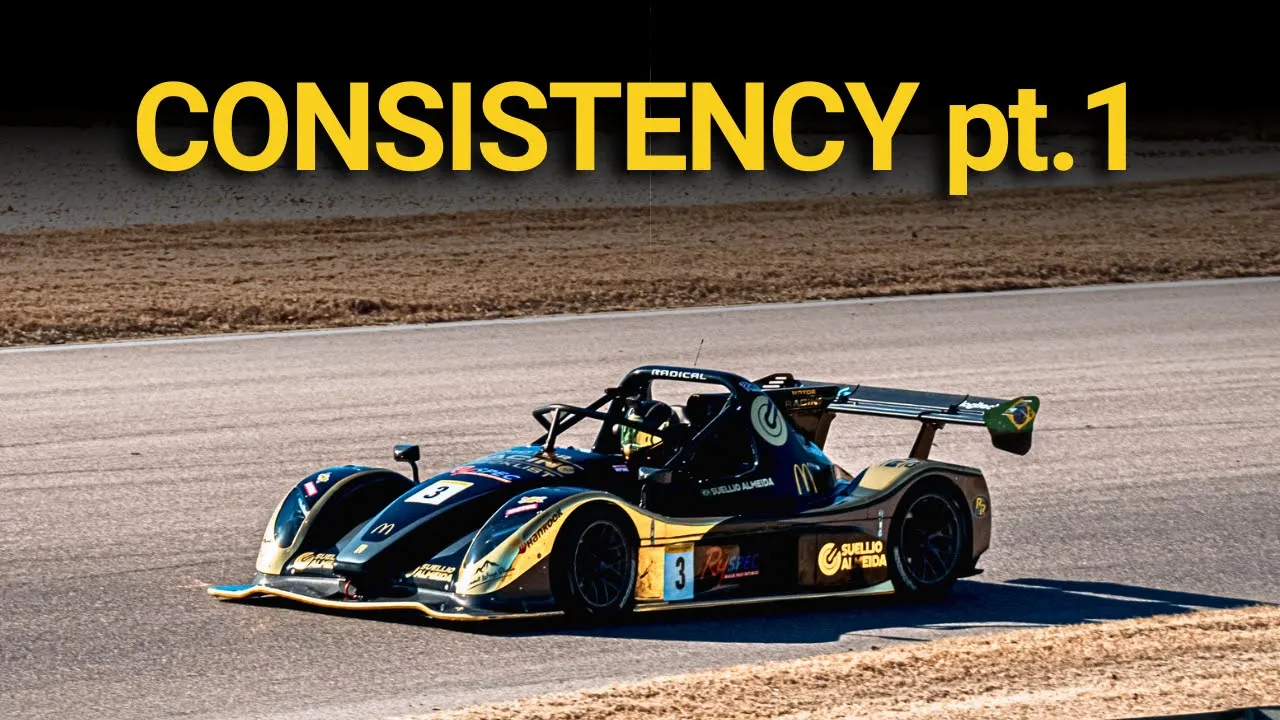
How to Brake Consistently in Sim Racing: The Secret Behind Fast Lap Times
Suellio Almeida
•
Monday, December 8, 2025
Why Your Braking Point Keeps Moving (And Why That's Actually Normal)
Let's start with the uncomfortable reality: your braking point will NEVER be exactly the same lap after lap.
I see drivers obsess over hitting the same marker every single time. They think consistency means robotic repetition. Then they get frustrated when lap 5 feels different than lap 1.
The thing is, your car changes. Your tires heat up. Fuel burns off. Track temperature shifts. Wind direction matters. The racing line evolves.
Consistency isn't about ignoring these variables. It's about adapting to them in real-time.
The Visual Reference System That Actually Works
Here's what separates amateur drivers from professionals: multiple reference points.
Most sim racers pick one brake marker and commit their entire corner entry to it. A sign. A cone. A crack in the pavement. Then when conditions change — even slightly — they're lost.
You need a system of visual references:
Primary marker — Your main braking point for optimal conditions.
Secondary marker — 10-20 meters earlier, your safety net when you're unsure or conditions are off.
Turn-in marker — Separate from braking. This tells you when to rotate the car.
Apex marker — Where your vision should be locked during entry.
When you have four distinct reference points instead of one, you can self-correct mid-corner. You start to feel if you're early or late on the brakes because you still have your turn-in marker coming up.
This is how I coached drivers from 2k iRating to 5k+ in months. They stopped guessing and started building a visual framework.
Brake Pressure: The Variable Everyone Gets Wrong
Right, so you've got your markers dialed in. Now the actual braking.
Here's the mistake: drivers think brake pressure should be consistent. It shouldn't.
What needs to be consistent is your brake application — the shape of how you load and release the pedal.
Let me break this down.
Lap 1, cold tires, full fuel: you need less peak pressure, more gradual application. If you slam 100% brake force into cold tires, you'll lock up instantly. The grip isn't there yet.
Lap 5, hot tires, lighter fuel: you can brake later and harder. The tire can take more load. You'll actually need more peak pressure to generate the same deceleration rate.
But here's what stays the same: the loading profile.
You should always:
Build pressure progressively (no stabbing)
Hit your peak pressure smoothly
Trail off gradually as you approach turn-in
Maintain light brake pressure through the apex if needed (trail braking)
The timing and magnitude of these phases change. The shape doesn't.
Basically, you're learning to feel how much brake the tire can handle right now, in this exact moment, and adjusting accordingly.
The One Drill That Fixed My Consistency (And My Students')
Want to actually practice this? Here's the drill I run with every coaching client.
5-Lap Consistency Test:
1. Pick one corner. Just one.
2. Run 5 laps focusing ONLY on that corner.
3. Record your minimum speed at the apex each lap.
4. Your goal: stay within 1 mph variation across all 5 laps.
No, seriously. 1 mph.
This forces you to adapt. Lap 1 with cold tires, you'll naturally carry less speed. Lap 3, you'll feel the grip window open up. Lap 5, you're pushing the limit.
But if you're truly consistent with your visual references and brake application, your apex speed spread stays tight.
When I do this drill with students, the first session usually shows 4-5 mph swings. After three practice sessions, we're down to 1-2 mph. That's real consistency.
And here's the thing: that 1 mph of apex speed consistency translates to 2-3 tenths per lap. Multiply that across 8-12 key corners on a track. You've just found a full second.
Setup Changes and Why Your Braking Needs to Evolve
Okay, another reality check: your brake consistency also depends on your car setup.
Brake bias is massive. If you're running too much rear bias, the rear will get loose under braking — your stopping distances become inconsistent because you're battling instability.
Too much front bias, you'll lock the fronts early and lose rotation. You'll brake in a straight line fine, but you'll struggle to trail brake effectively.
ABS settings (if your car has them) completely change your pedal feel. Non-ABS cars require much finer pressure control.
Differential settings affect how the car responds to trailing brake into a corner. A locked diff versus an open diff will change your entire approach.
You cannot separate driving consistency from setup consistency. They're linked.
This is why I always tell students: stop changing your setup every session. Lock in a baseline. Learn to drive it consistently. Then make changes and re-learn.
Jumping between setups every time you're slow? That's how you stay inconsistent forever.
Fuel Load and Tire Wear: The Reality of Stint Management
Let's talk about longer races, because this is where consistency matters most.
Your car at lap 1 with full fuel is a different machine than lap 20 with worn tires and low fuel.
Heavy fuel = longer braking distances. The car has more mass, more inertia. You need to brake earlier or harder (or both). The car will understeer more on entry.
As fuel burns off, your braking point moves deeper into the corner. If you don't adapt, you'll start arriving at the apex too slow. You'll feel like you're losing pace, but really, you're braking too early.
Tire wear compounds this. Fresh tires: shorter braking, more grip, you can attack. Worn tires: longer braking, less grip, you need to be smoother.
The drivers who dominate endurance races? They're constantly recalibrating their braking based on fuel load and tire condition. Every few laps, their markers shift slightly.
This is active consistency. Not robotic repetition.
The Mental Side: Why Overthinking Kills Your Braking
Here's something I learned the hard way transitioning from sim to real racing: you cannot think your way through a brake zone.
When you're coming into a 100 mph braking zone, you have maybe 2-3 seconds to execute. If you're consciously thinking about pressure, reference points, tire temp, fuel load — you're too slow.
Consistency comes from trained instinct.
You practice the visual system until it's automatic. You drill brake application until your foot knows the right pressure without thinking. You learn the feel of the car's weight transferring forward.
Then, in the race, you just drive.
Your conscious brain should be focused on racecraft: where's the car behind you, what's the gap to the car ahead, what's your tire strategy. Your subconscious handles the actual driving.
This is the difference between 36,000 students I've coached who improve versus the ones who plateau. The ones who plateau keep thinking. The ones who break through start feeling.
Why "Slow In, Fast Out" is Terrible Advice for Braking Consistency
Quick tangent: I need to kill this myth.
"Slow in, fast out" is the worst advice for developing consistent braking.
Yes, exit speed matters more than entry speed for lap time. That's physics. But if you use "slow in" as your strategy, you'll never learn where the actual limit is.
You'll always brake early. You'll always leave time on the table. And worse, you'll never develop the feedback loop that teaches you consistency.
Consistency comes from pushing to the edge and learning to ride it. Not from staying in the safe zone.
I've coached F1 engineers. I've coached guys running 9k iRating. None of them got fast by being cautious.
They got fast by learning their limits, then learning to hit those limits lap after lap after lap.
That's consistency.
Are You Practicing Braking or Just Hoping It Clicks?
Here's the question I ask every driver who comes to me frustrated with their consistency: When's the last time you deliberately practiced your braking?
Not just racing. Not just hotlapping. Actually isolating your brake zones and drilling them with intention.
Most drivers never do this. They just race and hope their braking magically improves.
It won't.
You need deliberate practice. The 5-Lap Consistency Test I mentioned earlier? That's deliberate practice. You're isolating one skill, measuring it, getting feedback, adjusting.
This is how I went from amateur sim racer to Canadian Sim Racing Champion to competing in IMSA. I didn't just drive more. I practiced better.
And this is exactly what we teach inside Almeida Racing Academy. Not vague tips. Not YouTube guesswork. Structured training that actually builds skills.
Because here's the reality: you're not going to stumble into consistency. You have to build it, corner by corner, lap by lap.
How Much Faster Could You Be If Your Braking Was Actually Dialed?
Think about your last race.
How many times did you miss your braking point? How many times did you arrive at the apex too fast or too slow? How many times did you lock up or get on the brakes too soft?
Now multiply that inconsistency across every braking zone on the track. Across an entire race stint.
That's not just a few tenths. That's seconds. That's positions. That's the difference between fighting for top-5 and fighting for podiums.
The fastest drivers aren't necessarily the most talented. They're the most consistent. They've systematized their braking. They've built the visual references. They've trained the muscle memory.
And they've done it through structured practice, not just seat time.
If you're serious about getting consistent — if you're tired of the guessing and the plateaus — we built something specifically for this.
Start with the free Car Handling course
and see how real coaching changes your driving. 11 lessons, zero cost, instant access. Then decide if you're ready for the full Gold membership and the rest of the system.
Or keep doing what you're doing and hope it clicks.
Your call.
Sim Racing Academy Membership
Everything you need to stop guessing and start getting faster.
Starting at
$25
/mo
Car Handling Online Course
4 levels, full curriculum. Aimed to get you to top 1% in driving pace.
Racecraft Online Course
Overtaking, Defending, Race Strategy
Live coaching + on-track practice
Bi-weekly pro-coach workshops (recorded — never miss one) plus on-track Pit Parties to practice racecraft with a coach.
Plus These Bonuses
13,000+ Member Community
League Racing
Advanced MX-5 Mini Course
Racing Technique Development Guide
The Motor Racing Book (260 pages)
Think & Behave Like a Pro Driver — Mini eBook
How to Brake Consistently in Sim Racing: The Secret Behind Fast Lap Times
Suellio Almeida
•
Monday, December 8, 2025
Why Your Braking Point Keeps Moving (And Why That's Actually Normal)
Let's start with the uncomfortable reality: your braking point will NEVER be exactly the same lap after lap.
I see drivers obsess over hitting the same marker every single time. They think consistency means robotic repetition. Then they get frustrated when lap 5 feels different than lap 1.
The thing is, your car changes. Your tires heat up. Fuel burns off. Track temperature shifts. Wind direction matters. The racing line evolves.
Consistency isn't about ignoring these variables. It's about adapting to them in real-time.
The Visual Reference System That Actually Works
Here's what separates amateur drivers from professionals: multiple reference points.
Most sim racers pick one brake marker and commit their entire corner entry to it. A sign. A cone. A crack in the pavement. Then when conditions change — even slightly — they're lost.
You need a system of visual references:
Primary marker — Your main braking point for optimal conditions.
Secondary marker — 10-20 meters earlier, your safety net when you're unsure or conditions are off.
Turn-in marker — Separate from braking. This tells you when to rotate the car.
Apex marker — Where your vision should be locked during entry.
When you have four distinct reference points instead of one, you can self-correct mid-corner. You start to feel if you're early or late on the brakes because you still have your turn-in marker coming up.
This is how I coached drivers from 2k iRating to 5k+ in months. They stopped guessing and started building a visual framework.
Brake Pressure: The Variable Everyone Gets Wrong
Right, so you've got your markers dialed in. Now the actual braking.
Here's the mistake: drivers think brake pressure should be consistent. It shouldn't.
What needs to be consistent is your brake application — the shape of how you load and release the pedal.
Let me break this down.
Lap 1, cold tires, full fuel: you need less peak pressure, more gradual application. If you slam 100% brake force into cold tires, you'll lock up instantly. The grip isn't there yet.
Lap 5, hot tires, lighter fuel: you can brake later and harder. The tire can take more load. You'll actually need more peak pressure to generate the same deceleration rate.
But here's what stays the same: the loading profile.
You should always:
Build pressure progressively (no stabbing)
Hit your peak pressure smoothly
Trail off gradually as you approach turn-in
Maintain light brake pressure through the apex if needed (trail braking)
The timing and magnitude of these phases change. The shape doesn't.
Basically, you're learning to feel how much brake the tire can handle right now, in this exact moment, and adjusting accordingly.
The One Drill That Fixed My Consistency (And My Students')
Want to actually practice this? Here's the drill I run with every coaching client.
5-Lap Consistency Test:
1. Pick one corner. Just one.
2. Run 5 laps focusing ONLY on that corner.
3. Record your minimum speed at the apex each lap.
4. Your goal: stay within 1 mph variation across all 5 laps.
No, seriously. 1 mph.
This forces you to adapt. Lap 1 with cold tires, you'll naturally carry less speed. Lap 3, you'll feel the grip window open up. Lap 5, you're pushing the limit.
But if you're truly consistent with your visual references and brake application, your apex speed spread stays tight.
When I do this drill with students, the first session usually shows 4-5 mph swings. After three practice sessions, we're down to 1-2 mph. That's real consistency.
And here's the thing: that 1 mph of apex speed consistency translates to 2-3 tenths per lap. Multiply that across 8-12 key corners on a track. You've just found a full second.
Setup Changes and Why Your Braking Needs to Evolve
Okay, another reality check: your brake consistency also depends on your car setup.
Brake bias is massive. If you're running too much rear bias, the rear will get loose under braking — your stopping distances become inconsistent because you're battling instability.
Too much front bias, you'll lock the fronts early and lose rotation. You'll brake in a straight line fine, but you'll struggle to trail brake effectively.
ABS settings (if your car has them) completely change your pedal feel. Non-ABS cars require much finer pressure control.
Differential settings affect how the car responds to trailing brake into a corner. A locked diff versus an open diff will change your entire approach.
You cannot separate driving consistency from setup consistency. They're linked.
This is why I always tell students: stop changing your setup every session. Lock in a baseline. Learn to drive it consistently. Then make changes and re-learn.
Jumping between setups every time you're slow? That's how you stay inconsistent forever.
Fuel Load and Tire Wear: The Reality of Stint Management
Let's talk about longer races, because this is where consistency matters most.
Your car at lap 1 with full fuel is a different machine than lap 20 with worn tires and low fuel.
Heavy fuel = longer braking distances. The car has more mass, more inertia. You need to brake earlier or harder (or both). The car will understeer more on entry.
As fuel burns off, your braking point moves deeper into the corner. If you don't adapt, you'll start arriving at the apex too slow. You'll feel like you're losing pace, but really, you're braking too early.
Tire wear compounds this. Fresh tires: shorter braking, more grip, you can attack. Worn tires: longer braking, less grip, you need to be smoother.
The drivers who dominate endurance races? They're constantly recalibrating their braking based on fuel load and tire condition. Every few laps, their markers shift slightly.
This is active consistency. Not robotic repetition.
The Mental Side: Why Overthinking Kills Your Braking
Here's something I learned the hard way transitioning from sim to real racing: you cannot think your way through a brake zone.
When you're coming into a 100 mph braking zone, you have maybe 2-3 seconds to execute. If you're consciously thinking about pressure, reference points, tire temp, fuel load — you're too slow.
Consistency comes from trained instinct.
You practice the visual system until it's automatic. You drill brake application until your foot knows the right pressure without thinking. You learn the feel of the car's weight transferring forward.
Then, in the race, you just drive.
Your conscious brain should be focused on racecraft: where's the car behind you, what's the gap to the car ahead, what's your tire strategy. Your subconscious handles the actual driving.
This is the difference between 36,000 students I've coached who improve versus the ones who plateau. The ones who plateau keep thinking. The ones who break through start feeling.
Why "Slow In, Fast Out" is Terrible Advice for Braking Consistency
Quick tangent: I need to kill this myth.
"Slow in, fast out" is the worst advice for developing consistent braking.
Yes, exit speed matters more than entry speed for lap time. That's physics. But if you use "slow in" as your strategy, you'll never learn where the actual limit is.
You'll always brake early. You'll always leave time on the table. And worse, you'll never develop the feedback loop that teaches you consistency.
Consistency comes from pushing to the edge and learning to ride it. Not from staying in the safe zone.
I've coached F1 engineers. I've coached guys running 9k iRating. None of them got fast by being cautious.
They got fast by learning their limits, then learning to hit those limits lap after lap after lap.
That's consistency.
Are You Practicing Braking or Just Hoping It Clicks?
Here's the question I ask every driver who comes to me frustrated with their consistency: When's the last time you deliberately practiced your braking?
Not just racing. Not just hotlapping. Actually isolating your brake zones and drilling them with intention.
Most drivers never do this. They just race and hope their braking magically improves.
It won't.
You need deliberate practice. The 5-Lap Consistency Test I mentioned earlier? That's deliberate practice. You're isolating one skill, measuring it, getting feedback, adjusting.
This is how I went from amateur sim racer to Canadian Sim Racing Champion to competing in IMSA. I didn't just drive more. I practiced better.
And this is exactly what we teach inside Almeida Racing Academy. Not vague tips. Not YouTube guesswork. Structured training that actually builds skills.
Because here's the reality: you're not going to stumble into consistency. You have to build it, corner by corner, lap by lap.
How Much Faster Could You Be If Your Braking Was Actually Dialed?
Think about your last race.
How many times did you miss your braking point? How many times did you arrive at the apex too fast or too slow? How many times did you lock up or get on the brakes too soft?
Now multiply that inconsistency across every braking zone on the track. Across an entire race stint.
That's not just a few tenths. That's seconds. That's positions. That's the difference between fighting for top-5 and fighting for podiums.
The fastest drivers aren't necessarily the most talented. They're the most consistent. They've systematized their braking. They've built the visual references. They've trained the muscle memory.
And they've done it through structured practice, not just seat time.
If you're serious about getting consistent — if you're tired of the guessing and the plateaus — we built something specifically for this.
Start with the free Car Handling course
and see how real coaching changes your driving. 11 lessons, zero cost, instant access. Then decide if you're ready for the full Gold membership and the rest of the system.
Or keep doing what you're doing and hope it clicks.
Your call.
Sim Racing Academy Membership
Everything you need to stop guessing and start getting faster.
Starting at
$25
/mo
Car Handling Online Course
4 levels, full curriculum. Aimed to get you to top 1% in driving pace.
Racecraft Online Course
Overtaking, Defending, Race Strategy
Live coaching + on-track practice
Bi-weekly pro-coach workshops (recorded — never miss one) plus on-track Pit Parties to practice racecraft with a coach.
Plus These Bonuses
13,000+ Member Community
League Racing
Advanced MX-5 Mini Course
Racing Technique Development Guide
The Motor Racing Book (260 pages)
Think & Behave Like a Pro Driver — Mini eBook
How to Brake Consistently in Sim Racing: The Secret Behind Fast Lap Times
Suellio Almeida
•
Monday, December 8, 2025
Why Your Braking Point Keeps Moving (And Why That's Actually Normal)
Let's start with the uncomfortable reality: your braking point will NEVER be exactly the same lap after lap.
I see drivers obsess over hitting the same marker every single time. They think consistency means robotic repetition. Then they get frustrated when lap 5 feels different than lap 1.
The thing is, your car changes. Your tires heat up. Fuel burns off. Track temperature shifts. Wind direction matters. The racing line evolves.
Consistency isn't about ignoring these variables. It's about adapting to them in real-time.
The Visual Reference System That Actually Works
Here's what separates amateur drivers from professionals: multiple reference points.
Most sim racers pick one brake marker and commit their entire corner entry to it. A sign. A cone. A crack in the pavement. Then when conditions change — even slightly — they're lost.
You need a system of visual references:
Primary marker — Your main braking point for optimal conditions.
Secondary marker — 10-20 meters earlier, your safety net when you're unsure or conditions are off.
Turn-in marker — Separate from braking. This tells you when to rotate the car.
Apex marker — Where your vision should be locked during entry.
When you have four distinct reference points instead of one, you can self-correct mid-corner. You start to feel if you're early or late on the brakes because you still have your turn-in marker coming up.
This is how I coached drivers from 2k iRating to 5k+ in months. They stopped guessing and started building a visual framework.
Brake Pressure: The Variable Everyone Gets Wrong
Right, so you've got your markers dialed in. Now the actual braking.
Here's the mistake: drivers think brake pressure should be consistent. It shouldn't.
What needs to be consistent is your brake application — the shape of how you load and release the pedal.
Let me break this down.
Lap 1, cold tires, full fuel: you need less peak pressure, more gradual application. If you slam 100% brake force into cold tires, you'll lock up instantly. The grip isn't there yet.
Lap 5, hot tires, lighter fuel: you can brake later and harder. The tire can take more load. You'll actually need more peak pressure to generate the same deceleration rate.
But here's what stays the same: the loading profile.
You should always:
Build pressure progressively (no stabbing)
Hit your peak pressure smoothly
Trail off gradually as you approach turn-in
Maintain light brake pressure through the apex if needed (trail braking)
The timing and magnitude of these phases change. The shape doesn't.
Basically, you're learning to feel how much brake the tire can handle right now, in this exact moment, and adjusting accordingly.
The One Drill That Fixed My Consistency (And My Students')
Want to actually practice this? Here's the drill I run with every coaching client.
5-Lap Consistency Test:
1. Pick one corner. Just one.
2. Run 5 laps focusing ONLY on that corner.
3. Record your minimum speed at the apex each lap.
4. Your goal: stay within 1 mph variation across all 5 laps.
No, seriously. 1 mph.
This forces you to adapt. Lap 1 with cold tires, you'll naturally carry less speed. Lap 3, you'll feel the grip window open up. Lap 5, you're pushing the limit.
But if you're truly consistent with your visual references and brake application, your apex speed spread stays tight.
When I do this drill with students, the first session usually shows 4-5 mph swings. After three practice sessions, we're down to 1-2 mph. That's real consistency.
And here's the thing: that 1 mph of apex speed consistency translates to 2-3 tenths per lap. Multiply that across 8-12 key corners on a track. You've just found a full second.
Setup Changes and Why Your Braking Needs to Evolve
Okay, another reality check: your brake consistency also depends on your car setup.
Brake bias is massive. If you're running too much rear bias, the rear will get loose under braking — your stopping distances become inconsistent because you're battling instability.
Too much front bias, you'll lock the fronts early and lose rotation. You'll brake in a straight line fine, but you'll struggle to trail brake effectively.
ABS settings (if your car has them) completely change your pedal feel. Non-ABS cars require much finer pressure control.
Differential settings affect how the car responds to trailing brake into a corner. A locked diff versus an open diff will change your entire approach.
You cannot separate driving consistency from setup consistency. They're linked.
This is why I always tell students: stop changing your setup every session. Lock in a baseline. Learn to drive it consistently. Then make changes and re-learn.
Jumping between setups every time you're slow? That's how you stay inconsistent forever.
Fuel Load and Tire Wear: The Reality of Stint Management
Let's talk about longer races, because this is where consistency matters most.
Your car at lap 1 with full fuel is a different machine than lap 20 with worn tires and low fuel.
Heavy fuel = longer braking distances. The car has more mass, more inertia. You need to brake earlier or harder (or both). The car will understeer more on entry.
As fuel burns off, your braking point moves deeper into the corner. If you don't adapt, you'll start arriving at the apex too slow. You'll feel like you're losing pace, but really, you're braking too early.
Tire wear compounds this. Fresh tires: shorter braking, more grip, you can attack. Worn tires: longer braking, less grip, you need to be smoother.
The drivers who dominate endurance races? They're constantly recalibrating their braking based on fuel load and tire condition. Every few laps, their markers shift slightly.
This is active consistency. Not robotic repetition.
The Mental Side: Why Overthinking Kills Your Braking
Here's something I learned the hard way transitioning from sim to real racing: you cannot think your way through a brake zone.
When you're coming into a 100 mph braking zone, you have maybe 2-3 seconds to execute. If you're consciously thinking about pressure, reference points, tire temp, fuel load — you're too slow.
Consistency comes from trained instinct.
You practice the visual system until it's automatic. You drill brake application until your foot knows the right pressure without thinking. You learn the feel of the car's weight transferring forward.
Then, in the race, you just drive.
Your conscious brain should be focused on racecraft: where's the car behind you, what's the gap to the car ahead, what's your tire strategy. Your subconscious handles the actual driving.
This is the difference between 36,000 students I've coached who improve versus the ones who plateau. The ones who plateau keep thinking. The ones who break through start feeling.
Why "Slow In, Fast Out" is Terrible Advice for Braking Consistency
Quick tangent: I need to kill this myth.
"Slow in, fast out" is the worst advice for developing consistent braking.
Yes, exit speed matters more than entry speed for lap time. That's physics. But if you use "slow in" as your strategy, you'll never learn where the actual limit is.
You'll always brake early. You'll always leave time on the table. And worse, you'll never develop the feedback loop that teaches you consistency.
Consistency comes from pushing to the edge and learning to ride it. Not from staying in the safe zone.
I've coached F1 engineers. I've coached guys running 9k iRating. None of them got fast by being cautious.
They got fast by learning their limits, then learning to hit those limits lap after lap after lap.
That's consistency.
Are You Practicing Braking or Just Hoping It Clicks?
Here's the question I ask every driver who comes to me frustrated with their consistency: When's the last time you deliberately practiced your braking?
Not just racing. Not just hotlapping. Actually isolating your brake zones and drilling them with intention.
Most drivers never do this. They just race and hope their braking magically improves.
It won't.
You need deliberate practice. The 5-Lap Consistency Test I mentioned earlier? That's deliberate practice. You're isolating one skill, measuring it, getting feedback, adjusting.
This is how I went from amateur sim racer to Canadian Sim Racing Champion to competing in IMSA. I didn't just drive more. I practiced better.
And this is exactly what we teach inside Almeida Racing Academy. Not vague tips. Not YouTube guesswork. Structured training that actually builds skills.
Because here's the reality: you're not going to stumble into consistency. You have to build it, corner by corner, lap by lap.
How Much Faster Could You Be If Your Braking Was Actually Dialed?
Think about your last race.
How many times did you miss your braking point? How many times did you arrive at the apex too fast or too slow? How many times did you lock up or get on the brakes too soft?
Now multiply that inconsistency across every braking zone on the track. Across an entire race stint.
That's not just a few tenths. That's seconds. That's positions. That's the difference between fighting for top-5 and fighting for podiums.
The fastest drivers aren't necessarily the most talented. They're the most consistent. They've systematized their braking. They've built the visual references. They've trained the muscle memory.
And they've done it through structured practice, not just seat time.
If you're serious about getting consistent — if you're tired of the guessing and the plateaus — we built something specifically for this.
Start with the free Car Handling course
and see how real coaching changes your driving. 11 lessons, zero cost, instant access. Then decide if you're ready for the full Gold membership and the rest of the system.
Or keep doing what you're doing and hope it clicks.
Your call.
Sim Racing Academy Membership
Everything you need to stop guessing and start getting faster.
Starting at
$25
/mo
Car Handling Online Course
4 levels, full curriculum. Aimed to get you to top 1% in driving pace.
Racecraft Online Course
Overtaking, Defending, Race Strategy
Live coaching + on-track practice
Bi-weekly pro-coach workshops (recorded — never miss one) plus on-track Pit Parties to practice racecraft with a coach.
Plus These Bonuses
13,000+ Member Community
League Racing
Advanced MX-5 Mini Course
Racing Technique Development Guide
The Motor Racing Book (260 pages)
Think & Behave Like a Pro Driver — Mini eBook