
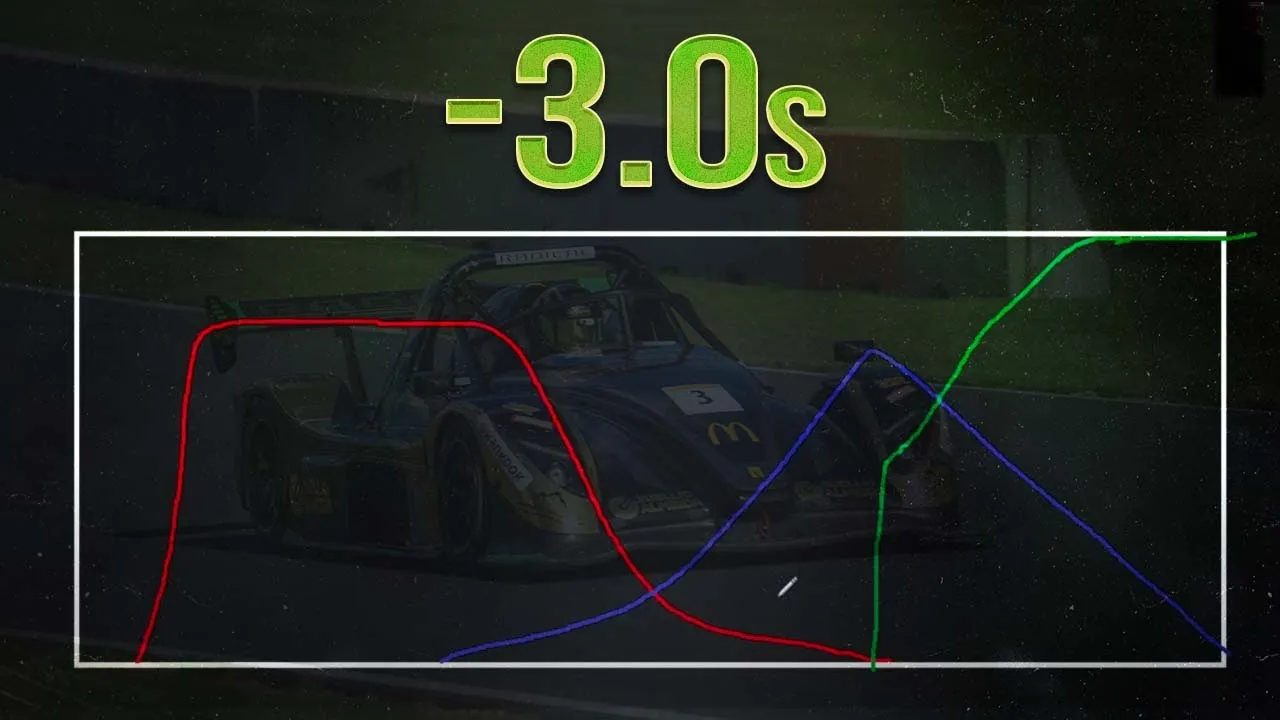
The Biggest Trail Braking Mistake That's Costing You Seconds Per Lap
Suellio Almeida
•
Tuesday, July 30, 2024
Why Your Trail Braking Isn't Working
You brake deep into the corner. You release the pedal smoothly. You think you're nailing trail braking.
But your lap times aren't dropping.
Here's what's actually happening: you're trail braking for the sake of trail braking. You're following a technique without understanding what that technique is supposed to accomplish. And that's the mistake that separates drivers who improve from drivers who plateau.
Trail braking isn't about keeping your foot on the brake as long as possible. It's about controlling weight transfer to maximize front grip exactly when and where you need it.
Let me break down what that actually means.
The Physics You're Missing
When you brake, weight transfers to the front tires. More weight = more grip. That's basic.
But here's the part most drivers ignore: front grip is what allows you to turn the car.
If you release the brakes too early — before you've initiated the turn — the weight shifts back. The front tires unload. And suddenly you don't have the grip you need to rotate the car into the apex.
What happens? Understeer. You miss the apex. You have to wait longer to get back on throttle. You lose time.
So you try to compensate by braking later or turning in sharper. But that just makes it worse because now you're asking the front tires to handle both braking AND turning forces at the same time, which exceeds their grip threshold.
The real solution? Trail brake through the turn-in phase to maintain front load exactly as you're asking the car to rotate.
The Three Phases of Corner Entry (And Where Trail Braking Actually Matters)
Phase 1: Initial Braking
This is your straight-line threshold braking. Maximum pressure. The car is still pointed straight. You're scrubbing speed.
Trail braking hasn't started yet. Don't confuse hard braking with trail braking — they're different techniques serving different purposes.
Phase 2: Turn-In (Where Trail Braking Happens)
Now you're beginning to rotate the steering wheel. This is where trail braking becomes critical.
As you turn in, you need to gradually reduce brake pressure while maintaining front load. Not release completely — reduce gradually.
The weight stays on the front. The front tires stay loaded. The car rotates willingly into the corner.
This is the phase most drivers get wrong. They either:
Release the brakes completely at turn-in (front unloads, understeer)
Keep too much brake pressure (front overloads, locks up or can't handle combined forces)
The sweet spot is a smooth, progressive release that matches your steering input.
Phase 3: Apex and Exit
By the time you reach the apex, you should be off the brakes completely and beginning throttle application.
If you're still on the brakes at apex, you've trail braked too long. The front is still loaded when it should be transferring weight rearward for exit traction.
The Real Mistake: Trail Braking Without Purpose
Here's what I see constantly: drivers trail braking on corners where it doesn't help — or worse, where it hurts.
Not every corner needs aggressive trail braking.
Fast, sweeping corners? Minimal trail braking. Maybe none. You need platform stability, not front rotation. Carrying brake pressure too deep upsets the car and kills your minimum speed.
Tight, slow corners? This is where trail braking shines. You need that front load to help the car rotate into a tight radius.
Front-limited cars (understeer-prone)? Trail braking helps. You're using weight transfer to compensate for a balance problem.
Rear-limited cars (oversteer-prone)? Be careful. Aggressive trail braking can overrotate the car and spin you. You might need earlier, smoother releases.
The technique isn't universal. You have to adapt it based on corner type, car balance, and what the car is telling you.
How to Fix Your Trail Braking Right Now
Step 1: Identify Your Current Pattern
Go into telemetry or just pay attention to your pedal inputs. Where are you releasing the brake relative to your steering input?
Releasing before you turn? You're giving up rotation.
Holding brake past apex? You're overslowing and delaying throttle.
Releasing too abruptly? You're unloading the front too quickly.
Step 2: Match Brake Release to Steering Input
As you begin turning the wheel, begin releasing the brake. The two movements should be coordinated, not separate.
Think of it like a lever: as steering goes up, brake pressure comes down. Smooth. Progressive. Connected.
Step 3: Feel the Car's Response
The car will tell you if you're doing it right.
Car rotates willingly, front feels planted = good trail braking
Front pushes wide, understeer = released too early or not enough brake pressure
Car feels nervous, rear steps out = too much brake pressure too late
Adjust based on feedback. This isn't a memorized pattern — it's a dynamic skill.
Step 4: Practice Corner by Corner
Don't try to fix every corner at once. Pick one corner. Nail the trail braking there. Then move to the next.
Muscle memory builds through repetition on specific corners, not vague attempts everywhere.
The Difference This Makes in Lap Time
Proper trail braking doesn't just shave a tenth here and there. It fundamentally changes how the car behaves through the entire corner sequence.
Better rotation at entry = earlier throttle at exit = more speed down the straight.
One corner might only gain you a tenth. But five corners per lap? Half a second. Over a race stint? You're in a completely different position.
And beyond lap time, it gives you racecraft. You can brake later because you have the control to actually use that extra speed. You can defend inside lines. You can overtake where others can't.
That's the real value.
What's Actually Holding You Back?
You've read this article. You understand the physics. You know what to do.
But here's the question: how long have you been trying to improve your trail braking on your own?
How many laps have you run where you thought you were doing it right, but the lap times didn't reflect it? How many times have you fixed one corner only to create a new problem somewhere else?
The difference between understanding a technique and actually executing it under pressure — that's where most drivers get stuck. Because you can't see your own inputs in real-time. You can't analyze your telemetry the way a coach can. You're guessing.
That's exactly why we built Almeida Racing Academy. Not generic YouTube tips. Not guesswork. A structured system that takes you from "I think I'm doing this right" to "I know exactly what I'm doing and the lap times prove it."
8 courses. 80 lessons. Coach-led workshops breaking down trail braking, weight transfer, racecraft, data analysis — every technique you actually need. And right now, Gold Membership is $25/month with code WINTER.
The method works. 36,000+ students. Proven iRating gains. Real lap time drops.
Ready to stop guessing?
Sim Racing Academy Membership
Everything you need to stop guessing and start getting faster.
Starting at
$25
/mo
Car Handling Online Course
4 levels, full curriculum. Aimed to get you to top 1% in driving pace.
Racecraft Online Course
Overtaking, Defending, Race Strategy
Live coaching + on-track practice
Bi-weekly pro-coach workshops (recorded — never miss one) plus on-track Pit Parties to practice racecraft with a coach.
Plus These Bonuses
13,000+ Member Community
League Racing
Advanced MX-5 Mini Course
Racing Technique Development Guide
The Motor Racing Book (260 pages)
Think & Behave Like a Pro Driver — Mini eBook
The Biggest Trail Braking Mistake That's Costing You Seconds Per Lap
Suellio Almeida
•
Tuesday, July 30, 2024
Why Your Trail Braking Isn't Working
You brake deep into the corner. You release the pedal smoothly. You think you're nailing trail braking.
But your lap times aren't dropping.
Here's what's actually happening: you're trail braking for the sake of trail braking. You're following a technique without understanding what that technique is supposed to accomplish. And that's the mistake that separates drivers who improve from drivers who plateau.
Trail braking isn't about keeping your foot on the brake as long as possible. It's about controlling weight transfer to maximize front grip exactly when and where you need it.
Let me break down what that actually means.
The Physics You're Missing
When you brake, weight transfers to the front tires. More weight = more grip. That's basic.
But here's the part most drivers ignore: front grip is what allows you to turn the car.
If you release the brakes too early — before you've initiated the turn — the weight shifts back. The front tires unload. And suddenly you don't have the grip you need to rotate the car into the apex.
What happens? Understeer. You miss the apex. You have to wait longer to get back on throttle. You lose time.
So you try to compensate by braking later or turning in sharper. But that just makes it worse because now you're asking the front tires to handle both braking AND turning forces at the same time, which exceeds their grip threshold.
The real solution? Trail brake through the turn-in phase to maintain front load exactly as you're asking the car to rotate.
The Three Phases of Corner Entry (And Where Trail Braking Actually Matters)
Phase 1: Initial Braking
This is your straight-line threshold braking. Maximum pressure. The car is still pointed straight. You're scrubbing speed.
Trail braking hasn't started yet. Don't confuse hard braking with trail braking — they're different techniques serving different purposes.
Phase 2: Turn-In (Where Trail Braking Happens)
Now you're beginning to rotate the steering wheel. This is where trail braking becomes critical.
As you turn in, you need to gradually reduce brake pressure while maintaining front load. Not release completely — reduce gradually.
The weight stays on the front. The front tires stay loaded. The car rotates willingly into the corner.
This is the phase most drivers get wrong. They either:
Release the brakes completely at turn-in (front unloads, understeer)
Keep too much brake pressure (front overloads, locks up or can't handle combined forces)
The sweet spot is a smooth, progressive release that matches your steering input.
Phase 3: Apex and Exit
By the time you reach the apex, you should be off the brakes completely and beginning throttle application.
If you're still on the brakes at apex, you've trail braked too long. The front is still loaded when it should be transferring weight rearward for exit traction.
The Real Mistake: Trail Braking Without Purpose
Here's what I see constantly: drivers trail braking on corners where it doesn't help — or worse, where it hurts.
Not every corner needs aggressive trail braking.
Fast, sweeping corners? Minimal trail braking. Maybe none. You need platform stability, not front rotation. Carrying brake pressure too deep upsets the car and kills your minimum speed.
Tight, slow corners? This is where trail braking shines. You need that front load to help the car rotate into a tight radius.
Front-limited cars (understeer-prone)? Trail braking helps. You're using weight transfer to compensate for a balance problem.
Rear-limited cars (oversteer-prone)? Be careful. Aggressive trail braking can overrotate the car and spin you. You might need earlier, smoother releases.
The technique isn't universal. You have to adapt it based on corner type, car balance, and what the car is telling you.
How to Fix Your Trail Braking Right Now
Step 1: Identify Your Current Pattern
Go into telemetry or just pay attention to your pedal inputs. Where are you releasing the brake relative to your steering input?
Releasing before you turn? You're giving up rotation.
Holding brake past apex? You're overslowing and delaying throttle.
Releasing too abruptly? You're unloading the front too quickly.
Step 2: Match Brake Release to Steering Input
As you begin turning the wheel, begin releasing the brake. The two movements should be coordinated, not separate.
Think of it like a lever: as steering goes up, brake pressure comes down. Smooth. Progressive. Connected.
Step 3: Feel the Car's Response
The car will tell you if you're doing it right.
Car rotates willingly, front feels planted = good trail braking
Front pushes wide, understeer = released too early or not enough brake pressure
Car feels nervous, rear steps out = too much brake pressure too late
Adjust based on feedback. This isn't a memorized pattern — it's a dynamic skill.
Step 4: Practice Corner by Corner
Don't try to fix every corner at once. Pick one corner. Nail the trail braking there. Then move to the next.
Muscle memory builds through repetition on specific corners, not vague attempts everywhere.
The Difference This Makes in Lap Time
Proper trail braking doesn't just shave a tenth here and there. It fundamentally changes how the car behaves through the entire corner sequence.
Better rotation at entry = earlier throttle at exit = more speed down the straight.
One corner might only gain you a tenth. But five corners per lap? Half a second. Over a race stint? You're in a completely different position.
And beyond lap time, it gives you racecraft. You can brake later because you have the control to actually use that extra speed. You can defend inside lines. You can overtake where others can't.
That's the real value.
What's Actually Holding You Back?
You've read this article. You understand the physics. You know what to do.
But here's the question: how long have you been trying to improve your trail braking on your own?
How many laps have you run where you thought you were doing it right, but the lap times didn't reflect it? How many times have you fixed one corner only to create a new problem somewhere else?
The difference between understanding a technique and actually executing it under pressure — that's where most drivers get stuck. Because you can't see your own inputs in real-time. You can't analyze your telemetry the way a coach can. You're guessing.
That's exactly why we built Almeida Racing Academy. Not generic YouTube tips. Not guesswork. A structured system that takes you from "I think I'm doing this right" to "I know exactly what I'm doing and the lap times prove it."
8 courses. 80 lessons. Coach-led workshops breaking down trail braking, weight transfer, racecraft, data analysis — every technique you actually need. And right now, Gold Membership is $25/month with code WINTER.
The method works. 36,000+ students. Proven iRating gains. Real lap time drops.
Ready to stop guessing?
Sim Racing Academy Membership
Everything you need to stop guessing and start getting faster.
Starting at
$25
/mo
Car Handling Online Course
4 levels, full curriculum. Aimed to get you to top 1% in driving pace.
Racecraft Online Course
Overtaking, Defending, Race Strategy
Live coaching + on-track practice
Bi-weekly pro-coach workshops (recorded — never miss one) plus on-track Pit Parties to practice racecraft with a coach.
Plus These Bonuses
13,000+ Member Community
League Racing
Advanced MX-5 Mini Course
Racing Technique Development Guide
The Motor Racing Book (260 pages)
Think & Behave Like a Pro Driver — Mini eBook
The Biggest Trail Braking Mistake That's Costing You Seconds Per Lap
Suellio Almeida
•
Tuesday, July 30, 2024
Why Your Trail Braking Isn't Working
You brake deep into the corner. You release the pedal smoothly. You think you're nailing trail braking.
But your lap times aren't dropping.
Here's what's actually happening: you're trail braking for the sake of trail braking. You're following a technique without understanding what that technique is supposed to accomplish. And that's the mistake that separates drivers who improve from drivers who plateau.
Trail braking isn't about keeping your foot on the brake as long as possible. It's about controlling weight transfer to maximize front grip exactly when and where you need it.
Let me break down what that actually means.
The Physics You're Missing
When you brake, weight transfers to the front tires. More weight = more grip. That's basic.
But here's the part most drivers ignore: front grip is what allows you to turn the car.
If you release the brakes too early — before you've initiated the turn — the weight shifts back. The front tires unload. And suddenly you don't have the grip you need to rotate the car into the apex.
What happens? Understeer. You miss the apex. You have to wait longer to get back on throttle. You lose time.
So you try to compensate by braking later or turning in sharper. But that just makes it worse because now you're asking the front tires to handle both braking AND turning forces at the same time, which exceeds their grip threshold.
The real solution? Trail brake through the turn-in phase to maintain front load exactly as you're asking the car to rotate.
The Three Phases of Corner Entry (And Where Trail Braking Actually Matters)
Phase 1: Initial Braking
This is your straight-line threshold braking. Maximum pressure. The car is still pointed straight. You're scrubbing speed.
Trail braking hasn't started yet. Don't confuse hard braking with trail braking — they're different techniques serving different purposes.
Phase 2: Turn-In (Where Trail Braking Happens)
Now you're beginning to rotate the steering wheel. This is where trail braking becomes critical.
As you turn in, you need to gradually reduce brake pressure while maintaining front load. Not release completely — reduce gradually.
The weight stays on the front. The front tires stay loaded. The car rotates willingly into the corner.
This is the phase most drivers get wrong. They either:
Release the brakes completely at turn-in (front unloads, understeer)
Keep too much brake pressure (front overloads, locks up or can't handle combined forces)
The sweet spot is a smooth, progressive release that matches your steering input.
Phase 3: Apex and Exit
By the time you reach the apex, you should be off the brakes completely and beginning throttle application.
If you're still on the brakes at apex, you've trail braked too long. The front is still loaded when it should be transferring weight rearward for exit traction.
The Real Mistake: Trail Braking Without Purpose
Here's what I see constantly: drivers trail braking on corners where it doesn't help — or worse, where it hurts.
Not every corner needs aggressive trail braking.
Fast, sweeping corners? Minimal trail braking. Maybe none. You need platform stability, not front rotation. Carrying brake pressure too deep upsets the car and kills your minimum speed.
Tight, slow corners? This is where trail braking shines. You need that front load to help the car rotate into a tight radius.
Front-limited cars (understeer-prone)? Trail braking helps. You're using weight transfer to compensate for a balance problem.
Rear-limited cars (oversteer-prone)? Be careful. Aggressive trail braking can overrotate the car and spin you. You might need earlier, smoother releases.
The technique isn't universal. You have to adapt it based on corner type, car balance, and what the car is telling you.
How to Fix Your Trail Braking Right Now
Step 1: Identify Your Current Pattern
Go into telemetry or just pay attention to your pedal inputs. Where are you releasing the brake relative to your steering input?
Releasing before you turn? You're giving up rotation.
Holding brake past apex? You're overslowing and delaying throttle.
Releasing too abruptly? You're unloading the front too quickly.
Step 2: Match Brake Release to Steering Input
As you begin turning the wheel, begin releasing the brake. The two movements should be coordinated, not separate.
Think of it like a lever: as steering goes up, brake pressure comes down. Smooth. Progressive. Connected.
Step 3: Feel the Car's Response
The car will tell you if you're doing it right.
Car rotates willingly, front feels planted = good trail braking
Front pushes wide, understeer = released too early or not enough brake pressure
Car feels nervous, rear steps out = too much brake pressure too late
Adjust based on feedback. This isn't a memorized pattern — it's a dynamic skill.
Step 4: Practice Corner by Corner
Don't try to fix every corner at once. Pick one corner. Nail the trail braking there. Then move to the next.
Muscle memory builds through repetition on specific corners, not vague attempts everywhere.
The Difference This Makes in Lap Time
Proper trail braking doesn't just shave a tenth here and there. It fundamentally changes how the car behaves through the entire corner sequence.
Better rotation at entry = earlier throttle at exit = more speed down the straight.
One corner might only gain you a tenth. But five corners per lap? Half a second. Over a race stint? You're in a completely different position.
And beyond lap time, it gives you racecraft. You can brake later because you have the control to actually use that extra speed. You can defend inside lines. You can overtake where others can't.
That's the real value.
What's Actually Holding You Back?
You've read this article. You understand the physics. You know what to do.
But here's the question: how long have you been trying to improve your trail braking on your own?
How many laps have you run where you thought you were doing it right, but the lap times didn't reflect it? How many times have you fixed one corner only to create a new problem somewhere else?
The difference between understanding a technique and actually executing it under pressure — that's where most drivers get stuck. Because you can't see your own inputs in real-time. You can't analyze your telemetry the way a coach can. You're guessing.
That's exactly why we built Almeida Racing Academy. Not generic YouTube tips. Not guesswork. A structured system that takes you from "I think I'm doing this right" to "I know exactly what I'm doing and the lap times prove it."
8 courses. 80 lessons. Coach-led workshops breaking down trail braking, weight transfer, racecraft, data analysis — every technique you actually need. And right now, Gold Membership is $25/month with code WINTER.
The method works. 36,000+ students. Proven iRating gains. Real lap time drops.
Ready to stop guessing?
Sim Racing Academy Membership
Everything you need to stop guessing and start getting faster.
Starting at
$25
/mo
Car Handling Online Course
4 levels, full curriculum. Aimed to get you to top 1% in driving pace.
Racecraft Online Course
Overtaking, Defending, Race Strategy
Live coaching + on-track practice
Bi-weekly pro-coach workshops (recorded — never miss one) plus on-track Pit Parties to practice racecraft with a coach.
Plus These Bonuses
13,000+ Member Community
League Racing
Advanced MX-5 Mini Course
Racing Technique Development Guide
The Motor Racing Book (260 pages)
Think & Behave Like a Pro Driver — Mini eBook