
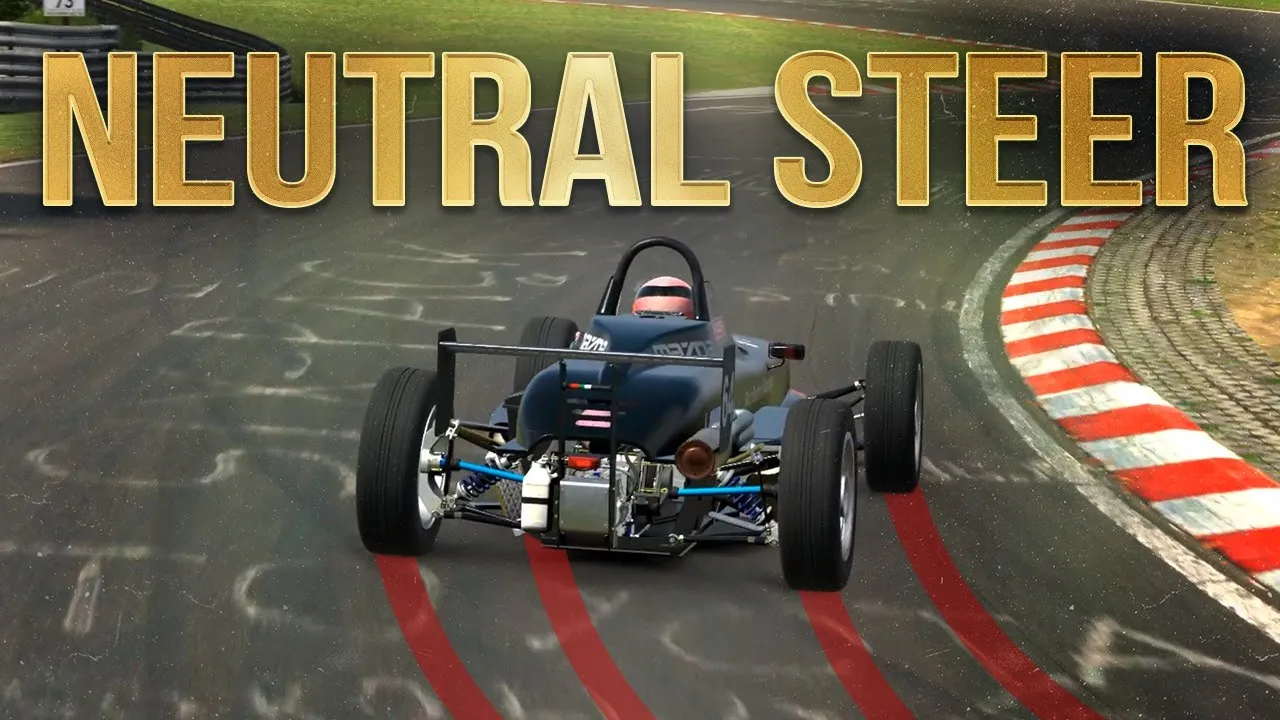
The Best Way to Visualize Neutral Steer in Racing (Finally Explained)
Suellio Almeida
•
Thursday, December 28, 2023
What Neutral Steer Actually Means (And Why You're Probably Wrong About It)
Let me guess — you think neutral steer is when the car "goes exactly where you point it." Or maybe you've heard it's "perfect balance between front and rear grip."
That's not wrong. It's just not useful.
Neutral steer is when both axles are sliding at the same rate. Front tires and rear tires lose grip proportionally. The car rotates predictably. You steer, it turns. No drama. No surprises.
The problem? Most drivers have never actually felt it. They're so used to understeer (pushing wide) or oversteer (rear stepping out) that neutral feels alien. Foreign. Wrong, even.
But once you learn to see it — really see it — everything changes.
The Visualization That Makes It Click
Forget slip angles and physics diagrams for a second. Here's the simplest way to picture neutral steer:
Imagine the car as a single rotating object.
Not front-vs-rear. Not tires vs chassis. One unified thing that pivots around its center of mass.
When you're neutral, the car rotates as a whole. Both ends slide together. You steer into the corner, the car arcs through, and both axles lose just enough traction to let it happen smoothly.
Now picture understeer: the front slides more than the rear. The car plows wide. You turn the wheel further, nothing happens. You're fighting the front end.
Picture oversteer: the rear slides more than the front. The car wants to spin. You catch it with counter-steer. You're babysitting the rear.
Neutral? You're steering the rotation. Not fighting it. Not catching it. Guiding it.
Why Neutral Steer Feels Wrong At First
Here's the thing nobody tells you: neutral steer feels unstable when you're used to understeer.
Most road cars push. Most sim racers drive with understeer because it feels safe. The car goes wide, you lift, problem solved. It's predictable.
Then you drive a neutral car and suddenly both ends are moving. The car feels loose. Twitchy. Like it wants to do something you didn't ask for.
That's not instability. That's responsiveness.
You're finally driving a car that listens to your inputs instead of ignoring them. But your brain hasn't caught up yet. You're still making understeer corrections (more steering angle, earlier braking) in a car that doesn't need them.
The fix? Recalibrate your expectations. Neutral doesn't mean glued to the road. It means both ends are working together.
How to Train Your Eyes to See Neutral Steer
You can't drive neutrally if you can't recognize it. Here's how to start seeing it:
Watch the car from behind (in replays or onboards). Look at the rear end's relationship to the front. Are they sliding at the same rate? Or is one end leading?
In neutral steer, the car rotates around its center. The front isn't plowing. The rear isn't swinging. Everything moves as one arc.
Feel the steering weight. Neutral steer has a specific feedback. The wheel isn't light (understeer) or suddenly heavy (oversteer correction). It's loaded but smooth. Constant pressure.
Listen to the tires. Both fronts and rears should be working at similar levels. If you only hear fronts scrubbing, you're understeering. If rears are screaming, you're oversteering.
Use telemetry. Compare front and rear slip angles. In neutral conditions, they track together. One doesn't spike while the other flatlines.
The more you train yourself to recognize these signals, the faster you'll spot neutral balance — and exploit it.
The Real Secret: Neutral Steer Is Dynamic, Not Static
Here's where most explanations fail: they treat neutral steer like a fixed state.
It's not.
Neutral steer is a range. A window. It shifts throughout the corner based on speed, load transfer, steering input, throttle application.
You enter the corner slightly understeery (stable). You hit the apex and rotate toward neutral (responsive). You exit on throttle and manage slight oversteer (fast).
That's not inconsistency. That's control.
The best drivers don't drive perfectly neutral all the time. They dance around it. They use understeer for stability on entry. They use neutral for rotation at the apex. They use slight oversteer to point the car for exit.
You're not chasing a perfect setup that gives you neutral in every phase. You're learning to manage the car's balance in real time.
Why This Matters More Than You Think
Neutral steer isn't just about lap time. It's about consistency.
When you're fighting understeer, every lap is a battle. You're sawing at the wheel, scrubbing speed, guessing where the limit is.
When you're catching oversteer, every corner is a rescue mission. You're reacting instead of driving.
When you're neutral, you're in control. The car does what you tell it. Your inputs translate directly to rotation. You can place the car within inches, lap after lap.
That's the difference between a 2:15 with three moments of panic and a 2:13 with zero drama.
Neutral steer gives you margin. Predictability. The ability to push without gambling.
How to Actually Develop Neutral Steer Feel
Knowing what it is doesn't mean you can do it. Here's the progression:
1. Start in slower corners. High-speed corners mask imbalance. Slow corners (hairpins, tight chicanes) amplify it. Learn to feel neutral here first.
2. Focus on mid-corner. Entry and exit have too many variables. Mid-corner is where neutral shows up clearest. Hold constant throttle and steering. Does the car arc smoothly? Or does one end slide more?
3. Make small steering corrections. If you're neutral, tiny inputs create big changes. If you're sawing at the wheel and nothing happens, you're understeering.
4. Experiment with trail braking depth. More trail braking = more front load = more front grip = less understeer. Too much trail braking = too much front grip = snap oversteer. Find the middle.
5. Review your replays. You can't improve what you don't see. Watch from trackside cameras. Is the car rotating as one object? Or is one end fighting the other?
This isn't a one-session fix. It's a months-long recalibration. But once you get it, you can't unsee it.
The Plateau Breaker
I've coached drivers stuck at the same iRating for years. Different skill levels, different cars, different tracks.
The common thread? They don't understand neutral steer. They think they do, but they're driving through understeer or oversteer constantly.
Once they start recognizing neutral — really seeing it, feeling it, chasing it — everything unlocks. Lap times drop. Consistency improves. Racecraft gets sharper because they're not busy wrestling the car.
Neutral steer isn't the final skill. But it's the foundation for every advanced technique that comes after.
What Would Change If You Could Actually Feel Balance?
You've been driving the same car for weeks. You know the track. You've watched tutorials, analyzed telemetry, tried different lines.
And you're still stuck. Same lap times. Same mistakes. Same feeling that you're missing something fundamental.
What if the issue isn't your racecraft or your consistency? What if it's that you've never actually learned to feel what the car is doing under you?
Neutral steer isn't a physics concept. It's a skill. The difference between good drivers and great drivers is that great drivers can recognize and manipulate balance in real time.
That's what we teach at Almeida Racing Academy. Not just what neutral steer is — but how to see it, feel it, and use it to drop seconds off your lap times. Our Gold Membership gives you access to eight full courses, including Car Handling where we break down weight transfer, rotation, and balance in ways no YouTube video ever will. Plus coach-led workshops, challenges, and Garage 61 Pro for telemetry analysis.
Right now, Gold is $25/month with code WINTER. That's less than one tank of gas. Less than one iRacing subscription. Less than the cost of staying stuck at the same skill level for another year.
Join Gold Membership and finally learn how to drive neutral →
Sim Racing Academy Membership
Everything you need to stop guessing and start getting faster.
Starting at
$25
/mo
Car Handling Online Course
4 levels, full curriculum. Aimed to get you to top 1% in driving pace.
Racecraft Online Course
Overtaking, Defending, Race Strategy
Live coaching + on-track practice
Bi-weekly pro-coach workshops (recorded — never miss one) plus on-track Pit Parties to practice racecraft with a coach.
Plus These Bonuses
13,000+ Member Community
League Racing
Advanced MX-5 Mini Course
Racing Technique Development Guide
The Motor Racing Book (260 pages)
Think & Behave Like a Pro Driver — Mini eBook
The Best Way to Visualize Neutral Steer in Racing (Finally Explained)
Suellio Almeida
•
Thursday, December 28, 2023
What Neutral Steer Actually Means (And Why You're Probably Wrong About It)
Let me guess — you think neutral steer is when the car "goes exactly where you point it." Or maybe you've heard it's "perfect balance between front and rear grip."
That's not wrong. It's just not useful.
Neutral steer is when both axles are sliding at the same rate. Front tires and rear tires lose grip proportionally. The car rotates predictably. You steer, it turns. No drama. No surprises.
The problem? Most drivers have never actually felt it. They're so used to understeer (pushing wide) or oversteer (rear stepping out) that neutral feels alien. Foreign. Wrong, even.
But once you learn to see it — really see it — everything changes.
The Visualization That Makes It Click
Forget slip angles and physics diagrams for a second. Here's the simplest way to picture neutral steer:
Imagine the car as a single rotating object.
Not front-vs-rear. Not tires vs chassis. One unified thing that pivots around its center of mass.
When you're neutral, the car rotates as a whole. Both ends slide together. You steer into the corner, the car arcs through, and both axles lose just enough traction to let it happen smoothly.
Now picture understeer: the front slides more than the rear. The car plows wide. You turn the wheel further, nothing happens. You're fighting the front end.
Picture oversteer: the rear slides more than the front. The car wants to spin. You catch it with counter-steer. You're babysitting the rear.
Neutral? You're steering the rotation. Not fighting it. Not catching it. Guiding it.
Why Neutral Steer Feels Wrong At First
Here's the thing nobody tells you: neutral steer feels unstable when you're used to understeer.
Most road cars push. Most sim racers drive with understeer because it feels safe. The car goes wide, you lift, problem solved. It's predictable.
Then you drive a neutral car and suddenly both ends are moving. The car feels loose. Twitchy. Like it wants to do something you didn't ask for.
That's not instability. That's responsiveness.
You're finally driving a car that listens to your inputs instead of ignoring them. But your brain hasn't caught up yet. You're still making understeer corrections (more steering angle, earlier braking) in a car that doesn't need them.
The fix? Recalibrate your expectations. Neutral doesn't mean glued to the road. It means both ends are working together.
How to Train Your Eyes to See Neutral Steer
You can't drive neutrally if you can't recognize it. Here's how to start seeing it:
Watch the car from behind (in replays or onboards). Look at the rear end's relationship to the front. Are they sliding at the same rate? Or is one end leading?
In neutral steer, the car rotates around its center. The front isn't plowing. The rear isn't swinging. Everything moves as one arc.
Feel the steering weight. Neutral steer has a specific feedback. The wheel isn't light (understeer) or suddenly heavy (oversteer correction). It's loaded but smooth. Constant pressure.
Listen to the tires. Both fronts and rears should be working at similar levels. If you only hear fronts scrubbing, you're understeering. If rears are screaming, you're oversteering.
Use telemetry. Compare front and rear slip angles. In neutral conditions, they track together. One doesn't spike while the other flatlines.
The more you train yourself to recognize these signals, the faster you'll spot neutral balance — and exploit it.
The Real Secret: Neutral Steer Is Dynamic, Not Static
Here's where most explanations fail: they treat neutral steer like a fixed state.
It's not.
Neutral steer is a range. A window. It shifts throughout the corner based on speed, load transfer, steering input, throttle application.
You enter the corner slightly understeery (stable). You hit the apex and rotate toward neutral (responsive). You exit on throttle and manage slight oversteer (fast).
That's not inconsistency. That's control.
The best drivers don't drive perfectly neutral all the time. They dance around it. They use understeer for stability on entry. They use neutral for rotation at the apex. They use slight oversteer to point the car for exit.
You're not chasing a perfect setup that gives you neutral in every phase. You're learning to manage the car's balance in real time.
Why This Matters More Than You Think
Neutral steer isn't just about lap time. It's about consistency.
When you're fighting understeer, every lap is a battle. You're sawing at the wheel, scrubbing speed, guessing where the limit is.
When you're catching oversteer, every corner is a rescue mission. You're reacting instead of driving.
When you're neutral, you're in control. The car does what you tell it. Your inputs translate directly to rotation. You can place the car within inches, lap after lap.
That's the difference between a 2:15 with three moments of panic and a 2:13 with zero drama.
Neutral steer gives you margin. Predictability. The ability to push without gambling.
How to Actually Develop Neutral Steer Feel
Knowing what it is doesn't mean you can do it. Here's the progression:
1. Start in slower corners. High-speed corners mask imbalance. Slow corners (hairpins, tight chicanes) amplify it. Learn to feel neutral here first.
2. Focus on mid-corner. Entry and exit have too many variables. Mid-corner is where neutral shows up clearest. Hold constant throttle and steering. Does the car arc smoothly? Or does one end slide more?
3. Make small steering corrections. If you're neutral, tiny inputs create big changes. If you're sawing at the wheel and nothing happens, you're understeering.
4. Experiment with trail braking depth. More trail braking = more front load = more front grip = less understeer. Too much trail braking = too much front grip = snap oversteer. Find the middle.
5. Review your replays. You can't improve what you don't see. Watch from trackside cameras. Is the car rotating as one object? Or is one end fighting the other?
This isn't a one-session fix. It's a months-long recalibration. But once you get it, you can't unsee it.
The Plateau Breaker
I've coached drivers stuck at the same iRating for years. Different skill levels, different cars, different tracks.
The common thread? They don't understand neutral steer. They think they do, but they're driving through understeer or oversteer constantly.
Once they start recognizing neutral — really seeing it, feeling it, chasing it — everything unlocks. Lap times drop. Consistency improves. Racecraft gets sharper because they're not busy wrestling the car.
Neutral steer isn't the final skill. But it's the foundation for every advanced technique that comes after.
What Would Change If You Could Actually Feel Balance?
You've been driving the same car for weeks. You know the track. You've watched tutorials, analyzed telemetry, tried different lines.
And you're still stuck. Same lap times. Same mistakes. Same feeling that you're missing something fundamental.
What if the issue isn't your racecraft or your consistency? What if it's that you've never actually learned to feel what the car is doing under you?
Neutral steer isn't a physics concept. It's a skill. The difference between good drivers and great drivers is that great drivers can recognize and manipulate balance in real time.
That's what we teach at Almeida Racing Academy. Not just what neutral steer is — but how to see it, feel it, and use it to drop seconds off your lap times. Our Gold Membership gives you access to eight full courses, including Car Handling where we break down weight transfer, rotation, and balance in ways no YouTube video ever will. Plus coach-led workshops, challenges, and Garage 61 Pro for telemetry analysis.
Right now, Gold is $25/month with code WINTER. That's less than one tank of gas. Less than one iRacing subscription. Less than the cost of staying stuck at the same skill level for another year.
Join Gold Membership and finally learn how to drive neutral →
Sim Racing Academy Membership
Everything you need to stop guessing and start getting faster.
Starting at
$25
/mo
Car Handling Online Course
4 levels, full curriculum. Aimed to get you to top 1% in driving pace.
Racecraft Online Course
Overtaking, Defending, Race Strategy
Live coaching + on-track practice
Bi-weekly pro-coach workshops (recorded — never miss one) plus on-track Pit Parties to practice racecraft with a coach.
Plus These Bonuses
13,000+ Member Community
League Racing
Advanced MX-5 Mini Course
Racing Technique Development Guide
The Motor Racing Book (260 pages)
Think & Behave Like a Pro Driver — Mini eBook
The Best Way to Visualize Neutral Steer in Racing (Finally Explained)
Suellio Almeida
•
Thursday, December 28, 2023
What Neutral Steer Actually Means (And Why You're Probably Wrong About It)
Let me guess — you think neutral steer is when the car "goes exactly where you point it." Or maybe you've heard it's "perfect balance between front and rear grip."
That's not wrong. It's just not useful.
Neutral steer is when both axles are sliding at the same rate. Front tires and rear tires lose grip proportionally. The car rotates predictably. You steer, it turns. No drama. No surprises.
The problem? Most drivers have never actually felt it. They're so used to understeer (pushing wide) or oversteer (rear stepping out) that neutral feels alien. Foreign. Wrong, even.
But once you learn to see it — really see it — everything changes.
The Visualization That Makes It Click
Forget slip angles and physics diagrams for a second. Here's the simplest way to picture neutral steer:
Imagine the car as a single rotating object.
Not front-vs-rear. Not tires vs chassis. One unified thing that pivots around its center of mass.
When you're neutral, the car rotates as a whole. Both ends slide together. You steer into the corner, the car arcs through, and both axles lose just enough traction to let it happen smoothly.
Now picture understeer: the front slides more than the rear. The car plows wide. You turn the wheel further, nothing happens. You're fighting the front end.
Picture oversteer: the rear slides more than the front. The car wants to spin. You catch it with counter-steer. You're babysitting the rear.
Neutral? You're steering the rotation. Not fighting it. Not catching it. Guiding it.
Why Neutral Steer Feels Wrong At First
Here's the thing nobody tells you: neutral steer feels unstable when you're used to understeer.
Most road cars push. Most sim racers drive with understeer because it feels safe. The car goes wide, you lift, problem solved. It's predictable.
Then you drive a neutral car and suddenly both ends are moving. The car feels loose. Twitchy. Like it wants to do something you didn't ask for.
That's not instability. That's responsiveness.
You're finally driving a car that listens to your inputs instead of ignoring them. But your brain hasn't caught up yet. You're still making understeer corrections (more steering angle, earlier braking) in a car that doesn't need them.
The fix? Recalibrate your expectations. Neutral doesn't mean glued to the road. It means both ends are working together.
How to Train Your Eyes to See Neutral Steer
You can't drive neutrally if you can't recognize it. Here's how to start seeing it:
Watch the car from behind (in replays or onboards). Look at the rear end's relationship to the front. Are they sliding at the same rate? Or is one end leading?
In neutral steer, the car rotates around its center. The front isn't plowing. The rear isn't swinging. Everything moves as one arc.
Feel the steering weight. Neutral steer has a specific feedback. The wheel isn't light (understeer) or suddenly heavy (oversteer correction). It's loaded but smooth. Constant pressure.
Listen to the tires. Both fronts and rears should be working at similar levels. If you only hear fronts scrubbing, you're understeering. If rears are screaming, you're oversteering.
Use telemetry. Compare front and rear slip angles. In neutral conditions, they track together. One doesn't spike while the other flatlines.
The more you train yourself to recognize these signals, the faster you'll spot neutral balance — and exploit it.
The Real Secret: Neutral Steer Is Dynamic, Not Static
Here's where most explanations fail: they treat neutral steer like a fixed state.
It's not.
Neutral steer is a range. A window. It shifts throughout the corner based on speed, load transfer, steering input, throttle application.
You enter the corner slightly understeery (stable). You hit the apex and rotate toward neutral (responsive). You exit on throttle and manage slight oversteer (fast).
That's not inconsistency. That's control.
The best drivers don't drive perfectly neutral all the time. They dance around it. They use understeer for stability on entry. They use neutral for rotation at the apex. They use slight oversteer to point the car for exit.
You're not chasing a perfect setup that gives you neutral in every phase. You're learning to manage the car's balance in real time.
Why This Matters More Than You Think
Neutral steer isn't just about lap time. It's about consistency.
When you're fighting understeer, every lap is a battle. You're sawing at the wheel, scrubbing speed, guessing where the limit is.
When you're catching oversteer, every corner is a rescue mission. You're reacting instead of driving.
When you're neutral, you're in control. The car does what you tell it. Your inputs translate directly to rotation. You can place the car within inches, lap after lap.
That's the difference between a 2:15 with three moments of panic and a 2:13 with zero drama.
Neutral steer gives you margin. Predictability. The ability to push without gambling.
How to Actually Develop Neutral Steer Feel
Knowing what it is doesn't mean you can do it. Here's the progression:
1. Start in slower corners. High-speed corners mask imbalance. Slow corners (hairpins, tight chicanes) amplify it. Learn to feel neutral here first.
2. Focus on mid-corner. Entry and exit have too many variables. Mid-corner is where neutral shows up clearest. Hold constant throttle and steering. Does the car arc smoothly? Or does one end slide more?
3. Make small steering corrections. If you're neutral, tiny inputs create big changes. If you're sawing at the wheel and nothing happens, you're understeering.
4. Experiment with trail braking depth. More trail braking = more front load = more front grip = less understeer. Too much trail braking = too much front grip = snap oversteer. Find the middle.
5. Review your replays. You can't improve what you don't see. Watch from trackside cameras. Is the car rotating as one object? Or is one end fighting the other?
This isn't a one-session fix. It's a months-long recalibration. But once you get it, you can't unsee it.
The Plateau Breaker
I've coached drivers stuck at the same iRating for years. Different skill levels, different cars, different tracks.
The common thread? They don't understand neutral steer. They think they do, but they're driving through understeer or oversteer constantly.
Once they start recognizing neutral — really seeing it, feeling it, chasing it — everything unlocks. Lap times drop. Consistency improves. Racecraft gets sharper because they're not busy wrestling the car.
Neutral steer isn't the final skill. But it's the foundation for every advanced technique that comes after.
What Would Change If You Could Actually Feel Balance?
You've been driving the same car for weeks. You know the track. You've watched tutorials, analyzed telemetry, tried different lines.
And you're still stuck. Same lap times. Same mistakes. Same feeling that you're missing something fundamental.
What if the issue isn't your racecraft or your consistency? What if it's that you've never actually learned to feel what the car is doing under you?
Neutral steer isn't a physics concept. It's a skill. The difference between good drivers and great drivers is that great drivers can recognize and manipulate balance in real time.
That's what we teach at Almeida Racing Academy. Not just what neutral steer is — but how to see it, feel it, and use it to drop seconds off your lap times. Our Gold Membership gives you access to eight full courses, including Car Handling where we break down weight transfer, rotation, and balance in ways no YouTube video ever will. Plus coach-led workshops, challenges, and Garage 61 Pro for telemetry analysis.
Right now, Gold is $25/month with code WINTER. That's less than one tank of gas. Less than one iRacing subscription. Less than the cost of staying stuck at the same skill level for another year.
Join Gold Membership and finally learn how to drive neutral →
Sim Racing Academy Membership
Everything you need to stop guessing and start getting faster.
Starting at
$25
/mo
Car Handling Online Course
4 levels, full curriculum. Aimed to get you to top 1% in driving pace.
Racecraft Online Course
Overtaking, Defending, Race Strategy
Live coaching + on-track practice
Bi-weekly pro-coach workshops (recorded — never miss one) plus on-track Pit Parties to practice racecraft with a coach.
Plus These Bonuses
13,000+ Member Community
League Racing
Advanced MX-5 Mini Course
Racing Technique Development Guide
The Motor Racing Book (260 pages)
Think & Behave Like a Pro Driver — Mini eBook