
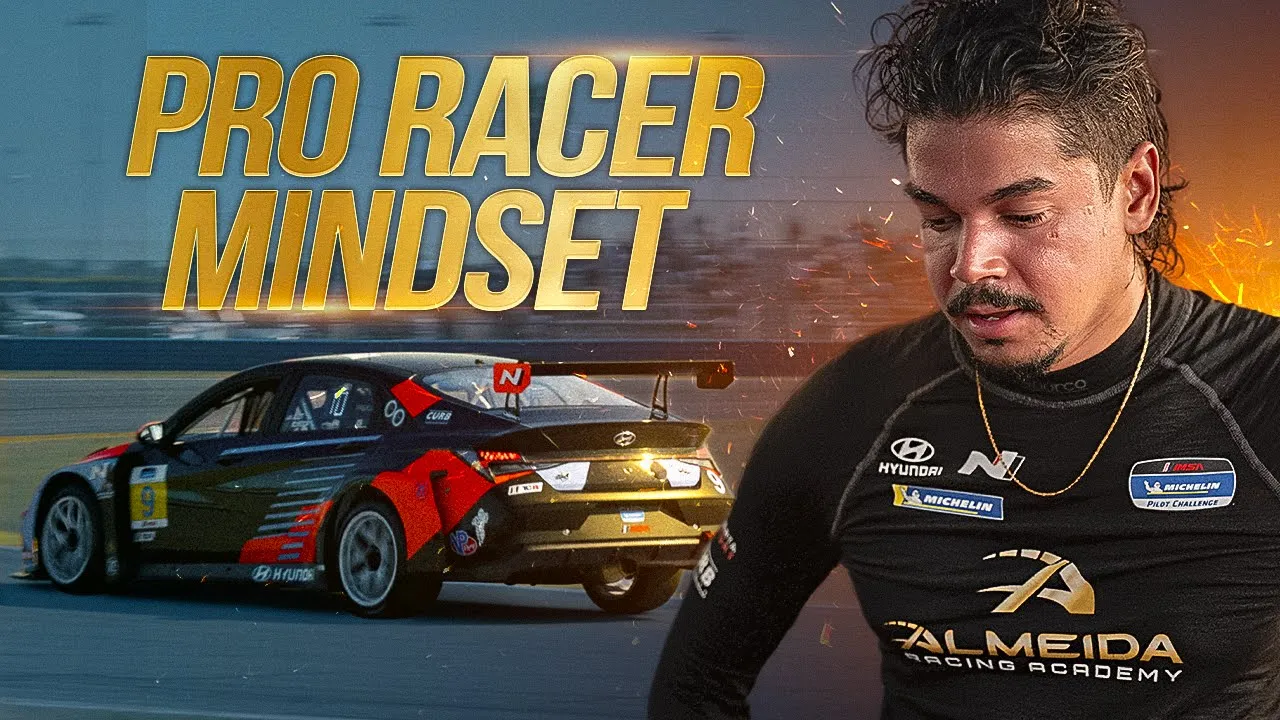
What Actually Makes You a Fast Driver? The Racing Psychology No One Talks About
Suellio Almeida
•
Tuesday, December 2, 2025
You're Not Slow Because of Your Technique
Let me tell you something that might hurt: your slow lap times probably aren't a technique problem.
You've watched the YouTube tutorials. You know what trail braking is. You understand racing lines in theory. Yet week after week, you're stuck at the same pace.
Here's why.
The drivers beating you aren't just executing techniques better. They're operating from a completely different mental framework. And until you understand that framework, no amount of track time will fix your speed problem.
The Two Types of Fast
There are two kinds of fast drivers in sim racing.
The first type can nail one flying lap. They're explosive. They can find three tenths when everything aligns. But put them in traffic? Ask them to do it consistently for 30 minutes? They fall apart.
The second type? They might not have the absolute one-lap pace. But they're within two tenths every single lap. For an hour straight. Under pressure. In dirty air. When it matters.
Guess which one wins races?
The difference between these drivers isn't physical skill. It's psychological. And it breaks down into three core attributes that every genuinely fast driver possesses.
Attribute #1: Pattern Recognition on Autopilot
Fast drivers don't think about driving.
Read that again.
When you're consciously thinking about your brake point, your turn-in, your throttle application — you're already too slow. Your conscious mind processes information at maybe 40-50 bits per second. Your subconscious? Eleven million bits per second.
The fastest drivers have moved their core techniques into subconscious pattern recognition. Their brain has logged thousands of corner entries, thousands of weight transfer moments, thousands of grip limit interactions. When they approach a corner, their subconscious pattern-matches it against this massive database and executes the optimal input sequence automatically.
You know that feeling when you suddenly nail a corner perfectly and can't explain exactly what you did differently? That's your subconscious taking over. That's what fast feels like.
But here's the problem: most sim racers never build this pattern library properly. They practice, sure. But they practice with conscious focus on individual techniques, never allowing their subconscious to integrate everything into automatic patterns.
You need to stop thinking so much. Seriously.
Why Your Conscious Mind Is Sabotaging You
Your conscious mind is a terrible racing driver.
It's too slow. Too analytical. Too distracted by the gap to the car ahead, the position counter, whether you're going to make your split target.
Every time you consciously think "brake here," you're adding a processing delay. Every time you focus on hitting your marks, you're pulling attention away from the continuous flow of driving.
The drivers beating you? They've offloaded the basics to autopilot. Their conscious mind is free to handle higher-order problems: racecraft, tire management, adapting to changing conditions, predicting what the car ahead will do.
You're still flying the plane manually. They've engaged autopilot for the basics and are thinking three corners ahead.
How Fast Drivers Actually Train
Here's what separates deliberate practice from just putting in laps.
Fast drivers practice until something becomes automatic, then they practice the next thing. They don't spend 100 laps consciously focusing on the same brake point. They focus on it intensely for 10-15 laps until their subconscious starts taking over, then they move on.
They practice one skill in isolation until it's integrated, then stack the next skill on top.
Trail braking feels conscious and difficult? Practice it until you stop thinking about it. Then work on rotation. Then work on exit timing. Then work on linking corners together.
Each layer becomes automatic before adding the next.
Most drivers try to consciously control everything at once. That's why they plateau. Your working memory can only handle 3-7 chunks of information at a time. If you're trying to consciously manage brake pressure, steering input, weight transfer, rotation, throttle application, and race position all simultaneously, you're overloaded.
Fast drivers have collapsed those six conscious decisions into one automatic pattern: "corner."
Attribute #2: Absolute Commitment to the Present
The second attribute that separates truly fast drivers: they exist entirely in the current moment.
No dwelling on the mistake three corners ago.
No calculating what gap they need to hold to win.
No anxiety about the fast guy closing from behind.
Just this corner. This brake point. This apex. This exit.
You know what kills more lap time than bad technique? Mental distraction. And the biggest distraction in racing is your own brain pulling you out of the present moment.
You miss a brake point. Instead of immediately resetting and nailing the next corner, you spend the next three turns replaying what went wrong, getting frustrated, losing another two tenths because you're not fully present.
Or you see you're two tenths up at the split. Your brain immediately jumps to "don't mess this up" mode. You tighten up. You drive conservatively. You give back the time you gained.
Fast drivers have trained themselves to exist in a continuous present. Each corner is its own isolated event. The previous corner doesn't exist. The next corner doesn't exist. Just this one.
This isn't some mystical mindfulness concept. It's practical psychology. Your performance maximizes when 100% of your processing power focuses on the current task. Any percentage spent on past or future is percentage stolen from present execution.
The Reset Button Doesn't Exist for Most Drivers
Here's a test: next time you make a mistake in a race, how long does it take you to return to your baseline pace?
For most drivers: multiple corners, sometimes multiple laps.
For fast drivers: immediately. The next corner is already a fresh start.
This isn't natural. It's trained. And it's trainable.
The technique is simple but requires practice: after every corner, good or bad, you have a mental trigger that says "reset." The corner is over. It's done. It no longer exists. All that exists is the next brake point.
Mistake? Reset. Perfect corner? Reset. Someone divebombs you? Reset.
The drivers who can reset instantly are the ones who maintain consistency under pressure. Because pressure is just your brain pulling you out of the present moment into anxiety about outcomes.
Stay present. Stay fast.
Attribute #3: Comfortable at the Limit
The third attribute: truly fast drivers are psychologically comfortable operating at the edge of grip.
Most sim racers drive at 92-94% because 96% feels dangerous. It feels like loss of control. It triggers a stress response.
Fast drivers have recalibrated their comfort zone to live at 98%. Not because they're braver or more reckless, but because they've spent enough time at the limit that their nervous system no longer treats it as a threat.
Your brain has a built-in safety margin. When you approach the grip limit, you get physiological signals: tension, faster heart rate, tunnel vision. These are fear responses telling you to back off.
Fast drivers have desensitized themselves to these signals through exposure. They've spent hundreds of hours right at the limit, teaching their nervous system that "this is normal, this is safe, this is where we operate."
You need to do the same.
Why You're Scared of the Limit (And How to Fix It)
Here's the thing about the limit: it's not actually a cliff edge.
Most drivers imagine grip as a binary: you have it or you don't. So they stay well back from the edge because crossing it means instant disaster.
But grip is a gradient. There's a huge space between "safe pace" and "crash." That space is where lap time lives.
Fast drivers have mapped that space through deliberate practice. They know exactly what 95% feels like, what 96% feels like, what 97% feels like, what 98% feels like. They know the signals the car gives at each level. They know how to recover from 99%.
You probably don't. So your brain defaults to the safe zone.
The fix? You need to practice going over the limit in controlled situations. Take one corner. Push it until you understeer or oversteer. Note what that feels like. Do it again. And again. Teach your nervous system that going past the limit isn't catastrophic — it's just information.
Once you're comfortable at 100%, driving at 97% becomes easy. Right now, you're trying to drive at 97% when your comfort zone tops out at 93%. That's why you're slow.
The Psychology of Consistency
Let's talk about why consistency is actually a psychological skill, not a technical one.
You've probably had this experience: you set a great lap time, then spend the next 30 minutes trying to match it and falling short.
Why?
Because your perfect lap was probably executed with your conscious mind shut off. You were in flow state. You weren't thinking, you were just driving. Your subconscious was running the show.
Then you see the lap time and your conscious mind says "I need to do that again." Now you're trying to consciously recreate what your subconscious did automatically. And you can't, because your conscious mind is too slow and too clumsy.
Consistent drivers have learned to stay in that flow state lap after lap. They've learned not to disrupt the subconscious process by trying to consciously control it.
How do you do this? You stop caring about the lap time.
Seriously.
You set a fast lap, you don't even look at the delta. You just drive the next lap. And the next. And the next. You focus on the process — smooth inputs, good rhythm, staying present — and let the lap times take care of themselves.
The moment you start chasing a number, you've pulled yourself out of the mental state that produces that number.
Why Most Practice Makes You Slower
Here's an uncomfortable truth: most sim racers practice in ways that actively prevent them from developing these psychological attributes.
They practice inconsistently — 20 minutes here, 30 minutes there, never building the deep pattern recognition that comes from sustained, focused practice.
They practice without structure — just running laps with no specific focus, so their subconscious never learns to isolate and integrate individual skills.
They practice with constant conscious intervention — analyzing every input, adjusting every corner, never allowing autopilot to develop.
And they practice without ever deliberately pushing past their comfort zone at the limit.
This kind of practice can actually make you slower. Because you're reinforcing the wrong mental patterns. You're training yourself to drive consciously, hesitantly, reactively.
Fast drivers practice like athletes train: structured sessions with specific focuses, progressive overload on their comfort zone, deliberate work on the mental game.
If you're just "getting laps in," you're not training. You're just driving.
The Gap Between Knowledge and Execution
You probably understand everything I've said so far.
The problem? Understanding doesn't equal execution.
You can intellectually know that you need to stop thinking and drive on autopilot. But knowing that doesn't magically make your subconscious take over. You can understand that you need to stay present. But understanding presence doesn't mean you can hold it under pressure.
These are skills. They require training. Deliberate, structured, progressive training.
And here's where most sim racers fail: they apply discipline to their technical practice but none to their psychological practice. They'll spend hours perfecting trail braking but won't spend 10 minutes specifically training their ability to reset after mistakes.
The drivers beating you are training both.
What Fast Actually Feels Like
Here's something almost no one talks about: being genuinely fast feels completely different than you think it does.
It doesn't feel like you're pushing. It doesn't feel like maximum effort. It doesn't feel like you're right on the edge.
It feels smooth. Easy. Almost boring.
That's because when you're operating from the right psychological framework — autopilot handling the basics, full presence in the moment, comfortable at the limit — speed stops feeling like work.
You're not fighting the car. You're not fighting your own brain. You're just driving.
If your fast laps feel frantic and effortful, you're not actually fast yet. You're just trying really hard.
Fast is when trying disappears.
The Training You're Not Doing
So what do you actually do with this information?
Start training your psychology the same way you train your technique.
Practice autopilot: Take one specific skill (trail braking, rotation, whatever you're working on) and practice it for 15-20 minutes until you stop consciously thinking about it. Then move on. Stop trying to consciously control skills you've already learned.
Practice presence: Set a timer for 20-minute sessions. If you catch yourself thinking about anything other than the current corner — past mistakes, future consequences, lap times, whatever — immediate mental reset. Just like you'd correct a driving error.
Practice the limit: Dedicate specific practice sessions to deliberately going past the edge. Pick one or two corners and push until you lose it. Do this until your nervous system stops treating the limit as scary.
These aren't things you do once. These are ongoing training practices, just like learning a new track or working on a new technique.
Your mental game needs the same structured development as your technical game.
Most drivers never do this. That's why most drivers never get genuinely fast.
So What's Actually Holding You Back?
You know the techniques. You've put in the hours. You understand the physics.
But are you training yourself to execute those techniques from autopilot? Are you training yourself to stay absolutely present under pressure? Are you training yourself to be comfortable operating at the limit?
If the answer is no, then technique isn't your problem.
Your psychology is.
And the good news? Psychology is trainable. You're not limited by natural talent or physical ability. You're limited by training methods that ignore the mental side of speed.
Change the training. Change the results.
Are You Ready to Actually Get Fast?
Be honest with yourself for a second.
How many more months are you going to practice the same way, expecting different results? How many more races are you going to finish wondering why you can't match the pace of drivers who seem like they're not even trying?
The difference between you and them isn't secret techniques. It's systematic training that develops both technical and psychological skills together.
Almeida Racing Academy exists because I got tired of watching talented sim racers plateau at 80% of their potential. We don't just teach you what to do — we teach you how to train your brain to do it automatically, under pressure, when it matters.
Our Gold membership gives you access to structured training programs that develop the exact psychological attributes I've talked about here. Not vague mindfulness advice. Actual drills, actual progression, actual feedback from coaches who've trained thousands of drivers through these same breakthroughs.
Start your training at Almeida Racing Academy
— use code WINTER for $25/month. Eight complete courses, 80 lessons, weekly coach-led workshops where we work on exactly this stuff.
Or keep practicing the same way. Your choice.
Sim Racing Academy Membership
Everything you need to stop guessing and start getting faster.
Starting at
$25
/mo
Car Handling Online Course
4 levels, full curriculum. Aimed to get you to top 1% in driving pace.
Racecraft Online Course
Overtaking, Defending, Race Strategy
Live coaching + on-track practice
Bi-weekly pro-coach workshops (recorded — never miss one) plus on-track Pit Parties to practice racecraft with a coach.
Plus These Bonuses
13,000+ Member Community
League Racing
Advanced MX-5 Mini Course
Racing Technique Development Guide
The Motor Racing Book (260 pages)
Think & Behave Like a Pro Driver — Mini eBook
What Actually Makes You a Fast Driver? The Racing Psychology No One Talks About
Suellio Almeida
•
Tuesday, December 2, 2025
You're Not Slow Because of Your Technique
Let me tell you something that might hurt: your slow lap times probably aren't a technique problem.
You've watched the YouTube tutorials. You know what trail braking is. You understand racing lines in theory. Yet week after week, you're stuck at the same pace.
Here's why.
The drivers beating you aren't just executing techniques better. They're operating from a completely different mental framework. And until you understand that framework, no amount of track time will fix your speed problem.
The Two Types of Fast
There are two kinds of fast drivers in sim racing.
The first type can nail one flying lap. They're explosive. They can find three tenths when everything aligns. But put them in traffic? Ask them to do it consistently for 30 minutes? They fall apart.
The second type? They might not have the absolute one-lap pace. But they're within two tenths every single lap. For an hour straight. Under pressure. In dirty air. When it matters.
Guess which one wins races?
The difference between these drivers isn't physical skill. It's psychological. And it breaks down into three core attributes that every genuinely fast driver possesses.
Attribute #1: Pattern Recognition on Autopilot
Fast drivers don't think about driving.
Read that again.
When you're consciously thinking about your brake point, your turn-in, your throttle application — you're already too slow. Your conscious mind processes information at maybe 40-50 bits per second. Your subconscious? Eleven million bits per second.
The fastest drivers have moved their core techniques into subconscious pattern recognition. Their brain has logged thousands of corner entries, thousands of weight transfer moments, thousands of grip limit interactions. When they approach a corner, their subconscious pattern-matches it against this massive database and executes the optimal input sequence automatically.
You know that feeling when you suddenly nail a corner perfectly and can't explain exactly what you did differently? That's your subconscious taking over. That's what fast feels like.
But here's the problem: most sim racers never build this pattern library properly. They practice, sure. But they practice with conscious focus on individual techniques, never allowing their subconscious to integrate everything into automatic patterns.
You need to stop thinking so much. Seriously.
Why Your Conscious Mind Is Sabotaging You
Your conscious mind is a terrible racing driver.
It's too slow. Too analytical. Too distracted by the gap to the car ahead, the position counter, whether you're going to make your split target.
Every time you consciously think "brake here," you're adding a processing delay. Every time you focus on hitting your marks, you're pulling attention away from the continuous flow of driving.
The drivers beating you? They've offloaded the basics to autopilot. Their conscious mind is free to handle higher-order problems: racecraft, tire management, adapting to changing conditions, predicting what the car ahead will do.
You're still flying the plane manually. They've engaged autopilot for the basics and are thinking three corners ahead.
How Fast Drivers Actually Train
Here's what separates deliberate practice from just putting in laps.
Fast drivers practice until something becomes automatic, then they practice the next thing. They don't spend 100 laps consciously focusing on the same brake point. They focus on it intensely for 10-15 laps until their subconscious starts taking over, then they move on.
They practice one skill in isolation until it's integrated, then stack the next skill on top.
Trail braking feels conscious and difficult? Practice it until you stop thinking about it. Then work on rotation. Then work on exit timing. Then work on linking corners together.
Each layer becomes automatic before adding the next.
Most drivers try to consciously control everything at once. That's why they plateau. Your working memory can only handle 3-7 chunks of information at a time. If you're trying to consciously manage brake pressure, steering input, weight transfer, rotation, throttle application, and race position all simultaneously, you're overloaded.
Fast drivers have collapsed those six conscious decisions into one automatic pattern: "corner."
Attribute #2: Absolute Commitment to the Present
The second attribute that separates truly fast drivers: they exist entirely in the current moment.
No dwelling on the mistake three corners ago.
No calculating what gap they need to hold to win.
No anxiety about the fast guy closing from behind.
Just this corner. This brake point. This apex. This exit.
You know what kills more lap time than bad technique? Mental distraction. And the biggest distraction in racing is your own brain pulling you out of the present moment.
You miss a brake point. Instead of immediately resetting and nailing the next corner, you spend the next three turns replaying what went wrong, getting frustrated, losing another two tenths because you're not fully present.
Or you see you're two tenths up at the split. Your brain immediately jumps to "don't mess this up" mode. You tighten up. You drive conservatively. You give back the time you gained.
Fast drivers have trained themselves to exist in a continuous present. Each corner is its own isolated event. The previous corner doesn't exist. The next corner doesn't exist. Just this one.
This isn't some mystical mindfulness concept. It's practical psychology. Your performance maximizes when 100% of your processing power focuses on the current task. Any percentage spent on past or future is percentage stolen from present execution.
The Reset Button Doesn't Exist for Most Drivers
Here's a test: next time you make a mistake in a race, how long does it take you to return to your baseline pace?
For most drivers: multiple corners, sometimes multiple laps.
For fast drivers: immediately. The next corner is already a fresh start.
This isn't natural. It's trained. And it's trainable.
The technique is simple but requires practice: after every corner, good or bad, you have a mental trigger that says "reset." The corner is over. It's done. It no longer exists. All that exists is the next brake point.
Mistake? Reset. Perfect corner? Reset. Someone divebombs you? Reset.
The drivers who can reset instantly are the ones who maintain consistency under pressure. Because pressure is just your brain pulling you out of the present moment into anxiety about outcomes.
Stay present. Stay fast.
Attribute #3: Comfortable at the Limit
The third attribute: truly fast drivers are psychologically comfortable operating at the edge of grip.
Most sim racers drive at 92-94% because 96% feels dangerous. It feels like loss of control. It triggers a stress response.
Fast drivers have recalibrated their comfort zone to live at 98%. Not because they're braver or more reckless, but because they've spent enough time at the limit that their nervous system no longer treats it as a threat.
Your brain has a built-in safety margin. When you approach the grip limit, you get physiological signals: tension, faster heart rate, tunnel vision. These are fear responses telling you to back off.
Fast drivers have desensitized themselves to these signals through exposure. They've spent hundreds of hours right at the limit, teaching their nervous system that "this is normal, this is safe, this is where we operate."
You need to do the same.
Why You're Scared of the Limit (And How to Fix It)
Here's the thing about the limit: it's not actually a cliff edge.
Most drivers imagine grip as a binary: you have it or you don't. So they stay well back from the edge because crossing it means instant disaster.
But grip is a gradient. There's a huge space between "safe pace" and "crash." That space is where lap time lives.
Fast drivers have mapped that space through deliberate practice. They know exactly what 95% feels like, what 96% feels like, what 97% feels like, what 98% feels like. They know the signals the car gives at each level. They know how to recover from 99%.
You probably don't. So your brain defaults to the safe zone.
The fix? You need to practice going over the limit in controlled situations. Take one corner. Push it until you understeer or oversteer. Note what that feels like. Do it again. And again. Teach your nervous system that going past the limit isn't catastrophic — it's just information.
Once you're comfortable at 100%, driving at 97% becomes easy. Right now, you're trying to drive at 97% when your comfort zone tops out at 93%. That's why you're slow.
The Psychology of Consistency
Let's talk about why consistency is actually a psychological skill, not a technical one.
You've probably had this experience: you set a great lap time, then spend the next 30 minutes trying to match it and falling short.
Why?
Because your perfect lap was probably executed with your conscious mind shut off. You were in flow state. You weren't thinking, you were just driving. Your subconscious was running the show.
Then you see the lap time and your conscious mind says "I need to do that again." Now you're trying to consciously recreate what your subconscious did automatically. And you can't, because your conscious mind is too slow and too clumsy.
Consistent drivers have learned to stay in that flow state lap after lap. They've learned not to disrupt the subconscious process by trying to consciously control it.
How do you do this? You stop caring about the lap time.
Seriously.
You set a fast lap, you don't even look at the delta. You just drive the next lap. And the next. And the next. You focus on the process — smooth inputs, good rhythm, staying present — and let the lap times take care of themselves.
The moment you start chasing a number, you've pulled yourself out of the mental state that produces that number.
Why Most Practice Makes You Slower
Here's an uncomfortable truth: most sim racers practice in ways that actively prevent them from developing these psychological attributes.
They practice inconsistently — 20 minutes here, 30 minutes there, never building the deep pattern recognition that comes from sustained, focused practice.
They practice without structure — just running laps with no specific focus, so their subconscious never learns to isolate and integrate individual skills.
They practice with constant conscious intervention — analyzing every input, adjusting every corner, never allowing autopilot to develop.
And they practice without ever deliberately pushing past their comfort zone at the limit.
This kind of practice can actually make you slower. Because you're reinforcing the wrong mental patterns. You're training yourself to drive consciously, hesitantly, reactively.
Fast drivers practice like athletes train: structured sessions with specific focuses, progressive overload on their comfort zone, deliberate work on the mental game.
If you're just "getting laps in," you're not training. You're just driving.
The Gap Between Knowledge and Execution
You probably understand everything I've said so far.
The problem? Understanding doesn't equal execution.
You can intellectually know that you need to stop thinking and drive on autopilot. But knowing that doesn't magically make your subconscious take over. You can understand that you need to stay present. But understanding presence doesn't mean you can hold it under pressure.
These are skills. They require training. Deliberate, structured, progressive training.
And here's where most sim racers fail: they apply discipline to their technical practice but none to their psychological practice. They'll spend hours perfecting trail braking but won't spend 10 minutes specifically training their ability to reset after mistakes.
The drivers beating you are training both.
What Fast Actually Feels Like
Here's something almost no one talks about: being genuinely fast feels completely different than you think it does.
It doesn't feel like you're pushing. It doesn't feel like maximum effort. It doesn't feel like you're right on the edge.
It feels smooth. Easy. Almost boring.
That's because when you're operating from the right psychological framework — autopilot handling the basics, full presence in the moment, comfortable at the limit — speed stops feeling like work.
You're not fighting the car. You're not fighting your own brain. You're just driving.
If your fast laps feel frantic and effortful, you're not actually fast yet. You're just trying really hard.
Fast is when trying disappears.
The Training You're Not Doing
So what do you actually do with this information?
Start training your psychology the same way you train your technique.
Practice autopilot: Take one specific skill (trail braking, rotation, whatever you're working on) and practice it for 15-20 minutes until you stop consciously thinking about it. Then move on. Stop trying to consciously control skills you've already learned.
Practice presence: Set a timer for 20-minute sessions. If you catch yourself thinking about anything other than the current corner — past mistakes, future consequences, lap times, whatever — immediate mental reset. Just like you'd correct a driving error.
Practice the limit: Dedicate specific practice sessions to deliberately going past the edge. Pick one or two corners and push until you lose it. Do this until your nervous system stops treating the limit as scary.
These aren't things you do once. These are ongoing training practices, just like learning a new track or working on a new technique.
Your mental game needs the same structured development as your technical game.
Most drivers never do this. That's why most drivers never get genuinely fast.
So What's Actually Holding You Back?
You know the techniques. You've put in the hours. You understand the physics.
But are you training yourself to execute those techniques from autopilot? Are you training yourself to stay absolutely present under pressure? Are you training yourself to be comfortable operating at the limit?
If the answer is no, then technique isn't your problem.
Your psychology is.
And the good news? Psychology is trainable. You're not limited by natural talent or physical ability. You're limited by training methods that ignore the mental side of speed.
Change the training. Change the results.
Are You Ready to Actually Get Fast?
Be honest with yourself for a second.
How many more months are you going to practice the same way, expecting different results? How many more races are you going to finish wondering why you can't match the pace of drivers who seem like they're not even trying?
The difference between you and them isn't secret techniques. It's systematic training that develops both technical and psychological skills together.
Almeida Racing Academy exists because I got tired of watching talented sim racers plateau at 80% of their potential. We don't just teach you what to do — we teach you how to train your brain to do it automatically, under pressure, when it matters.
Our Gold membership gives you access to structured training programs that develop the exact psychological attributes I've talked about here. Not vague mindfulness advice. Actual drills, actual progression, actual feedback from coaches who've trained thousands of drivers through these same breakthroughs.
Start your training at Almeida Racing Academy
— use code WINTER for $25/month. Eight complete courses, 80 lessons, weekly coach-led workshops where we work on exactly this stuff.
Or keep practicing the same way. Your choice.
Sim Racing Academy Membership
Everything you need to stop guessing and start getting faster.
Starting at
$25
/mo
Car Handling Online Course
4 levels, full curriculum. Aimed to get you to top 1% in driving pace.
Racecraft Online Course
Overtaking, Defending, Race Strategy
Live coaching + on-track practice
Bi-weekly pro-coach workshops (recorded — never miss one) plus on-track Pit Parties to practice racecraft with a coach.
Plus These Bonuses
13,000+ Member Community
League Racing
Advanced MX-5 Mini Course
Racing Technique Development Guide
The Motor Racing Book (260 pages)
Think & Behave Like a Pro Driver — Mini eBook
What Actually Makes You a Fast Driver? The Racing Psychology No One Talks About
Suellio Almeida
•
Tuesday, December 2, 2025
You're Not Slow Because of Your Technique
Let me tell you something that might hurt: your slow lap times probably aren't a technique problem.
You've watched the YouTube tutorials. You know what trail braking is. You understand racing lines in theory. Yet week after week, you're stuck at the same pace.
Here's why.
The drivers beating you aren't just executing techniques better. They're operating from a completely different mental framework. And until you understand that framework, no amount of track time will fix your speed problem.
The Two Types of Fast
There are two kinds of fast drivers in sim racing.
The first type can nail one flying lap. They're explosive. They can find three tenths when everything aligns. But put them in traffic? Ask them to do it consistently for 30 minutes? They fall apart.
The second type? They might not have the absolute one-lap pace. But they're within two tenths every single lap. For an hour straight. Under pressure. In dirty air. When it matters.
Guess which one wins races?
The difference between these drivers isn't physical skill. It's psychological. And it breaks down into three core attributes that every genuinely fast driver possesses.
Attribute #1: Pattern Recognition on Autopilot
Fast drivers don't think about driving.
Read that again.
When you're consciously thinking about your brake point, your turn-in, your throttle application — you're already too slow. Your conscious mind processes information at maybe 40-50 bits per second. Your subconscious? Eleven million bits per second.
The fastest drivers have moved their core techniques into subconscious pattern recognition. Their brain has logged thousands of corner entries, thousands of weight transfer moments, thousands of grip limit interactions. When they approach a corner, their subconscious pattern-matches it against this massive database and executes the optimal input sequence automatically.
You know that feeling when you suddenly nail a corner perfectly and can't explain exactly what you did differently? That's your subconscious taking over. That's what fast feels like.
But here's the problem: most sim racers never build this pattern library properly. They practice, sure. But they practice with conscious focus on individual techniques, never allowing their subconscious to integrate everything into automatic patterns.
You need to stop thinking so much. Seriously.
Why Your Conscious Mind Is Sabotaging You
Your conscious mind is a terrible racing driver.
It's too slow. Too analytical. Too distracted by the gap to the car ahead, the position counter, whether you're going to make your split target.
Every time you consciously think "brake here," you're adding a processing delay. Every time you focus on hitting your marks, you're pulling attention away from the continuous flow of driving.
The drivers beating you? They've offloaded the basics to autopilot. Their conscious mind is free to handle higher-order problems: racecraft, tire management, adapting to changing conditions, predicting what the car ahead will do.
You're still flying the plane manually. They've engaged autopilot for the basics and are thinking three corners ahead.
How Fast Drivers Actually Train
Here's what separates deliberate practice from just putting in laps.
Fast drivers practice until something becomes automatic, then they practice the next thing. They don't spend 100 laps consciously focusing on the same brake point. They focus on it intensely for 10-15 laps until their subconscious starts taking over, then they move on.
They practice one skill in isolation until it's integrated, then stack the next skill on top.
Trail braking feels conscious and difficult? Practice it until you stop thinking about it. Then work on rotation. Then work on exit timing. Then work on linking corners together.
Each layer becomes automatic before adding the next.
Most drivers try to consciously control everything at once. That's why they plateau. Your working memory can only handle 3-7 chunks of information at a time. If you're trying to consciously manage brake pressure, steering input, weight transfer, rotation, throttle application, and race position all simultaneously, you're overloaded.
Fast drivers have collapsed those six conscious decisions into one automatic pattern: "corner."
Attribute #2: Absolute Commitment to the Present
The second attribute that separates truly fast drivers: they exist entirely in the current moment.
No dwelling on the mistake three corners ago.
No calculating what gap they need to hold to win.
No anxiety about the fast guy closing from behind.
Just this corner. This brake point. This apex. This exit.
You know what kills more lap time than bad technique? Mental distraction. And the biggest distraction in racing is your own brain pulling you out of the present moment.
You miss a brake point. Instead of immediately resetting and nailing the next corner, you spend the next three turns replaying what went wrong, getting frustrated, losing another two tenths because you're not fully present.
Or you see you're two tenths up at the split. Your brain immediately jumps to "don't mess this up" mode. You tighten up. You drive conservatively. You give back the time you gained.
Fast drivers have trained themselves to exist in a continuous present. Each corner is its own isolated event. The previous corner doesn't exist. The next corner doesn't exist. Just this one.
This isn't some mystical mindfulness concept. It's practical psychology. Your performance maximizes when 100% of your processing power focuses on the current task. Any percentage spent on past or future is percentage stolen from present execution.
The Reset Button Doesn't Exist for Most Drivers
Here's a test: next time you make a mistake in a race, how long does it take you to return to your baseline pace?
For most drivers: multiple corners, sometimes multiple laps.
For fast drivers: immediately. The next corner is already a fresh start.
This isn't natural. It's trained. And it's trainable.
The technique is simple but requires practice: after every corner, good or bad, you have a mental trigger that says "reset." The corner is over. It's done. It no longer exists. All that exists is the next brake point.
Mistake? Reset. Perfect corner? Reset. Someone divebombs you? Reset.
The drivers who can reset instantly are the ones who maintain consistency under pressure. Because pressure is just your brain pulling you out of the present moment into anxiety about outcomes.
Stay present. Stay fast.
Attribute #3: Comfortable at the Limit
The third attribute: truly fast drivers are psychologically comfortable operating at the edge of grip.
Most sim racers drive at 92-94% because 96% feels dangerous. It feels like loss of control. It triggers a stress response.
Fast drivers have recalibrated their comfort zone to live at 98%. Not because they're braver or more reckless, but because they've spent enough time at the limit that their nervous system no longer treats it as a threat.
Your brain has a built-in safety margin. When you approach the grip limit, you get physiological signals: tension, faster heart rate, tunnel vision. These are fear responses telling you to back off.
Fast drivers have desensitized themselves to these signals through exposure. They've spent hundreds of hours right at the limit, teaching their nervous system that "this is normal, this is safe, this is where we operate."
You need to do the same.
Why You're Scared of the Limit (And How to Fix It)
Here's the thing about the limit: it's not actually a cliff edge.
Most drivers imagine grip as a binary: you have it or you don't. So they stay well back from the edge because crossing it means instant disaster.
But grip is a gradient. There's a huge space between "safe pace" and "crash." That space is where lap time lives.
Fast drivers have mapped that space through deliberate practice. They know exactly what 95% feels like, what 96% feels like, what 97% feels like, what 98% feels like. They know the signals the car gives at each level. They know how to recover from 99%.
You probably don't. So your brain defaults to the safe zone.
The fix? You need to practice going over the limit in controlled situations. Take one corner. Push it until you understeer or oversteer. Note what that feels like. Do it again. And again. Teach your nervous system that going past the limit isn't catastrophic — it's just information.
Once you're comfortable at 100%, driving at 97% becomes easy. Right now, you're trying to drive at 97% when your comfort zone tops out at 93%. That's why you're slow.
The Psychology of Consistency
Let's talk about why consistency is actually a psychological skill, not a technical one.
You've probably had this experience: you set a great lap time, then spend the next 30 minutes trying to match it and falling short.
Why?
Because your perfect lap was probably executed with your conscious mind shut off. You were in flow state. You weren't thinking, you were just driving. Your subconscious was running the show.
Then you see the lap time and your conscious mind says "I need to do that again." Now you're trying to consciously recreate what your subconscious did automatically. And you can't, because your conscious mind is too slow and too clumsy.
Consistent drivers have learned to stay in that flow state lap after lap. They've learned not to disrupt the subconscious process by trying to consciously control it.
How do you do this? You stop caring about the lap time.
Seriously.
You set a fast lap, you don't even look at the delta. You just drive the next lap. And the next. And the next. You focus on the process — smooth inputs, good rhythm, staying present — and let the lap times take care of themselves.
The moment you start chasing a number, you've pulled yourself out of the mental state that produces that number.
Why Most Practice Makes You Slower
Here's an uncomfortable truth: most sim racers practice in ways that actively prevent them from developing these psychological attributes.
They practice inconsistently — 20 minutes here, 30 minutes there, never building the deep pattern recognition that comes from sustained, focused practice.
They practice without structure — just running laps with no specific focus, so their subconscious never learns to isolate and integrate individual skills.
They practice with constant conscious intervention — analyzing every input, adjusting every corner, never allowing autopilot to develop.
And they practice without ever deliberately pushing past their comfort zone at the limit.
This kind of practice can actually make you slower. Because you're reinforcing the wrong mental patterns. You're training yourself to drive consciously, hesitantly, reactively.
Fast drivers practice like athletes train: structured sessions with specific focuses, progressive overload on their comfort zone, deliberate work on the mental game.
If you're just "getting laps in," you're not training. You're just driving.
The Gap Between Knowledge and Execution
You probably understand everything I've said so far.
The problem? Understanding doesn't equal execution.
You can intellectually know that you need to stop thinking and drive on autopilot. But knowing that doesn't magically make your subconscious take over. You can understand that you need to stay present. But understanding presence doesn't mean you can hold it under pressure.
These are skills. They require training. Deliberate, structured, progressive training.
And here's where most sim racers fail: they apply discipline to their technical practice but none to their psychological practice. They'll spend hours perfecting trail braking but won't spend 10 minutes specifically training their ability to reset after mistakes.
The drivers beating you are training both.
What Fast Actually Feels Like
Here's something almost no one talks about: being genuinely fast feels completely different than you think it does.
It doesn't feel like you're pushing. It doesn't feel like maximum effort. It doesn't feel like you're right on the edge.
It feels smooth. Easy. Almost boring.
That's because when you're operating from the right psychological framework — autopilot handling the basics, full presence in the moment, comfortable at the limit — speed stops feeling like work.
You're not fighting the car. You're not fighting your own brain. You're just driving.
If your fast laps feel frantic and effortful, you're not actually fast yet. You're just trying really hard.
Fast is when trying disappears.
The Training You're Not Doing
So what do you actually do with this information?
Start training your psychology the same way you train your technique.
Practice autopilot: Take one specific skill (trail braking, rotation, whatever you're working on) and practice it for 15-20 minutes until you stop consciously thinking about it. Then move on. Stop trying to consciously control skills you've already learned.
Practice presence: Set a timer for 20-minute sessions. If you catch yourself thinking about anything other than the current corner — past mistakes, future consequences, lap times, whatever — immediate mental reset. Just like you'd correct a driving error.
Practice the limit: Dedicate specific practice sessions to deliberately going past the edge. Pick one or two corners and push until you lose it. Do this until your nervous system stops treating the limit as scary.
These aren't things you do once. These are ongoing training practices, just like learning a new track or working on a new technique.
Your mental game needs the same structured development as your technical game.
Most drivers never do this. That's why most drivers never get genuinely fast.
So What's Actually Holding You Back?
You know the techniques. You've put in the hours. You understand the physics.
But are you training yourself to execute those techniques from autopilot? Are you training yourself to stay absolutely present under pressure? Are you training yourself to be comfortable operating at the limit?
If the answer is no, then technique isn't your problem.
Your psychology is.
And the good news? Psychology is trainable. You're not limited by natural talent or physical ability. You're limited by training methods that ignore the mental side of speed.
Change the training. Change the results.
Are You Ready to Actually Get Fast?
Be honest with yourself for a second.
How many more months are you going to practice the same way, expecting different results? How many more races are you going to finish wondering why you can't match the pace of drivers who seem like they're not even trying?
The difference between you and them isn't secret techniques. It's systematic training that develops both technical and psychological skills together.
Almeida Racing Academy exists because I got tired of watching talented sim racers plateau at 80% of their potential. We don't just teach you what to do — we teach you how to train your brain to do it automatically, under pressure, when it matters.
Our Gold membership gives you access to structured training programs that develop the exact psychological attributes I've talked about here. Not vague mindfulness advice. Actual drills, actual progression, actual feedback from coaches who've trained thousands of drivers through these same breakthroughs.
Start your training at Almeida Racing Academy
— use code WINTER for $25/month. Eight complete courses, 80 lessons, weekly coach-led workshops where we work on exactly this stuff.
Or keep practicing the same way. Your choice.
Sim Racing Academy Membership
Everything you need to stop guessing and start getting faster.
Starting at
$25
/mo
Car Handling Online Course
4 levels, full curriculum. Aimed to get you to top 1% in driving pace.
Racecraft Online Course
Overtaking, Defending, Race Strategy
Live coaching + on-track practice
Bi-weekly pro-coach workshops (recorded — never miss one) plus on-track Pit Parties to practice racecraft with a coach.
Plus These Bonuses
13,000+ Member Community
League Racing
Advanced MX-5 Mini Course
Racing Technique Development Guide
The Motor Racing Book (260 pages)
Think & Behave Like a Pro Driver — Mini eBook