
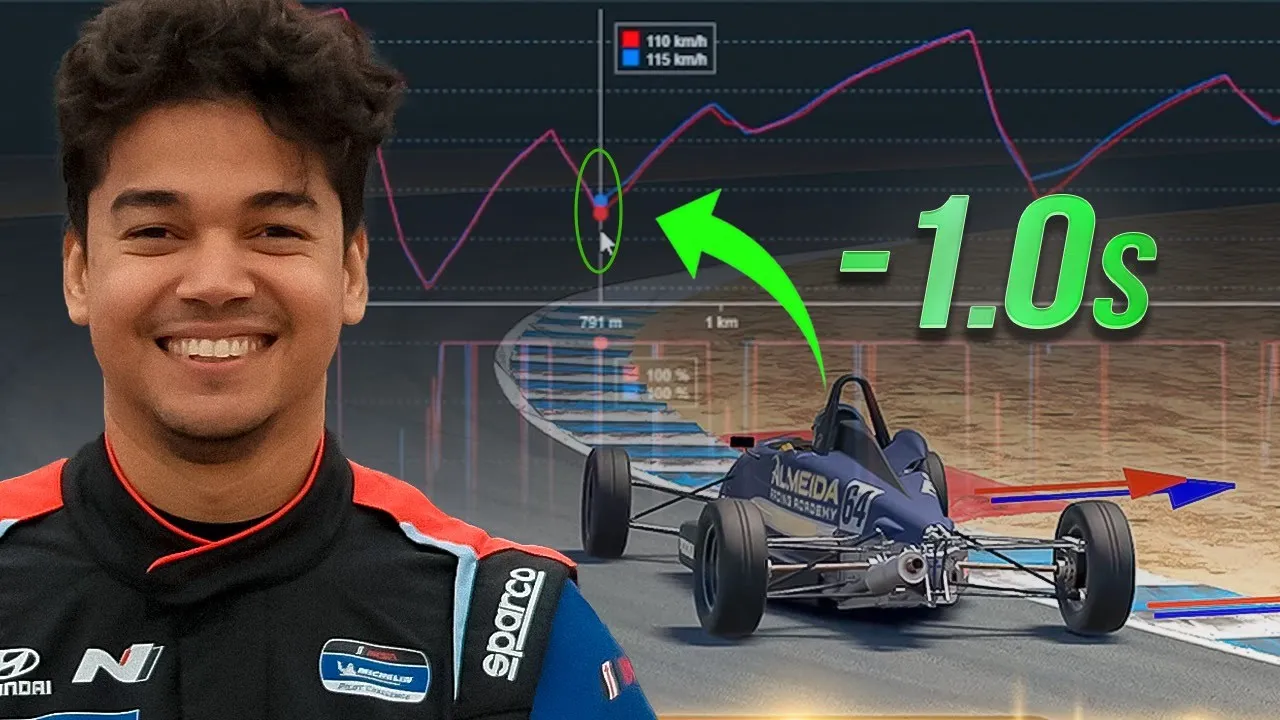
95% of Drivers Get Stuck Here — How to Master Oversteery Cars in Sim Racing
Suellio Almeida
•
Tuesday, March 25, 2025
Why Oversteery Cars Expose Every Mistake You Make
You can get away with sloppy inputs in an understeery car. The front washes out, you wait, you try again. Boring, but forgiving.
Oversteery cars don't forgive.
Every steering correction matters. Every brake input. Every throttle adjustment. The car is constantly communicating with you — and if you're not listening, you're spinning.
This is where 95% of drivers get stuck. They treat oversteer like a problem to fight instead of a conversation to have.
The Physics You're Ignoring: Why the Rear Loses Grip
Oversteer happens when the rear tires lose grip before the fronts. Simple.
But why does that happen?
Three main reasons:
1. Weight transfer off the rear — You brake hard, weight shifts forward, rear gets light.
2. Too much rotation from steering input — You turn the wheel, the car pivots, rear steps out.
3. Throttle application under rotation — You're still turning, rear tires are already loaded laterally, you add power, they give up.
Most drivers only react to oversteer after it's already happening. You need to anticipate it by understanding what causes it.
Ask yourself: Where in the corner is weight transferring? When am I asking the rear tires to do too much?
The Countersteer Trap — Why Your Hands Are Too Slow
Here's the brutal truth: If you're waiting to feel the rear step out, you're already too late.
By the time your brain processes the slide, sends the signal to your hands, and you countersteer — the car has rotated past the point of recovery.
This is why sim racers with fast reaction times still spin. Reaction speed doesn't matter if you're reacting to the wrong thing.
You need to stop countersteering after the slide starts. You need to countersteer as it starts — or better yet, prevent it entirely.
The Steering Correction You Should Be Making (Before the Slide)
The key to mastering oversteery cars isn't countersteering skill. It's steering precision at turn-in.
Most drivers turn in too aggressively. They crank the wheel, the car rotates sharply, weight shifts, rear steps out.
Instead:
Turn in with less initial steering angle. Let the car rotate naturally.
Use progressive steering input. Smooth ramp-up, not a snap.
Hold the wheel steady mid-corner. Don't keep adjusting — one smooth arc.
The smoother your steering input, the less the car destabilizes. The less it destabilizes, the less oversteer you create.
You're not fighting oversteer. You're not creating it in the first place.
Trail Braking: The Technique That Controls Oversteer
If you're not trail braking, you're driving oversteery cars with one hand tied behind your back.
Trail braking lets you control weight transfer into the corner. You're actively deciding how much grip the rear has.
Brake hard on entry → weight forward → rear light → car rotates easily.
Release brake smoothly → weight shifts back → rear gains grip → car stabilizes.
The mistake most drivers make: they release the brake too early or too abruptly. The weight snaps back to the rear, the car understeers, they add more steering, the rear gives up.
Instead, hold brake pressure deeper into the corner and release it gradually as you unwind the wheel.
This keeps the car balanced. The rear stays planted because weight transfer is progressive, not violent.
Throttle Control: The Difference Between Fast and Spinning
You can nail turn-in, trail brake perfectly, and still spin if your throttle application is garbage.
Here's what happens: You're mid-corner, the car is already rotated, rear tires are loaded laterally. You get excited, mash the throttle, the rear tires are already at their limit, they break loose.
Throttle application in oversteery cars is about timing and progression.
Wait until the wheel is past the Maximum Rotation Point — the moment where you've turned in the most and are starting to unwind.
Apply throttle progressively — not a binary on/off switch.
Match throttle application to steering reduction — as you unwind, you accelerate.
If you're spinning on corner exit, you're applying power too early or too aggressively. Period.
Vision: The One Thing That Changes Everything
You want to know the real secret to driving oversteery cars?
Look further ahead.
Most drivers stare at the apex. Their eyes are glued to where the car is, not where it's going.
When you look ahead — exit, next braking zone, next turn-in point — your hands respond earlier. Your inputs become predictive, not reactive.
This is why experienced drivers seem to countersteer effortlessly. They're not reacting faster. They're seeing sooner.
Shift your vision forward. Your hands will follow.
The Setup Myth: Why You Don't Need a Stable Car
Drivers love to blame the setup. "The car is too loose." "I need more rear downforce." "This setup sucks."
Here's the truth: If you can't drive an oversteery car, adding rear stability won't make you faster. It'll just mask your mistakes.
You'll plateau. You'll never learn the technique that unlocks the next level.
The best drivers in the world — across sim racing and real motorsports — prefer a car that's slightly loose. Why? Because it teaches them precision.
Every input matters. Every mistake is immediate feedback.
Don't run from the challenge. Embrace it.
The Practice Routine: How to Actually Get Better at This
You don't master oversteery cars by hoping. You master them through deliberate practice.
Here's the routine:
1. Pick one corner — ideally a slow-to-medium speed corner where oversteer is a problem.
2. Run 20 laps — focus only on steering smoothness. No other variables.
3. Run 20 more laps — focus only on brake release timing.
4. Run 20 more laps — focus only on throttle application timing.
5. Review telemetry — compare your smoothest lap to your fastest lap. What's different?
Repetition builds muscle memory. Focused repetition builds correct muscle memory.
Stop doing random laps and hoping for improvement. Train with purpose.
What Separates Good Drivers from Great Drivers
Good drivers can control an understeery car. They're consistent, safe, predictable.
Great drivers can control an oversteery car. They're on the edge, extracting every tenth, dancing with the limit.
The difference isn't talent. It's willingness to be uncomfortable.
You're going to spin. A lot. That's the process. Every spin teaches you where the limit is. Every save teaches you how to respond.
Most drivers quit before they get good. Don't be most drivers.
Are You Ready to Stop Fighting the Car and Start Controlling It?
How many more laps are you going to run before you admit your technique needs work?
You're fast in stable cars. But the moment the rear gets loose, you're guessing. You're reacting too late. You're spinning in the same corners, session after session.
What if you could actually control oversteer? What if you could feel the car step out and catch it effortlessly — not through reaction speed, but through anticipation?
That's what the Gold Membership at Almeida Racing Academy teaches. Trail braking modules. Weight transfer lessons. Vision techniques. Throttle control drills. Everything you need to stop being a passenger and start being a driver.
Join Gold for $25/month (code: WINTER) and learn to master oversteery cars →
Sim Racing Academy Membership
Everything you need to stop guessing and start getting faster.
Starting at
$25
/mo
Car Handling Online Course
4 levels, full curriculum. Aimed to get you to top 1% in driving pace.
Racecraft Online Course
Overtaking, Defending, Race Strategy
Live coaching + on-track practice
Bi-weekly pro-coach workshops (recorded — never miss one) plus on-track Pit Parties to practice racecraft with a coach.
Plus These Bonuses
13,000+ Member Community
League Racing
Advanced MX-5 Mini Course
Racing Technique Development Guide
The Motor Racing Book (260 pages)
Think & Behave Like a Pro Driver — Mini eBook
95% of Drivers Get Stuck Here — How to Master Oversteery Cars in Sim Racing
Suellio Almeida
•
Tuesday, March 25, 2025
Why Oversteery Cars Expose Every Mistake You Make
You can get away with sloppy inputs in an understeery car. The front washes out, you wait, you try again. Boring, but forgiving.
Oversteery cars don't forgive.
Every steering correction matters. Every brake input. Every throttle adjustment. The car is constantly communicating with you — and if you're not listening, you're spinning.
This is where 95% of drivers get stuck. They treat oversteer like a problem to fight instead of a conversation to have.
The Physics You're Ignoring: Why the Rear Loses Grip
Oversteer happens when the rear tires lose grip before the fronts. Simple.
But why does that happen?
Three main reasons:
1. Weight transfer off the rear — You brake hard, weight shifts forward, rear gets light.
2. Too much rotation from steering input — You turn the wheel, the car pivots, rear steps out.
3. Throttle application under rotation — You're still turning, rear tires are already loaded laterally, you add power, they give up.
Most drivers only react to oversteer after it's already happening. You need to anticipate it by understanding what causes it.
Ask yourself: Where in the corner is weight transferring? When am I asking the rear tires to do too much?
The Countersteer Trap — Why Your Hands Are Too Slow
Here's the brutal truth: If you're waiting to feel the rear step out, you're already too late.
By the time your brain processes the slide, sends the signal to your hands, and you countersteer — the car has rotated past the point of recovery.
This is why sim racers with fast reaction times still spin. Reaction speed doesn't matter if you're reacting to the wrong thing.
You need to stop countersteering after the slide starts. You need to countersteer as it starts — or better yet, prevent it entirely.
The Steering Correction You Should Be Making (Before the Slide)
The key to mastering oversteery cars isn't countersteering skill. It's steering precision at turn-in.
Most drivers turn in too aggressively. They crank the wheel, the car rotates sharply, weight shifts, rear steps out.
Instead:
Turn in with less initial steering angle. Let the car rotate naturally.
Use progressive steering input. Smooth ramp-up, not a snap.
Hold the wheel steady mid-corner. Don't keep adjusting — one smooth arc.
The smoother your steering input, the less the car destabilizes. The less it destabilizes, the less oversteer you create.
You're not fighting oversteer. You're not creating it in the first place.
Trail Braking: The Technique That Controls Oversteer
If you're not trail braking, you're driving oversteery cars with one hand tied behind your back.
Trail braking lets you control weight transfer into the corner. You're actively deciding how much grip the rear has.
Brake hard on entry → weight forward → rear light → car rotates easily.
Release brake smoothly → weight shifts back → rear gains grip → car stabilizes.
The mistake most drivers make: they release the brake too early or too abruptly. The weight snaps back to the rear, the car understeers, they add more steering, the rear gives up.
Instead, hold brake pressure deeper into the corner and release it gradually as you unwind the wheel.
This keeps the car balanced. The rear stays planted because weight transfer is progressive, not violent.
Throttle Control: The Difference Between Fast and Spinning
You can nail turn-in, trail brake perfectly, and still spin if your throttle application is garbage.
Here's what happens: You're mid-corner, the car is already rotated, rear tires are loaded laterally. You get excited, mash the throttle, the rear tires are already at their limit, they break loose.
Throttle application in oversteery cars is about timing and progression.
Wait until the wheel is past the Maximum Rotation Point — the moment where you've turned in the most and are starting to unwind.
Apply throttle progressively — not a binary on/off switch.
Match throttle application to steering reduction — as you unwind, you accelerate.
If you're spinning on corner exit, you're applying power too early or too aggressively. Period.
Vision: The One Thing That Changes Everything
You want to know the real secret to driving oversteery cars?
Look further ahead.
Most drivers stare at the apex. Their eyes are glued to where the car is, not where it's going.
When you look ahead — exit, next braking zone, next turn-in point — your hands respond earlier. Your inputs become predictive, not reactive.
This is why experienced drivers seem to countersteer effortlessly. They're not reacting faster. They're seeing sooner.
Shift your vision forward. Your hands will follow.
The Setup Myth: Why You Don't Need a Stable Car
Drivers love to blame the setup. "The car is too loose." "I need more rear downforce." "This setup sucks."
Here's the truth: If you can't drive an oversteery car, adding rear stability won't make you faster. It'll just mask your mistakes.
You'll plateau. You'll never learn the technique that unlocks the next level.
The best drivers in the world — across sim racing and real motorsports — prefer a car that's slightly loose. Why? Because it teaches them precision.
Every input matters. Every mistake is immediate feedback.
Don't run from the challenge. Embrace it.
The Practice Routine: How to Actually Get Better at This
You don't master oversteery cars by hoping. You master them through deliberate practice.
Here's the routine:
1. Pick one corner — ideally a slow-to-medium speed corner where oversteer is a problem.
2. Run 20 laps — focus only on steering smoothness. No other variables.
3. Run 20 more laps — focus only on brake release timing.
4. Run 20 more laps — focus only on throttle application timing.
5. Review telemetry — compare your smoothest lap to your fastest lap. What's different?
Repetition builds muscle memory. Focused repetition builds correct muscle memory.
Stop doing random laps and hoping for improvement. Train with purpose.
What Separates Good Drivers from Great Drivers
Good drivers can control an understeery car. They're consistent, safe, predictable.
Great drivers can control an oversteery car. They're on the edge, extracting every tenth, dancing with the limit.
The difference isn't talent. It's willingness to be uncomfortable.
You're going to spin. A lot. That's the process. Every spin teaches you where the limit is. Every save teaches you how to respond.
Most drivers quit before they get good. Don't be most drivers.
Are You Ready to Stop Fighting the Car and Start Controlling It?
How many more laps are you going to run before you admit your technique needs work?
You're fast in stable cars. But the moment the rear gets loose, you're guessing. You're reacting too late. You're spinning in the same corners, session after session.
What if you could actually control oversteer? What if you could feel the car step out and catch it effortlessly — not through reaction speed, but through anticipation?
That's what the Gold Membership at Almeida Racing Academy teaches. Trail braking modules. Weight transfer lessons. Vision techniques. Throttle control drills. Everything you need to stop being a passenger and start being a driver.
Join Gold for $25/month (code: WINTER) and learn to master oversteery cars →
Sim Racing Academy Membership
Everything you need to stop guessing and start getting faster.
Starting at
$25
/mo
Car Handling Online Course
4 levels, full curriculum. Aimed to get you to top 1% in driving pace.
Racecraft Online Course
Overtaking, Defending, Race Strategy
Live coaching + on-track practice
Bi-weekly pro-coach workshops (recorded — never miss one) plus on-track Pit Parties to practice racecraft with a coach.
Plus These Bonuses
13,000+ Member Community
League Racing
Advanced MX-5 Mini Course
Racing Technique Development Guide
The Motor Racing Book (260 pages)
Think & Behave Like a Pro Driver — Mini eBook
95% of Drivers Get Stuck Here — How to Master Oversteery Cars in Sim Racing
Suellio Almeida
•
Tuesday, March 25, 2025
Why Oversteery Cars Expose Every Mistake You Make
You can get away with sloppy inputs in an understeery car. The front washes out, you wait, you try again. Boring, but forgiving.
Oversteery cars don't forgive.
Every steering correction matters. Every brake input. Every throttle adjustment. The car is constantly communicating with you — and if you're not listening, you're spinning.
This is where 95% of drivers get stuck. They treat oversteer like a problem to fight instead of a conversation to have.
The Physics You're Ignoring: Why the Rear Loses Grip
Oversteer happens when the rear tires lose grip before the fronts. Simple.
But why does that happen?
Three main reasons:
1. Weight transfer off the rear — You brake hard, weight shifts forward, rear gets light.
2. Too much rotation from steering input — You turn the wheel, the car pivots, rear steps out.
3. Throttle application under rotation — You're still turning, rear tires are already loaded laterally, you add power, they give up.
Most drivers only react to oversteer after it's already happening. You need to anticipate it by understanding what causes it.
Ask yourself: Where in the corner is weight transferring? When am I asking the rear tires to do too much?
The Countersteer Trap — Why Your Hands Are Too Slow
Here's the brutal truth: If you're waiting to feel the rear step out, you're already too late.
By the time your brain processes the slide, sends the signal to your hands, and you countersteer — the car has rotated past the point of recovery.
This is why sim racers with fast reaction times still spin. Reaction speed doesn't matter if you're reacting to the wrong thing.
You need to stop countersteering after the slide starts. You need to countersteer as it starts — or better yet, prevent it entirely.
The Steering Correction You Should Be Making (Before the Slide)
The key to mastering oversteery cars isn't countersteering skill. It's steering precision at turn-in.
Most drivers turn in too aggressively. They crank the wheel, the car rotates sharply, weight shifts, rear steps out.
Instead:
Turn in with less initial steering angle. Let the car rotate naturally.
Use progressive steering input. Smooth ramp-up, not a snap.
Hold the wheel steady mid-corner. Don't keep adjusting — one smooth arc.
The smoother your steering input, the less the car destabilizes. The less it destabilizes, the less oversteer you create.
You're not fighting oversteer. You're not creating it in the first place.
Trail Braking: The Technique That Controls Oversteer
If you're not trail braking, you're driving oversteery cars with one hand tied behind your back.
Trail braking lets you control weight transfer into the corner. You're actively deciding how much grip the rear has.
Brake hard on entry → weight forward → rear light → car rotates easily.
Release brake smoothly → weight shifts back → rear gains grip → car stabilizes.
The mistake most drivers make: they release the brake too early or too abruptly. The weight snaps back to the rear, the car understeers, they add more steering, the rear gives up.
Instead, hold brake pressure deeper into the corner and release it gradually as you unwind the wheel.
This keeps the car balanced. The rear stays planted because weight transfer is progressive, not violent.
Throttle Control: The Difference Between Fast and Spinning
You can nail turn-in, trail brake perfectly, and still spin if your throttle application is garbage.
Here's what happens: You're mid-corner, the car is already rotated, rear tires are loaded laterally. You get excited, mash the throttle, the rear tires are already at their limit, they break loose.
Throttle application in oversteery cars is about timing and progression.
Wait until the wheel is past the Maximum Rotation Point — the moment where you've turned in the most and are starting to unwind.
Apply throttle progressively — not a binary on/off switch.
Match throttle application to steering reduction — as you unwind, you accelerate.
If you're spinning on corner exit, you're applying power too early or too aggressively. Period.
Vision: The One Thing That Changes Everything
You want to know the real secret to driving oversteery cars?
Look further ahead.
Most drivers stare at the apex. Their eyes are glued to where the car is, not where it's going.
When you look ahead — exit, next braking zone, next turn-in point — your hands respond earlier. Your inputs become predictive, not reactive.
This is why experienced drivers seem to countersteer effortlessly. They're not reacting faster. They're seeing sooner.
Shift your vision forward. Your hands will follow.
The Setup Myth: Why You Don't Need a Stable Car
Drivers love to blame the setup. "The car is too loose." "I need more rear downforce." "This setup sucks."
Here's the truth: If you can't drive an oversteery car, adding rear stability won't make you faster. It'll just mask your mistakes.
You'll plateau. You'll never learn the technique that unlocks the next level.
The best drivers in the world — across sim racing and real motorsports — prefer a car that's slightly loose. Why? Because it teaches them precision.
Every input matters. Every mistake is immediate feedback.
Don't run from the challenge. Embrace it.
The Practice Routine: How to Actually Get Better at This
You don't master oversteery cars by hoping. You master them through deliberate practice.
Here's the routine:
1. Pick one corner — ideally a slow-to-medium speed corner where oversteer is a problem.
2. Run 20 laps — focus only on steering smoothness. No other variables.
3. Run 20 more laps — focus only on brake release timing.
4. Run 20 more laps — focus only on throttle application timing.
5. Review telemetry — compare your smoothest lap to your fastest lap. What's different?
Repetition builds muscle memory. Focused repetition builds correct muscle memory.
Stop doing random laps and hoping for improvement. Train with purpose.
What Separates Good Drivers from Great Drivers
Good drivers can control an understeery car. They're consistent, safe, predictable.
Great drivers can control an oversteery car. They're on the edge, extracting every tenth, dancing with the limit.
The difference isn't talent. It's willingness to be uncomfortable.
You're going to spin. A lot. That's the process. Every spin teaches you where the limit is. Every save teaches you how to respond.
Most drivers quit before they get good. Don't be most drivers.
Are You Ready to Stop Fighting the Car and Start Controlling It?
How many more laps are you going to run before you admit your technique needs work?
You're fast in stable cars. But the moment the rear gets loose, you're guessing. You're reacting too late. You're spinning in the same corners, session after session.
What if you could actually control oversteer? What if you could feel the car step out and catch it effortlessly — not through reaction speed, but through anticipation?
That's what the Gold Membership at Almeida Racing Academy teaches. Trail braking modules. Weight transfer lessons. Vision techniques. Throttle control drills. Everything you need to stop being a passenger and start being a driver.
Join Gold for $25/month (code: WINTER) and learn to master oversteery cars →
Sim Racing Academy Membership
Everything you need to stop guessing and start getting faster.
Starting at
$25
/mo
Car Handling Online Course
4 levels, full curriculum. Aimed to get you to top 1% in driving pace.
Racecraft Online Course
Overtaking, Defending, Race Strategy
Live coaching + on-track practice
Bi-weekly pro-coach workshops (recorded — never miss one) plus on-track Pit Parties to practice racecraft with a coach.
Plus These Bonuses
13,000+ Member Community
League Racing
Advanced MX-5 Mini Course
Racing Technique Development Guide
The Motor Racing Book (260 pages)
Think & Behave Like a Pro Driver — Mini eBook