
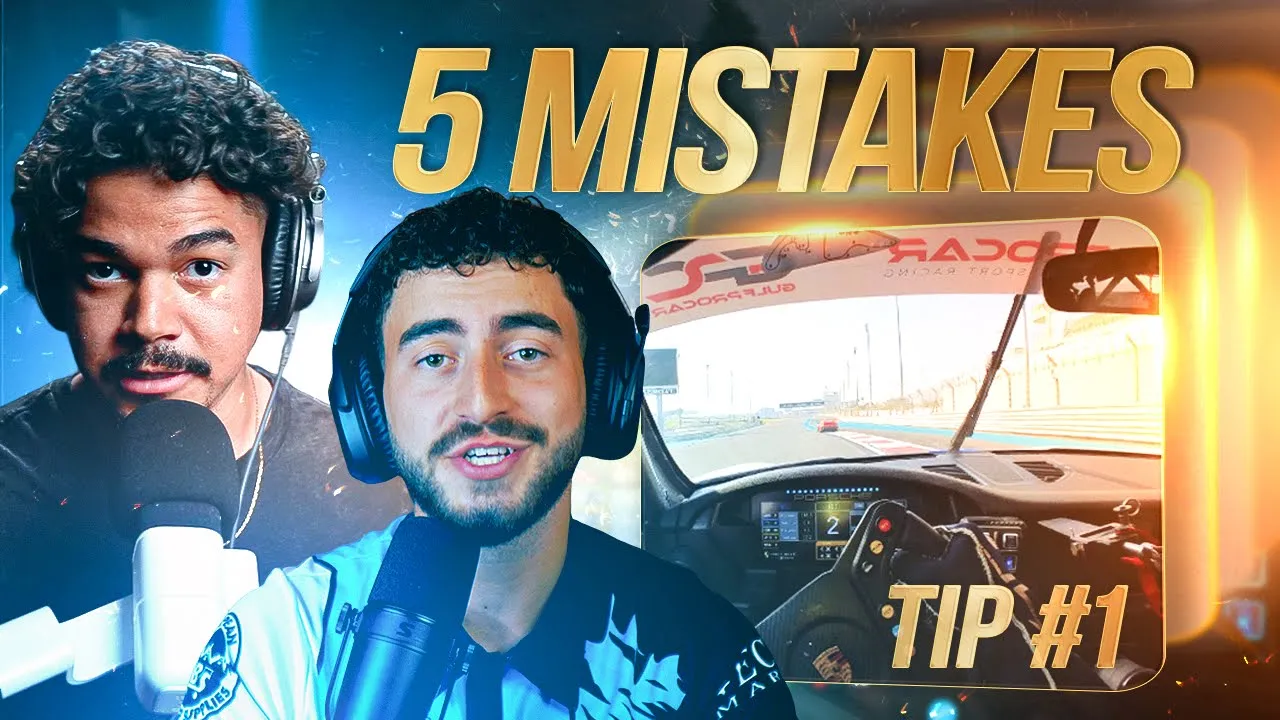
5 Racing Mistakes That Kill Your Lap Time (And How to Fix Them)
Suellio Almeida
•
Wednesday, September 24, 2025
You're Braking Too Early Because You're Scared
Let me guess. You brake early because late braking feels dangerous. You want margin. You want safety.
Here's the problem: early braking doesn't make you safer. It makes you slower AND unpredictable.
When you brake too early, you're coasting into corners. You lose all the load transfer benefits of proper trail braking. Your front tires aren't loaded. Your rotation suffers. You understeer mid-corner because the car never got into its optimal platform.
But worse? You become a moving chicane for faster drivers. They can't predict your braking point. They get surprised. That's when contact happens.
The fix isn't "brake later." It's brake at the limit of grip, then trail brake properly through turn-in. That might mean braking 10 meters earlier than the alien you're chasing, but doing it with full commitment and proper pressure.
Commitment beats aggression every time.
You're Turning In Too Early and Killing Your Exit
This one destroyed my lap times for months.
You hit the brakes. You start turning. You think you're being smooth. But watch your replay — you're already at full lock halfway through the braking zone.
Early turn-in = early apex = terrible exit.
When you turn too early, you run out of track on exit. You have to lift. You scrub speed. You lose the entire next straight.
The thing is, it feels fast. You feel like you're attacking the corner. But look at your minimum speed. Look at your exit speed. You're bleeding time.
Maximum Rotation Point changes everything. You keep the car straighter longer during braking. You delay turn-in. You hit a later apex. Suddenly you have track to work with on exit. Your minimum speed drops slightly, but your exit speed jumps.
That's where real lap time lives.
You're Not Managing Weight Transfer (And It's Costing You)
Weight transfer is the foundation of car control. But most drivers treat it like it's optional.
You brake. The weight goes forward. You turn in. The weight shifts laterally. You get on throttle. The weight goes rearward.
Every input you make moves weight around the car.
When you're jerky with the wheel, you shock-load the front tires. They give up grip. You understeer. Then you panic and make it worse.
When you dump the throttle mid-corner, you shift weight forward violently. The rear lightens. You spin.
Smooth doesn't mean slow. Smooth means you're managing load transfer deliberately. You're giving the tires time to build and release grip progressively.
Watch your steering input trace in telemetry. Is it smooth? Or does it look like a heart rate monitor during a panic attack?
The best drivers in the world have the smoothest inputs. There's a reason.
You're Chasing Setup Instead of Fixing Your Driving
Here's a hard truth: Your setup isn't your problem. Your driving is.
I see this constantly. Driver struggles with understeer. Immediately jumps into setup changes. Front wing. Tire pressures. Springs.
Meanwhile, they're trail braking inconsistently. Their vision is late. Their weight transfer is chaotic.
Setup can't fix fundamental technique issues.
Yes, setup matters at the top level. But if you're more than half a second off the pace, setup is not your limitation. Your braking consistency is. Your turn-in timing is. Your throttle application is.
The baseline setup in most sims is 90% of the way there for most tracks. Drive it. Master it. THEN start making small, data-driven adjustments.
I've watched drivers gain a full second per lap just by fixing their trail braking. No setup changes. Just technique.
You're Not Training With Purpose
You fire up the sim. You run laps. You check your time. You run more laps.
That's not practice. That's just driving around.
Every session needs a focus. Today you're working on turn 3 braking consistency. Tomorrow you're drilling trail braking in the slow chicane. Next session you're analyzing your throttle application on exit.
You film your screen. You review the replay. You compare against faster drivers. You identify the ONE thing that's costing you the most time. You isolate it. You drill it.
This is how you build skill. Not by mindlessly running laps hoping you magically get faster.
The drivers who improve fastest are the ones who train like athletes. They have structure. They have measurables. They iterate deliberately.
Random practice gets random results.
What If You Could Stop Making These Mistakes Tomorrow?
How much time have you lost to these five mistakes already? How many laps have you run with early braking, bad turn-in timing, and no weight transfer awareness?
What would change if you had a structured path that addressed these issues systematically — not through guesswork, but through proven technique?
The difference between struggling for months and breaking through in weeks isn't talent. It's method.
That's why I built Almeida Racing Academy. Free account gets you the Car Handling Fundamentals course — 11 lessons that fix the foundation most drivers are missing. Weight transfer, trail braking, rotation, vision techniques. The stuff that actually matters.
No credit card. No upsell pressure. Just the technique that took me from struggling sim racer to IMSA driver.
Sim Racing Academy Membership
Everything you need to stop guessing and start getting faster.
Starting at
$25
/mo
Car Handling Online Course
4 levels, full curriculum. Aimed to get you to top 1% in driving pace.
Racecraft Online Course
Overtaking, Defending, Race Strategy
Live coaching + on-track practice
Bi-weekly pro-coach workshops (recorded — never miss one) plus on-track Pit Parties to practice racecraft with a coach.
Plus These Bonuses
13,000+ Member Community
League Racing
Advanced MX-5 Mini Course
Racing Technique Development Guide
The Motor Racing Book (260 pages)
Think & Behave Like a Pro Driver — Mini eBook
5 Racing Mistakes That Kill Your Lap Time (And How to Fix Them)
Suellio Almeida
•
Wednesday, September 24, 2025
You're Braking Too Early Because You're Scared
Let me guess. You brake early because late braking feels dangerous. You want margin. You want safety.
Here's the problem: early braking doesn't make you safer. It makes you slower AND unpredictable.
When you brake too early, you're coasting into corners. You lose all the load transfer benefits of proper trail braking. Your front tires aren't loaded. Your rotation suffers. You understeer mid-corner because the car never got into its optimal platform.
But worse? You become a moving chicane for faster drivers. They can't predict your braking point. They get surprised. That's when contact happens.
The fix isn't "brake later." It's brake at the limit of grip, then trail brake properly through turn-in. That might mean braking 10 meters earlier than the alien you're chasing, but doing it with full commitment and proper pressure.
Commitment beats aggression every time.
You're Turning In Too Early and Killing Your Exit
This one destroyed my lap times for months.
You hit the brakes. You start turning. You think you're being smooth. But watch your replay — you're already at full lock halfway through the braking zone.
Early turn-in = early apex = terrible exit.
When you turn too early, you run out of track on exit. You have to lift. You scrub speed. You lose the entire next straight.
The thing is, it feels fast. You feel like you're attacking the corner. But look at your minimum speed. Look at your exit speed. You're bleeding time.
Maximum Rotation Point changes everything. You keep the car straighter longer during braking. You delay turn-in. You hit a later apex. Suddenly you have track to work with on exit. Your minimum speed drops slightly, but your exit speed jumps.
That's where real lap time lives.
You're Not Managing Weight Transfer (And It's Costing You)
Weight transfer is the foundation of car control. But most drivers treat it like it's optional.
You brake. The weight goes forward. You turn in. The weight shifts laterally. You get on throttle. The weight goes rearward.
Every input you make moves weight around the car.
When you're jerky with the wheel, you shock-load the front tires. They give up grip. You understeer. Then you panic and make it worse.
When you dump the throttle mid-corner, you shift weight forward violently. The rear lightens. You spin.
Smooth doesn't mean slow. Smooth means you're managing load transfer deliberately. You're giving the tires time to build and release grip progressively.
Watch your steering input trace in telemetry. Is it smooth? Or does it look like a heart rate monitor during a panic attack?
The best drivers in the world have the smoothest inputs. There's a reason.
You're Chasing Setup Instead of Fixing Your Driving
Here's a hard truth: Your setup isn't your problem. Your driving is.
I see this constantly. Driver struggles with understeer. Immediately jumps into setup changes. Front wing. Tire pressures. Springs.
Meanwhile, they're trail braking inconsistently. Their vision is late. Their weight transfer is chaotic.
Setup can't fix fundamental technique issues.
Yes, setup matters at the top level. But if you're more than half a second off the pace, setup is not your limitation. Your braking consistency is. Your turn-in timing is. Your throttle application is.
The baseline setup in most sims is 90% of the way there for most tracks. Drive it. Master it. THEN start making small, data-driven adjustments.
I've watched drivers gain a full second per lap just by fixing their trail braking. No setup changes. Just technique.
You're Not Training With Purpose
You fire up the sim. You run laps. You check your time. You run more laps.
That's not practice. That's just driving around.
Every session needs a focus. Today you're working on turn 3 braking consistency. Tomorrow you're drilling trail braking in the slow chicane. Next session you're analyzing your throttle application on exit.
You film your screen. You review the replay. You compare against faster drivers. You identify the ONE thing that's costing you the most time. You isolate it. You drill it.
This is how you build skill. Not by mindlessly running laps hoping you magically get faster.
The drivers who improve fastest are the ones who train like athletes. They have structure. They have measurables. They iterate deliberately.
Random practice gets random results.
What If You Could Stop Making These Mistakes Tomorrow?
How much time have you lost to these five mistakes already? How many laps have you run with early braking, bad turn-in timing, and no weight transfer awareness?
What would change if you had a structured path that addressed these issues systematically — not through guesswork, but through proven technique?
The difference between struggling for months and breaking through in weeks isn't talent. It's method.
That's why I built Almeida Racing Academy. Free account gets you the Car Handling Fundamentals course — 11 lessons that fix the foundation most drivers are missing. Weight transfer, trail braking, rotation, vision techniques. The stuff that actually matters.
No credit card. No upsell pressure. Just the technique that took me from struggling sim racer to IMSA driver.
Sim Racing Academy Membership
Everything you need to stop guessing and start getting faster.
Starting at
$25
/mo
Car Handling Online Course
4 levels, full curriculum. Aimed to get you to top 1% in driving pace.
Racecraft Online Course
Overtaking, Defending, Race Strategy
Live coaching + on-track practice
Bi-weekly pro-coach workshops (recorded — never miss one) plus on-track Pit Parties to practice racecraft with a coach.
Plus These Bonuses
13,000+ Member Community
League Racing
Advanced MX-5 Mini Course
Racing Technique Development Guide
The Motor Racing Book (260 pages)
Think & Behave Like a Pro Driver — Mini eBook
5 Racing Mistakes That Kill Your Lap Time (And How to Fix Them)
Suellio Almeida
•
Wednesday, September 24, 2025
You're Braking Too Early Because You're Scared
Let me guess. You brake early because late braking feels dangerous. You want margin. You want safety.
Here's the problem: early braking doesn't make you safer. It makes you slower AND unpredictable.
When you brake too early, you're coasting into corners. You lose all the load transfer benefits of proper trail braking. Your front tires aren't loaded. Your rotation suffers. You understeer mid-corner because the car never got into its optimal platform.
But worse? You become a moving chicane for faster drivers. They can't predict your braking point. They get surprised. That's when contact happens.
The fix isn't "brake later." It's brake at the limit of grip, then trail brake properly through turn-in. That might mean braking 10 meters earlier than the alien you're chasing, but doing it with full commitment and proper pressure.
Commitment beats aggression every time.
You're Turning In Too Early and Killing Your Exit
This one destroyed my lap times for months.
You hit the brakes. You start turning. You think you're being smooth. But watch your replay — you're already at full lock halfway through the braking zone.
Early turn-in = early apex = terrible exit.
When you turn too early, you run out of track on exit. You have to lift. You scrub speed. You lose the entire next straight.
The thing is, it feels fast. You feel like you're attacking the corner. But look at your minimum speed. Look at your exit speed. You're bleeding time.
Maximum Rotation Point changes everything. You keep the car straighter longer during braking. You delay turn-in. You hit a later apex. Suddenly you have track to work with on exit. Your minimum speed drops slightly, but your exit speed jumps.
That's where real lap time lives.
You're Not Managing Weight Transfer (And It's Costing You)
Weight transfer is the foundation of car control. But most drivers treat it like it's optional.
You brake. The weight goes forward. You turn in. The weight shifts laterally. You get on throttle. The weight goes rearward.
Every input you make moves weight around the car.
When you're jerky with the wheel, you shock-load the front tires. They give up grip. You understeer. Then you panic and make it worse.
When you dump the throttle mid-corner, you shift weight forward violently. The rear lightens. You spin.
Smooth doesn't mean slow. Smooth means you're managing load transfer deliberately. You're giving the tires time to build and release grip progressively.
Watch your steering input trace in telemetry. Is it smooth? Or does it look like a heart rate monitor during a panic attack?
The best drivers in the world have the smoothest inputs. There's a reason.
You're Chasing Setup Instead of Fixing Your Driving
Here's a hard truth: Your setup isn't your problem. Your driving is.
I see this constantly. Driver struggles with understeer. Immediately jumps into setup changes. Front wing. Tire pressures. Springs.
Meanwhile, they're trail braking inconsistently. Their vision is late. Their weight transfer is chaotic.
Setup can't fix fundamental technique issues.
Yes, setup matters at the top level. But if you're more than half a second off the pace, setup is not your limitation. Your braking consistency is. Your turn-in timing is. Your throttle application is.
The baseline setup in most sims is 90% of the way there for most tracks. Drive it. Master it. THEN start making small, data-driven adjustments.
I've watched drivers gain a full second per lap just by fixing their trail braking. No setup changes. Just technique.
You're Not Training With Purpose
You fire up the sim. You run laps. You check your time. You run more laps.
That's not practice. That's just driving around.
Every session needs a focus. Today you're working on turn 3 braking consistency. Tomorrow you're drilling trail braking in the slow chicane. Next session you're analyzing your throttle application on exit.
You film your screen. You review the replay. You compare against faster drivers. You identify the ONE thing that's costing you the most time. You isolate it. You drill it.
This is how you build skill. Not by mindlessly running laps hoping you magically get faster.
The drivers who improve fastest are the ones who train like athletes. They have structure. They have measurables. They iterate deliberately.
Random practice gets random results.
What If You Could Stop Making These Mistakes Tomorrow?
How much time have you lost to these five mistakes already? How many laps have you run with early braking, bad turn-in timing, and no weight transfer awareness?
What would change if you had a structured path that addressed these issues systematically — not through guesswork, but through proven technique?
The difference between struggling for months and breaking through in weeks isn't talent. It's method.
That's why I built Almeida Racing Academy. Free account gets you the Car Handling Fundamentals course — 11 lessons that fix the foundation most drivers are missing. Weight transfer, trail braking, rotation, vision techniques. The stuff that actually matters.
No credit card. No upsell pressure. Just the technique that took me from struggling sim racer to IMSA driver.
Sim Racing Academy Membership
Everything you need to stop guessing and start getting faster.
Starting at
$25
/mo
Car Handling Online Course
4 levels, full curriculum. Aimed to get you to top 1% in driving pace.
Racecraft Online Course
Overtaking, Defending, Race Strategy
Live coaching + on-track practice
Bi-weekly pro-coach workshops (recorded — never miss one) plus on-track Pit Parties to practice racecraft with a coach.
Plus These Bonuses
13,000+ Member Community
League Racing
Advanced MX-5 Mini Course
Racing Technique Development Guide
The Motor Racing Book (260 pages)
Think & Behave Like a Pro Driver — Mini eBook