
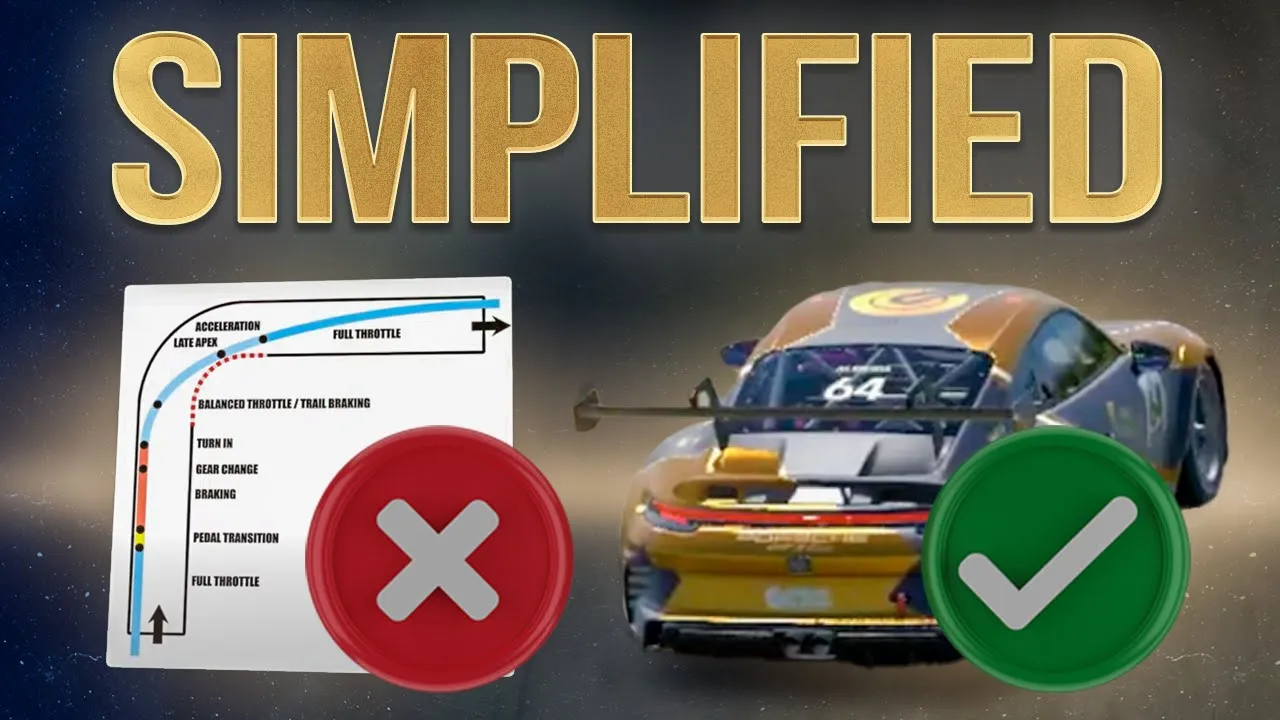
The 4 Stages of a Corner: High-Level Racing Technique Breakdown
Suellio Almeida
•
Saturday, October 28, 2023
You're Not Taking One Corner — You're Managing Four Phases
Here's the problem: most drivers think about corners as a single event. You turn in, you apex, you exit. Done.
Wrong.
Every corner is actually four separate stages, each with its own objective, its own physics, and its own way to cost you time if you screw it up. Miss the goal of Stage 2, and Stage 3 becomes impossible. Mess up Stage 3, and your exit speed — the thing that matters most — is gone.
Let's break it down the way a professional driver thinks about it.
Stage 1: Entry — Setting Up Everything That Follows
Goal: Get the car rotated and pointed at the apex.
This is where most mistakes happen, because drivers don't understand what "entry" actually means. It's not just braking. It's not just turning in. It's the entire process of transitioning from straight-line speed to a rotating platform.
You need three things here:
1. Braking pressure — Not just slowing down, but loading the front tires to give them grip.
2. Trail braking — Maintaining brake pressure as you turn in to keep weight forward and rotation alive.
3. Vision — Your eyes should already be tracking toward the apex, not stuck on the turn-in point.
The entry is about rotation. You want the car's nose pointed at the apex before you reach it. If you're still fighting understeer mid-corner, you didn't rotate enough in Stage 1.
Here's the test: if you have to add more steering angle after turn-in, your entry failed. The car should feel like it's falling into the corner, not being dragged.
Stage 2: Transition to Apex — The Minimum Speed Point
Goal: Reach the apex at the slowest speed you'll be in the corner.
This is the minimum speed point. It's also where the car is most loaded, most compressed, most on the edge of grip.
Right?
You're still trail braking here — not hard, but enough to keep weight on the front. The car should feel balanced, neutral, alive. If you release the brakes too early, the weight shifts back, the front goes light, and you understeer wide.
If you brake too late or carry too much speed into the apex, you'll either miss it entirely or have to stay on the brakes longer — which means you can't get on the throttle when you need to.
The apex isn't just a geometric point. It's a speed target. You want to arrive there at exactly the right speed to start accelerating. Not slower. Not faster. Exactly right.
And here's the thing most drivers miss: the apex is where you transition from braking to throttle. That transition has to be smooth. Abrupt inputs here will unsettle the car and kill your exit.
Stage 3: Apex to Exit Point — Building Speed
Goal: Maximize acceleration from apex to track-out.
This is where you make or lose the lap.
Once you hit the apex, you should be done with braking. You're on maintenance throttle or already starting to roll into power. The car should be unwinding — less steering angle, more throttle, using the full width of the track.
If you're still adding steering or fighting the car here, you messed up Stage 1 or Stage 2. You can't fix a bad entry with a good exit. The physics won't let you.
Your vision should now be locked on the exit point — the spot where you'll use the full track width on corner exit. That's where you're driving to. Not the apex anymore. The apex is behind you.
The goal is simple: get to full throttle as early as possible without running out of track. Every 0.1 seconds you delay full throttle costs you speed all the way down the next straight.
This is where patience matters. Drivers who rush the throttle here get snap oversteer or understeer wide and lose more time than they gained by being aggressive.
Stage 4: Exit — Carrying Speed Into the Next Section
Goal: Use all the track, maximize exit speed, set up the next corner.
The exit isn't just about this corner. It's about the next 500 meters. Exit speed determines how fast you'll be when you reach the next braking zone. That's why exits matter more than entries.
You should be at full throttle here, unwinding the steering to zero, using every centimeter of track width. If you're not at the exit curb or track edge, you left time on the table.
Look at your data. Compare your exit speed to the fastest drivers. If you're 2-3 mph slower, you'll lose half a second by the time you brake for the next turn. That's where races are won and lost.
And here's the brutal truth: if your exit is weak, it's because your entry or apex phase was wrong. The exit is just the consequence of everything before it.
The Mistake Most Drivers Make: Treating It Like One Event
You're trying to do too much at once.
You turn in and try to rotate, brake, hit the apex, and get on throttle all in the same instant. That's not how physics works. That's not how fast drivers think.
Each stage has a job. Entry rotates the car. Transition to apex finds minimum speed. Apex to exit builds acceleration. Exit maximizes carry-over speed.
Do one stage wrong, and the next three suffer. It's a chain reaction.
So here's what you do: pick one corner. Break it into these four stages. Focus on one stage at a time in practice. Get Stage 1 clean — just the entry, just the rotation. Then add Stage 2. Then 3. Then 4.
Stop trying to nail the whole corner at once. You're not ready for that yet.
What Happens When You Master All Four Stages?
Consistency.
That's the real benefit. When you understand the structure of a corner, you stop guessing. You stop making random inputs hoping something works. You know exactly what you're trying to achieve at every phase.
Your lap times tighten up. Your racecraft improves because you can predict where you'll be and where other drivers will be. You can defend, attack, adjust — all because you understand the framework.
And you stop plateauing. Because now you can diagnose your own mistakes. "I'm losing time in Turn 3" becomes "I'm not rotating enough in Stage 1 of Turn 3, so my apex speed is too high, which delays my throttle application in Stage 3."
See the difference?
That's what separates fast drivers from elite drivers. Structure. Process. Awareness.
Are You Actually Training, or Just Driving Laps?
Here's the question you need to ask yourself: when was the last time you practiced one specific stage of a corner in isolation?
Not just hotlapping. Not just racing. Actually drilling a single phase until it became automatic.
If the answer is "never," you're not training. You're just driving.
And that's fine — if you're okay with staying exactly where you are right now.
But if you're serious about getting faster, if you're tired of seeing the same lap times week after week, if you want to actually understand what you're doing behind the wheel instead of guessing...
...then you need structure. You need a system. You need coaching that breaks down every technique, every phase, every input into something you can practice and measure.
That's exactly what we do inside Almeida Racing Academy. Structured courses on trail braking, weight transfer, vision techniques, racecraft — taught by drivers who've done this at the highest level. IMSA. iRacing World Championship. Canadian National Champions.
And right now, you can get access to everything — 8 full courses, 80+ lessons, weekly workshops, challenges, data analysis tools — for $25/month with code WINTER.
No guesswork. No YouTube rabbit holes. Just the system that's helped 36,000+ drivers actually get faster.
Sim Racing Academy Membership
Everything you need to stop guessing and start getting faster.
Starting at
$25
/mo
Car Handling Online Course
4 levels, full curriculum. Aimed to get you to top 1% in driving pace.
Racecraft Online Course
Overtaking, Defending, Race Strategy
Live coaching + on-track practice
Bi-weekly pro-coach workshops (recorded — never miss one) plus on-track Pit Parties to practice racecraft with a coach.
Plus These Bonuses
13,000+ Member Community
League Racing
Advanced MX-5 Mini Course
Racing Technique Development Guide
The Motor Racing Book (260 pages)
Think & Behave Like a Pro Driver — Mini eBook
The 4 Stages of a Corner: High-Level Racing Technique Breakdown
Suellio Almeida
•
Saturday, October 28, 2023
You're Not Taking One Corner — You're Managing Four Phases
Here's the problem: most drivers think about corners as a single event. You turn in, you apex, you exit. Done.
Wrong.
Every corner is actually four separate stages, each with its own objective, its own physics, and its own way to cost you time if you screw it up. Miss the goal of Stage 2, and Stage 3 becomes impossible. Mess up Stage 3, and your exit speed — the thing that matters most — is gone.
Let's break it down the way a professional driver thinks about it.
Stage 1: Entry — Setting Up Everything That Follows
Goal: Get the car rotated and pointed at the apex.
This is where most mistakes happen, because drivers don't understand what "entry" actually means. It's not just braking. It's not just turning in. It's the entire process of transitioning from straight-line speed to a rotating platform.
You need three things here:
1. Braking pressure — Not just slowing down, but loading the front tires to give them grip.
2. Trail braking — Maintaining brake pressure as you turn in to keep weight forward and rotation alive.
3. Vision — Your eyes should already be tracking toward the apex, not stuck on the turn-in point.
The entry is about rotation. You want the car's nose pointed at the apex before you reach it. If you're still fighting understeer mid-corner, you didn't rotate enough in Stage 1.
Here's the test: if you have to add more steering angle after turn-in, your entry failed. The car should feel like it's falling into the corner, not being dragged.
Stage 2: Transition to Apex — The Minimum Speed Point
Goal: Reach the apex at the slowest speed you'll be in the corner.
This is the minimum speed point. It's also where the car is most loaded, most compressed, most on the edge of grip.
Right?
You're still trail braking here — not hard, but enough to keep weight on the front. The car should feel balanced, neutral, alive. If you release the brakes too early, the weight shifts back, the front goes light, and you understeer wide.
If you brake too late or carry too much speed into the apex, you'll either miss it entirely or have to stay on the brakes longer — which means you can't get on the throttle when you need to.
The apex isn't just a geometric point. It's a speed target. You want to arrive there at exactly the right speed to start accelerating. Not slower. Not faster. Exactly right.
And here's the thing most drivers miss: the apex is where you transition from braking to throttle. That transition has to be smooth. Abrupt inputs here will unsettle the car and kill your exit.
Stage 3: Apex to Exit Point — Building Speed
Goal: Maximize acceleration from apex to track-out.
This is where you make or lose the lap.
Once you hit the apex, you should be done with braking. You're on maintenance throttle or already starting to roll into power. The car should be unwinding — less steering angle, more throttle, using the full width of the track.
If you're still adding steering or fighting the car here, you messed up Stage 1 or Stage 2. You can't fix a bad entry with a good exit. The physics won't let you.
Your vision should now be locked on the exit point — the spot where you'll use the full track width on corner exit. That's where you're driving to. Not the apex anymore. The apex is behind you.
The goal is simple: get to full throttle as early as possible without running out of track. Every 0.1 seconds you delay full throttle costs you speed all the way down the next straight.
This is where patience matters. Drivers who rush the throttle here get snap oversteer or understeer wide and lose more time than they gained by being aggressive.
Stage 4: Exit — Carrying Speed Into the Next Section
Goal: Use all the track, maximize exit speed, set up the next corner.
The exit isn't just about this corner. It's about the next 500 meters. Exit speed determines how fast you'll be when you reach the next braking zone. That's why exits matter more than entries.
You should be at full throttle here, unwinding the steering to zero, using every centimeter of track width. If you're not at the exit curb or track edge, you left time on the table.
Look at your data. Compare your exit speed to the fastest drivers. If you're 2-3 mph slower, you'll lose half a second by the time you brake for the next turn. That's where races are won and lost.
And here's the brutal truth: if your exit is weak, it's because your entry or apex phase was wrong. The exit is just the consequence of everything before it.
The Mistake Most Drivers Make: Treating It Like One Event
You're trying to do too much at once.
You turn in and try to rotate, brake, hit the apex, and get on throttle all in the same instant. That's not how physics works. That's not how fast drivers think.
Each stage has a job. Entry rotates the car. Transition to apex finds minimum speed. Apex to exit builds acceleration. Exit maximizes carry-over speed.
Do one stage wrong, and the next three suffer. It's a chain reaction.
So here's what you do: pick one corner. Break it into these four stages. Focus on one stage at a time in practice. Get Stage 1 clean — just the entry, just the rotation. Then add Stage 2. Then 3. Then 4.
Stop trying to nail the whole corner at once. You're not ready for that yet.
What Happens When You Master All Four Stages?
Consistency.
That's the real benefit. When you understand the structure of a corner, you stop guessing. You stop making random inputs hoping something works. You know exactly what you're trying to achieve at every phase.
Your lap times tighten up. Your racecraft improves because you can predict where you'll be and where other drivers will be. You can defend, attack, adjust — all because you understand the framework.
And you stop plateauing. Because now you can diagnose your own mistakes. "I'm losing time in Turn 3" becomes "I'm not rotating enough in Stage 1 of Turn 3, so my apex speed is too high, which delays my throttle application in Stage 3."
See the difference?
That's what separates fast drivers from elite drivers. Structure. Process. Awareness.
Are You Actually Training, or Just Driving Laps?
Here's the question you need to ask yourself: when was the last time you practiced one specific stage of a corner in isolation?
Not just hotlapping. Not just racing. Actually drilling a single phase until it became automatic.
If the answer is "never," you're not training. You're just driving.
And that's fine — if you're okay with staying exactly where you are right now.
But if you're serious about getting faster, if you're tired of seeing the same lap times week after week, if you want to actually understand what you're doing behind the wheel instead of guessing...
...then you need structure. You need a system. You need coaching that breaks down every technique, every phase, every input into something you can practice and measure.
That's exactly what we do inside Almeida Racing Academy. Structured courses on trail braking, weight transfer, vision techniques, racecraft — taught by drivers who've done this at the highest level. IMSA. iRacing World Championship. Canadian National Champions.
And right now, you can get access to everything — 8 full courses, 80+ lessons, weekly workshops, challenges, data analysis tools — for $25/month with code WINTER.
No guesswork. No YouTube rabbit holes. Just the system that's helped 36,000+ drivers actually get faster.
Sim Racing Academy Membership
Everything you need to stop guessing and start getting faster.
Starting at
$25
/mo
Car Handling Online Course
4 levels, full curriculum. Aimed to get you to top 1% in driving pace.
Racecraft Online Course
Overtaking, Defending, Race Strategy
Live coaching + on-track practice
Bi-weekly pro-coach workshops (recorded — never miss one) plus on-track Pit Parties to practice racecraft with a coach.
Plus These Bonuses
13,000+ Member Community
League Racing
Advanced MX-5 Mini Course
Racing Technique Development Guide
The Motor Racing Book (260 pages)
Think & Behave Like a Pro Driver — Mini eBook
The 4 Stages of a Corner: High-Level Racing Technique Breakdown
Suellio Almeida
•
Saturday, October 28, 2023
You're Not Taking One Corner — You're Managing Four Phases
Here's the problem: most drivers think about corners as a single event. You turn in, you apex, you exit. Done.
Wrong.
Every corner is actually four separate stages, each with its own objective, its own physics, and its own way to cost you time if you screw it up. Miss the goal of Stage 2, and Stage 3 becomes impossible. Mess up Stage 3, and your exit speed — the thing that matters most — is gone.
Let's break it down the way a professional driver thinks about it.
Stage 1: Entry — Setting Up Everything That Follows
Goal: Get the car rotated and pointed at the apex.
This is where most mistakes happen, because drivers don't understand what "entry" actually means. It's not just braking. It's not just turning in. It's the entire process of transitioning from straight-line speed to a rotating platform.
You need three things here:
1. Braking pressure — Not just slowing down, but loading the front tires to give them grip.
2. Trail braking — Maintaining brake pressure as you turn in to keep weight forward and rotation alive.
3. Vision — Your eyes should already be tracking toward the apex, not stuck on the turn-in point.
The entry is about rotation. You want the car's nose pointed at the apex before you reach it. If you're still fighting understeer mid-corner, you didn't rotate enough in Stage 1.
Here's the test: if you have to add more steering angle after turn-in, your entry failed. The car should feel like it's falling into the corner, not being dragged.
Stage 2: Transition to Apex — The Minimum Speed Point
Goal: Reach the apex at the slowest speed you'll be in the corner.
This is the minimum speed point. It's also where the car is most loaded, most compressed, most on the edge of grip.
Right?
You're still trail braking here — not hard, but enough to keep weight on the front. The car should feel balanced, neutral, alive. If you release the brakes too early, the weight shifts back, the front goes light, and you understeer wide.
If you brake too late or carry too much speed into the apex, you'll either miss it entirely or have to stay on the brakes longer — which means you can't get on the throttle when you need to.
The apex isn't just a geometric point. It's a speed target. You want to arrive there at exactly the right speed to start accelerating. Not slower. Not faster. Exactly right.
And here's the thing most drivers miss: the apex is where you transition from braking to throttle. That transition has to be smooth. Abrupt inputs here will unsettle the car and kill your exit.
Stage 3: Apex to Exit Point — Building Speed
Goal: Maximize acceleration from apex to track-out.
This is where you make or lose the lap.
Once you hit the apex, you should be done with braking. You're on maintenance throttle or already starting to roll into power. The car should be unwinding — less steering angle, more throttle, using the full width of the track.
If you're still adding steering or fighting the car here, you messed up Stage 1 or Stage 2. You can't fix a bad entry with a good exit. The physics won't let you.
Your vision should now be locked on the exit point — the spot where you'll use the full track width on corner exit. That's where you're driving to. Not the apex anymore. The apex is behind you.
The goal is simple: get to full throttle as early as possible without running out of track. Every 0.1 seconds you delay full throttle costs you speed all the way down the next straight.
This is where patience matters. Drivers who rush the throttle here get snap oversteer or understeer wide and lose more time than they gained by being aggressive.
Stage 4: Exit — Carrying Speed Into the Next Section
Goal: Use all the track, maximize exit speed, set up the next corner.
The exit isn't just about this corner. It's about the next 500 meters. Exit speed determines how fast you'll be when you reach the next braking zone. That's why exits matter more than entries.
You should be at full throttle here, unwinding the steering to zero, using every centimeter of track width. If you're not at the exit curb or track edge, you left time on the table.
Look at your data. Compare your exit speed to the fastest drivers. If you're 2-3 mph slower, you'll lose half a second by the time you brake for the next turn. That's where races are won and lost.
And here's the brutal truth: if your exit is weak, it's because your entry or apex phase was wrong. The exit is just the consequence of everything before it.
The Mistake Most Drivers Make: Treating It Like One Event
You're trying to do too much at once.
You turn in and try to rotate, brake, hit the apex, and get on throttle all in the same instant. That's not how physics works. That's not how fast drivers think.
Each stage has a job. Entry rotates the car. Transition to apex finds minimum speed. Apex to exit builds acceleration. Exit maximizes carry-over speed.
Do one stage wrong, and the next three suffer. It's a chain reaction.
So here's what you do: pick one corner. Break it into these four stages. Focus on one stage at a time in practice. Get Stage 1 clean — just the entry, just the rotation. Then add Stage 2. Then 3. Then 4.
Stop trying to nail the whole corner at once. You're not ready for that yet.
What Happens When You Master All Four Stages?
Consistency.
That's the real benefit. When you understand the structure of a corner, you stop guessing. You stop making random inputs hoping something works. You know exactly what you're trying to achieve at every phase.
Your lap times tighten up. Your racecraft improves because you can predict where you'll be and where other drivers will be. You can defend, attack, adjust — all because you understand the framework.
And you stop plateauing. Because now you can diagnose your own mistakes. "I'm losing time in Turn 3" becomes "I'm not rotating enough in Stage 1 of Turn 3, so my apex speed is too high, which delays my throttle application in Stage 3."
See the difference?
That's what separates fast drivers from elite drivers. Structure. Process. Awareness.
Are You Actually Training, or Just Driving Laps?
Here's the question you need to ask yourself: when was the last time you practiced one specific stage of a corner in isolation?
Not just hotlapping. Not just racing. Actually drilling a single phase until it became automatic.
If the answer is "never," you're not training. You're just driving.
And that's fine — if you're okay with staying exactly where you are right now.
But if you're serious about getting faster, if you're tired of seeing the same lap times week after week, if you want to actually understand what you're doing behind the wheel instead of guessing...
...then you need structure. You need a system. You need coaching that breaks down every technique, every phase, every input into something you can practice and measure.
That's exactly what we do inside Almeida Racing Academy. Structured courses on trail braking, weight transfer, vision techniques, racecraft — taught by drivers who've done this at the highest level. IMSA. iRacing World Championship. Canadian National Champions.
And right now, you can get access to everything — 8 full courses, 80+ lessons, weekly workshops, challenges, data analysis tools — for $25/month with code WINTER.
No guesswork. No YouTube rabbit holes. Just the system that's helped 36,000+ drivers actually get faster.
Sim Racing Academy Membership
Everything you need to stop guessing and start getting faster.
Starting at
$25
/mo
Car Handling Online Course
4 levels, full curriculum. Aimed to get you to top 1% in driving pace.
Racecraft Online Course
Overtaking, Defending, Race Strategy
Live coaching + on-track practice
Bi-weekly pro-coach workshops (recorded — never miss one) plus on-track Pit Parties to practice racecraft with a coach.
Plus These Bonuses
13,000+ Member Community
League Racing
Advanced MX-5 Mini Course
Racing Technique Development Guide
The Motor Racing Book (260 pages)
Think & Behave Like a Pro Driver — Mini eBook